


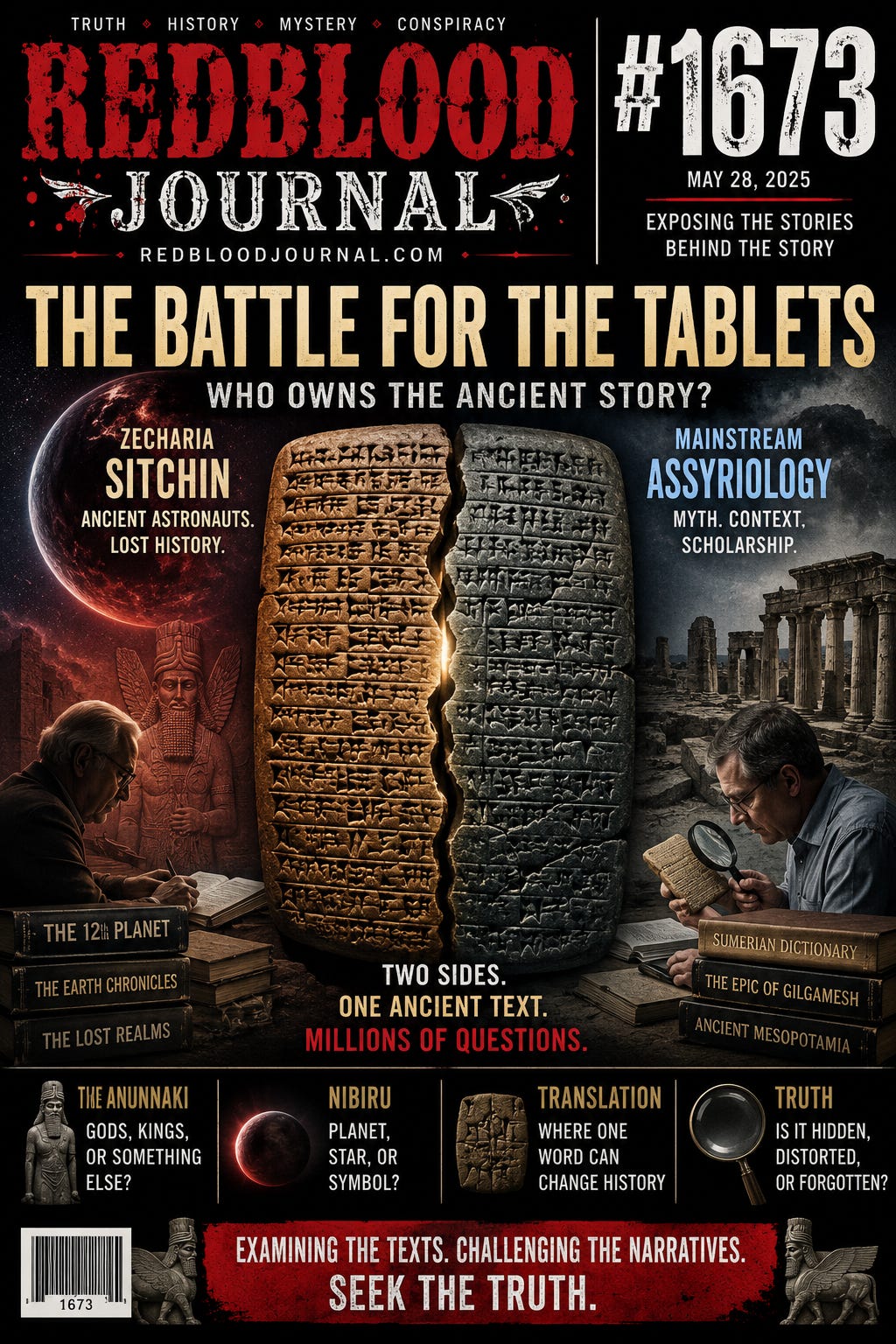
#1673 — The Battle for the Tablets
Who Owns the Ancient Story?
July 29, 2026
🩸 RedBloodJournal.com 🩸
For nearly two centuries, thousands of clay tablets buried beneath the sands of Mesopotamia have challenged humanity’s understanding of its earliest civilizations.
Written in cuneiform and preserved for thousands of years, these tablets describe kings, cities, floods, laws, commerce, astronomy, religion, mathematics, poetry, and myths that predate many later civilizations.
But another battle began long after the tablets were written.
Not a battle between ancient kings.
A battle over interpretation.
Who decides what these tablets mean?
The Discovery
Beginning in the nineteenth century, archaeologists uncovered hundreds of thousands of clay tablets throughout present-day Iraq and neighboring regions.
Sites such as Ur, Uruk, Nineveh, Nippur, Ashur, and others revealed libraries unlike anything previously imagined.
Many tablets were remarkably well preserved.
Others survived only as fragments.
Each discovery added another piece to humanity’s oldest written records.
Learning to Read the Forgotten Language
For centuries, cuneiform was unreadable.
The wedge-shaped symbols had become a forgotten language.
Through decades of painstaking work, linguists eventually deciphered Akkadian, Sumerian, Babylonian, and Assyrian writing.
The process relied on:
Comparing inscriptions.
Studying multilingual texts.
Building dictionaries.
Analyzing grammar.
Comparing thousands of tablets with one another.
Translation became an evolving science rather than a finished achievement.
Translation Is Not Interpretation
One of the greatest misunderstandings surrounding ancient texts is believing that translation and interpretation are identical.
They are not.
Translation asks:
“What do these symbols literally say?”
Interpretation asks:
“What do these words actually mean?”
The first attempts to preserve grammar.
The second attempts to explain intent.
That difference can change an entire historical narrative.
The Academic Approach
Modern Assyriology generally studies every tablet within its historical and linguistic context.
Scholars compare:
Grammar.
Vocabulary.
Earlier and later versions.
Archaeological evidence.
Contemporary writings.
Cultural practices.
This approach seeks consistency across thousands of surviving inscriptions.
As new discoveries emerge, translations are sometimes refined or revised.
The Sitchin Interpretation
Author Zecharia Sitchin became widely known for proposing that some Sumerian texts preserve memories of advanced beings who interacted with early humanity.
His books connected many tablets into a single historical narrative involving:
The Anunnaki.
Nibiru.
Ancient engineering.
Human origins.
Kings before the Flood.
Long chronological timelines.
His work reached millions of readers and inspired generations interested in ancient mysteries.
Supporters argue that he asked questions mainstream scholarship avoided.
Critics argue that many of his conclusions extend beyond what the cuneiform grammar directly supports.
The Real Question
Whether one agrees with Sitchin or with mainstream scholarship may not be the first question.
A more fundamental question may be:
How certain can any translation be?
Ancient languages often contain words with multiple meanings.
Some tablets are damaged.
Others are incomplete.
Many rely upon cultural references no longer fully understood.
Every translator inevitably makes choices.
One Word Can Change Everything
History contains countless examples where a single word has influenced entire debates.
A title may be translated as:
King.
Governor.
Chief.
Prince.
Ruler.
Each carries a different implication.
Likewise, a word describing a celestial object may be rendered differently depending upon context.
Translation is therefore both linguistic and interpretive.
New Discoveries Continue
Thousands of tablets remain untranslated or only partially studied.
New fragments continue to be identified in museum collections.
Advances in:
High-resolution imaging.
Digital reconstruction.
Artificial intelligence.
Comparative linguistics.
are allowing damaged inscriptions to be studied in ways unimaginable only a generation ago.
The story may still be incomplete.
Between Certainty and Curiosity
Perhaps the greatest lesson is neither to accept every extraordinary claim without evidence nor to dismiss every unconventional question simply because it challenges established ideas.
History has repeatedly shown that scholarship evolves.
Ideas once dismissed have later gained acceptance.
Other ideas have faded as new evidence appeared.
Curiosity and evidence work best together.
The Battle Continues
The battle over the tablets is not fought with armies.
It is fought with dictionaries.
Grammar.
Fragments of clay.
Historical context.
Questions.
And imagination.
Whether the ancient scribes intended mythology, history, theology, astronomy, political propaganda, or a blend of many forms remains an ongoing field of study.
The tablets themselves remain silent.
It is humanity that continues to debate their meaning.
Perhaps the greatest responsibility is not to defend a preferred conclusion, but to remain willing to examine the evidence wherever it leads.
The oldest voices in recorded history still have much to teach those willing to listen carefully.
Subjects
Mesopotamian Cuneiform
Ancient Sumer
Assyriology
Zecharia Sitchin
Ancient Text Translation
The Anunnaki Debate
Nibiru
Archaeological Interpretation
History vs. Myth
Ancient Civilizations
Linguistics
Cuneiform Tablets
Tags
Ancient Sumer, Cuneiform, Mesopotamia, Assyriology, Zecharia Sitchin, Translation, Archaeology, Ancient History, Anunnaki, Nibiru, Babylon, Akkadian, Sumerian Language, Red Blood Journal
🩸🌊✨ Fantastic!
May every ancient inscription remind us that knowledge grows not only through certainty, but through careful questioning, honest investigation, and a willingness to let evidence guide the journey across the great Ocean of Love and Positivity.
📜
📜 The Battle for the Tablets:
Interpreting Ancient Mesopotamia
Jul 29, 2026
This article explores the ongoing intellectual conflict regarding the translation and interpretation of ancient Mesopotamian cuneiform tablets. While professional Assyriologists rely on rigorous linguistic and historical frameworks to understand these records, alternative authors like Zecharia Sitchin propose more radical theories involving extraterrestrial influence and advanced technology. The text emphasizes that the process of turning wedge-shaped symbols into modern language is an evolving science filled with complexities, such as damaged artifacts and ambiguous vocabulary. Ultimately, the source argues that the battle for meaning is shaped by the tension between established academic evidence and speculative curiosity. Because thousands of tablets remain unstudied, new technologies like artificial intelligence are now being used to further unlock the secrets of these ancient voices.


