


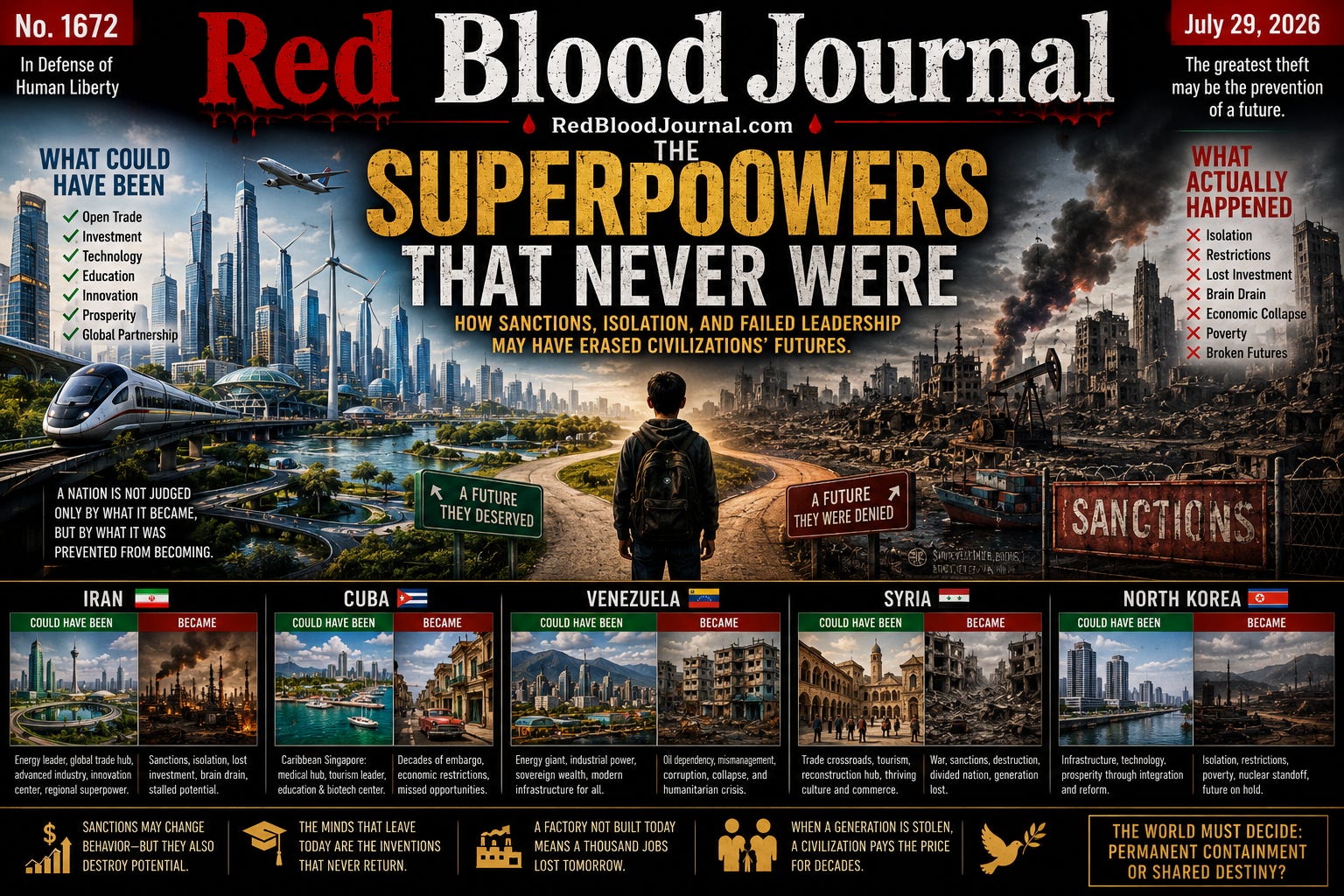
#1672 — The Superpowers That Never Were
The Invisible Civilizations Buried Beneath Sanctions, Isolation, and Failed Leadership
🩸 RedBloodJournal.com 🩸
History records the nations that rose.
The empires that expanded.
The economies that became dominant.
The technologies that transformed civilization.
But history rarely records something far more difficult to see:
The nations that might have become great—but never received the opportunity.
There are no photographs of the factories that were never constructed.
There are no museums displaying inventions that were never completed.
There are no financial statements for companies that were never created.
There are no monuments honoring scientists who emigrated before making discoveries in their homeland.
A destroyed building leaves ruins.
A prevented future leaves almost nothing.
That may be the deepest and least understood consequence of economic sanctions.
Economic War Without Bombs
Sanctions are usually presented as an alternative to military conflict.
They freeze assets.
Restrict trade.
Block financial transactions.
Prevent access to technology.
Limit shipping, insurance, investment, banking, and international partnerships.
The United States Treasury explains that American sanctions programs may be comprehensive or selective and can use asset blocking and trade restrictions to pursue foreign-policy and national-security objectives.
No buildings need to be bombed.
No tanks need to cross a border.
Yet an entire economy can gradually lose access to the machinery of modern development.
A company cannot obtain replacement parts.
An airline cannot purchase aircraft.
A hospital cannot easily acquire specialized equipment.
A university cannot maintain international partnerships.
A manufacturer cannot process payments.
An entrepreneur cannot attract investment.
The damage often appears slowly enough that the world stops noticing it.
The Parallel Timeline
Imagine a second version of history.
In that timeline, countries such as Iran, Cuba, Venezuela, Syria, North Korea, and others were never isolated from the global financial and commercial system.
They could trade normally.
They could borrow capital.
They could acquire technology.
Their students could collaborate internationally.
Their industries could purchase modern equipment.
Their businesses could access global markets.
Their governments would still have made mistakes.
Corruption would still have existed.
Authoritarianism might still have restricted creativity and enterprise.
Sanctions are not the only explanation for national decline.
But the question remains:
What might these nations have become if external containment had not been added to their internal failures?
Iran: The Superpower That Geography Designed
Iran may represent one of the clearest examples of unrealized national potential.
It possesses a large population, a long scientific and commercial history, access to the Persian Gulf and Gulf of Oman, proximity to Central Asia, South Asia, the Caucasus, the Arab world, and Europe, and enormous energy resources.
The World Bank describes Iran as holding the world’s second-largest natural-gas reserves and fourth-largest proven crude-oil reserves. It also notes that Iran has agricultural, manufacturing, service, and hydrocarbon sectors, making it relatively diversified for an oil-exporting country.
That is not the geography of an insignificant state.
It is the geography of a potential continental power.
Without decades of confrontation and isolation—and with competent, accountable leadership—Iran might have become:
A global natural-gas exporter.
A railway and transportation bridge between Asia and Europe.
A center for petrochemicals and advanced manufacturing.
A regional automobile and aircraft producer.
A medical and scientific center.
A tourism giant.
A financial gateway connecting Central Asia, the Persian Gulf, India, Turkey, and Europe.
A major electricity exporter.
A country capable of transforming energy wealth into universities, research laboratories, industries, and sovereign investment funds.
The World Bank previously observed that sanctions relief could allow Iran to develop major gas exports through pipelines and liquefied natural gas, while using its resources to expand petrochemicals, electricity exports, domestic industry, and petroleum production.
A brief period of sanctions relief also demonstrated how quickly production could respond. Iran’s economy recorded a major oil-driven rebound in 2016, with oil and gas production rising sharply following the easing of restrictions, although non-oil growth remained much more modest.
This does not prove that Iran would automatically have become a superpower.
It demonstrates that access matters.
Technology matters.
Markets matter.
Investment matters.
And lost decades matter.
Greater Than Russia?
Could Iran have become economically stronger than Russia?
Under the right historical conditions, it is plausible.
Iran possesses access to warm-water maritime trade routes.
It sits close to major international shipping corridors.
It has a large domestic consumer market.
It connects several economic regions.
Its climate and geography allow more diversified economic activity than much of Russia.
Its energy resources could have funded generations of industrial development.
A peaceful, well-governed, commercially open Iran might have developed into a power combining several advantages:
The energy capacity of a major petroleum state.
The manufacturing position of Turkey.
The commercial geography of the Persian Gulf.
The population and internal market of a major regional civilization.
The scientific potential of a highly educated society.
But this outcome would have required more than the absence of sanctions.
It would have required stable laws.
Property rights.
Independent institutions.
Educational freedom.
Reduced corruption.
International trust.
Investment in people rather than ideological expansion.
Sanctions may have prevented doors from opening.
Domestic leadership also kept many doors locked.
Cuba: The Singapore of the Caribbean That Never Appeared
Cuba possesses another remarkable geographical position.
It sits near the United States, Mexico, Central America, the Gulf of Mexico, and some of the most important commercial routes in the Western Hemisphere.
Its small size would likely have prevented it from becoming a military superpower.
But it might have become something different:
A wealthy commercial, medical, educational, biotechnology, tourism, and logistics center.
The World Bank has described Cuba’s achievements in education and health as surpassing those of most developing nations and, in certain areas, approaching standards found in wealthier countries.
Imagine that human capital connected to unrestricted markets.
Cuban medicine combined with international pharmaceutical investment.
Cuban education connected to global universities.
Cuban geography supporting shipping, aviation, finance, tourism, and professional services.
Cuba might not have become another United States.
It might have become a Caribbean Singapore.
Not great through territory.
Great through people, position, and knowledge.
Venezuela: The Energy Civilization That Consumed Its Own Future
Venezuela provides a different lesson.
It possessed extraordinary petroleum wealth.
For decades, oil dominated its exports and government revenues, leaving the entire national structure dangerously dependent on a single commodity. Historical World Bank material noted that oil-related activity once generated roughly 80 percent of both merchandise-export earnings and government revenues.
Without sanctions, Venezuela would have enjoyed greater access to finance, equipment, customers, and investment.
But sanctions alone cannot explain its collapse.
Oil dependency.
Government mismanagement.
Institutional deterioration.
Corruption.
Political repression.
Falling production.
Failure to diversify.
These forces also damaged the country.
A successful alternative Venezuela would therefore require two different freedoms:
Freedom from external economic isolation.
Freedom from internal economic destruction.
With both, Venezuela might have transformed petroleum wealth into:
A sovereign wealth fund.
Modern infrastructure.
Petrochemical manufacturing.
Universities.
Agricultural development.
Regional energy systems.
Technology investment.
A diversified industrial economy.
It might have become Latin America’s great energy and financial power.
Instead, an enormous portion of its national potential disappeared between outside pressure and inside failure.
The Sanctions Development Gap
The real economic damage of sanctions cannot be measured only by asking how much money was lost this year.
The deeper calculation would ask:
How many factories were never built?
How much foreign investment never arrived?
How many aircraft remained grounded?
How many oil and gas projects remained undeveloped?
How many students left permanently?
How many scientific partnerships disappeared?
How many companies moved abroad?
How many industries remained decades behind?
How many children inherited scarcity from decisions made before they were born?
This difference between actual development and possible development could be called:
The Sanctions Development Gap
It is not a perfect number.
Counterfactual history never is.
But economists could construct alternative scenarios using comparable countries.
Iran could be compared with Turkey, South Korea, Saudi Arabia, the United Arab Emirates, Malaysia, or other countries at different stages of development.
Cuba could be compared with Caribbean economies, Singapore, Costa Rica, or other small nations that developed through trade, education, tourism, and services.
Venezuela could be compared with oil-producing countries that created long-term investment funds and stronger institutions.
The purpose would not be to produce fantasy.
It would be to estimate the size of the missing future.
Could They Have Surpassed America?
Could one of these nations have become greater than the United States?
That is far less likely.
The United States possesses continental scale, enormous agricultural capacity, major energy production, deep capital markets, globally influential universities, advanced technology industries, military alliances, and a currency central to international finance.
Removing sanctions from another country would not erase those advantages.
But the question changes when several nations are considered together.
Imagine an open commercial alliance joining:
Iranian energy, geography, and engineering.
Venezuelan petroleum.
Cuban medicine and education.
Russian minerals and industrial capacity.
Central Asian transportation routes.
Chinese manufacturing.
African resources.
Latin American agriculture.
If organized around commerce instead of permanent conflict, such a network could control an extraordinary share of global energy, minerals, shipping routes, food production, manufacturing, scientific talent, and population.
It might not replace America.
It could become an independent pole powerful enough that no single government could dominate the world economy.
Are Sanctions About Behavior—or Competition?
Governments officially describe sanctions as tools to change behavior, protect security, punish aggression, oppose weapons development, fight terrorism, or defend human rights.
Sometimes they may achieve those objectives.
Sometimes they may prevent military conflict.
Sometimes they may isolate individual officials without destroying an entire population’s economy.
But broad and prolonged sanctions raise a more uncomfortable question:
At what point does changing a government’s behavior become preventing an entire nation from developing?
A nation cut off from banking, technology, trade, shipping, investment, and international markets does not remain frozen in place.
It falls behind.
Competitors move forward.
Its best minds leave.
Its industries age.
Its currency weakens.
Its population becomes poorer.
Eventually, the country’s poverty is presented as evidence that its society was incapable of success.
The restraints disappear from the story.
Only the failure remains visible.
The Two Jailers
It would be dishonest to blame every national failure on foreign sanctions.
Many governments under sanctions have also imprisoned their own economies.
They suppress free thought.
Reward loyalty over competence.
Drive away investors.
Confiscate businesses.
Control prices irrationally.
Misuse natural resources.
Expand military projects while ordinary infrastructure collapses.
Silence criticism.
Turn universities into ideological institutions.
Send wealth abroad while telling citizens to endure sacrifice.
Sanctioned populations may therefore face two jailers.
One closes the gates from outside.
The other closes them from within.
The citizen stands between them.
The Greatest Loss Is Invisible
When a missile destroys a factory, the world can photograph the destruction.
When sanctions prevent that factory from being built, there is nothing to photograph.
When a scientist is killed, the loss is recorded.
When the scientist emigrates and creates an invention elsewhere, the original country may never know what it lost.
When a bridge collapses, engineers calculate the damage.
When a railway connecting continents is never constructed, no official ledger records the missing commerce.
This may be why sanctions are politically easier than war.
Their casualties are scattered across time.
Their ruins are invisible.
Their victims often appear as unemployment, inflation, migration, lost education, delayed medicine, broken industries, and diminished expectations.
The future dies quietly.
The Superpowers That Never Were
Perhaps Iran might have surpassed Russia economically.
Perhaps Cuba might have become one of the wealthiest societies in the Americas.
Perhaps Venezuela might have become a stable energy and industrial giant.
Perhaps none of them would have reached those heights.
Counterfactual history cannot offer certainty.
But it can reveal something that conventional history often hides:
A country should not be measured only against what it became.
It should also be measured against what its resources, people, geography, and culture made possible.
The greatest theft may not be the seizure of existing wealth.
It may be the prevention of future wealth.
The greatest destruction may not be a demolished city.
It may be a civilization that never had the chance to be born.
Subjects
Economic Sanctions
Counterfactual History
Iran’s Lost Potential
Cuba’s Alternative Future
Venezuela and Oil
Economic Containment
Geopolitical Competition
Brain Drain
Technology Restrictions
National Development
Strategic Resources
The Sanctions Development Gap
Invisible Economic Warfare
Global Power
The Missing Future
Tags
Economic Sanctions, Iran, Cuba, Venezuela, Counterfactual History, Economic Warfare, Geopolitics, National Development, Brain Drain, Energy, Global Trade, Superpowers, Foreign Policy, Lost Opportunity, Red Blood Journal
🩸 The world remembers the civilizations that rose and the civilizations that fell. It rarely remembers the civilizations that were prevented from rising at all. Somewhere beneath every blocked transaction, abandoned factory, departing scientist, and restricted classroom may lie the outline of a superpower that history never permitted the world to meet. 🌊✨
Fantastic!
🚧
🚧 The Invisible Ruins of Prevented Superpowers
Jul 29, 2026
The provided text explores the Sanctions Development Gap, examining how economic isolation and internal mismanagement have prevented specific nations from achieving their full potential. It argues that while military conflict leaves visible ruins, protracted sanctions create an “invisible” destruction by stifling technological advancement, infrastructure, and global trade. Through the lens of counterfactual history, the author suggests that countries like Iran, Cuba, and Venezuela possessed the geographic and human capital to become regional superpowers or economic hubs. However, these prospects were dismantled by the dual pressures of external containment and domestic leadership failures. Ultimately, the narrative highlights the lost future of civilizations that might have transformed the global balance of power had they not been disconnected from the modern world economy.


