


🩸 RedBloodJournal.com
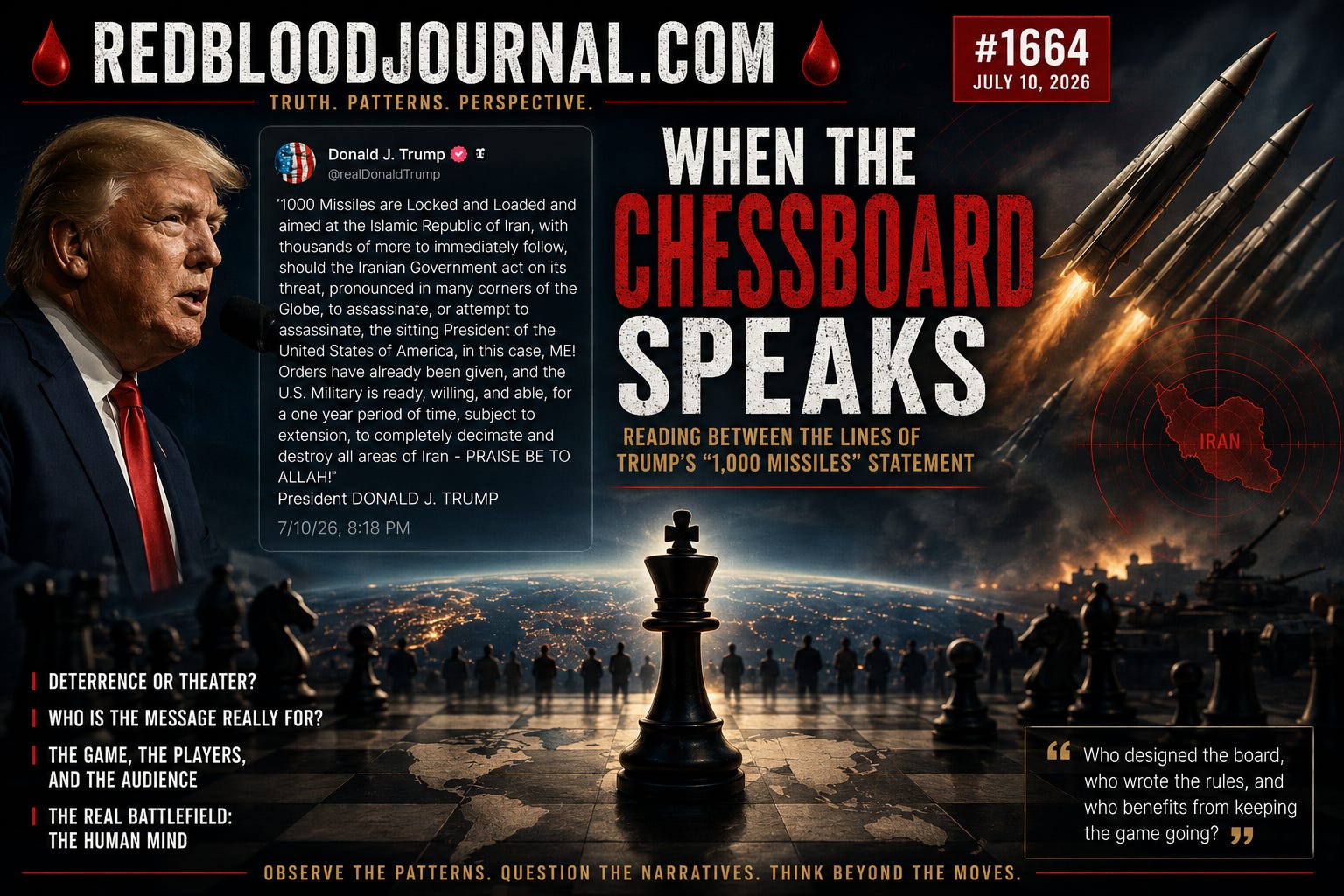
#1664 – When the Chessboard Speaks
Reading Between the Lines of Trump’s “1,000 Missiles” Statement
Every major geopolitical conflict has two battles.
The first is fought with missiles, sanctions, intelligence operations, and diplomacy.
The second is fought inside the minds of billions of observers.
President Donald Trump’s recent Truth Social statement declaring that “1,000 missiles are locked and loaded” against the Islamic Republic of Iran if the Iranian government attempts to assassinate him is one of the strongest public deterrence messages issued in recent years. The statement was widely reported after being posted on Truth Social. (Reuters)
The military aspect of the message is obvious.
The psychological aspect deserves equal attention.
The Real Audience
On the surface, the statement is directed toward Iran’s leadership.
But major geopolitical declarations are rarely read by only one audience.
They are simultaneously consumed by:
Political leaders
Military planners
Financial markets
Intelligence agencies
Allies
Adversaries
And billions of ordinary citizens.
Every dramatic declaration influences perception before it influences events.
The Chessboard
When political communication reaches this level of intensity, many observers begin to see world affairs as a giant chessboard.
Every speech appears to be a move.
Every response becomes another move.
Every headline invites the public to predict the next move.
The game itself becomes the center of attention.
But Who Watches the Players?
This report asks a different question.
Instead of asking who wins the next move...
Ask who benefits from keeping everyone emotionally invested in the game.
Fear captures attention.
Uncertainty keeps populations watching.
Markets react.
Media cycles accelerate.
Political support shifts.
Whether this is the result of deliberate strategy, institutional incentives, or simply the dynamics of international politics is open to interpretation. What can be observed is that high-profile statements can shape public perception long before any military action occurs. (Reuters)
Our Lives Become the Stage
From this perspective, ordinary people become spectators whose savings, businesses, careers, and families are affected by decisions made far beyond their control.
Every escalation pulls millions of minds back onto the same stage.
The citizens become emotionally invested.
The actors continue performing.
The audience keeps watching.
Reading Between the Lines
Whether one views current events as genuine geopolitical competition, strategic deterrence, political theater, or some combination of these, there is value in stepping back from the immediate headlines.
The most important question may not be:
“Who wins this move?”
It may instead be:
“What effect is this move intended to have on everyone watching?”
Because sometimes the most significant battlefield is not the map.
It is the human mind.
Observation distinguishes what is publicly visible from what is inferred. The statement itself is verifiable; interpretations about its broader strategic meaning remain analysis and opinion rather than established fact.
♟️ The Psychopolitics of Global Deterrence
Jul 11, 2026
The provided text explores the psychological and strategic implications of former President Donald Trump’s aggressive warning regarding a potential Iranian assassination plot. While the statement physically threatens military retaliation, the author argues its primary impact is a form of geopolitical theater designed to capture global attention. Such high-stakes rhetoric functions as a deterrence tool that influences political leaders, financial markets, and the general public simultaneously. By framing international relations as a metaphorical chessboard, the source suggests that these declarations are often intended to manipulate human perception rather than just communicate military intent. Ultimately, the article encourages readers to look past the immediate threat to consider who benefits from keeping the populace in a state of constant emotional investment and fear.


