


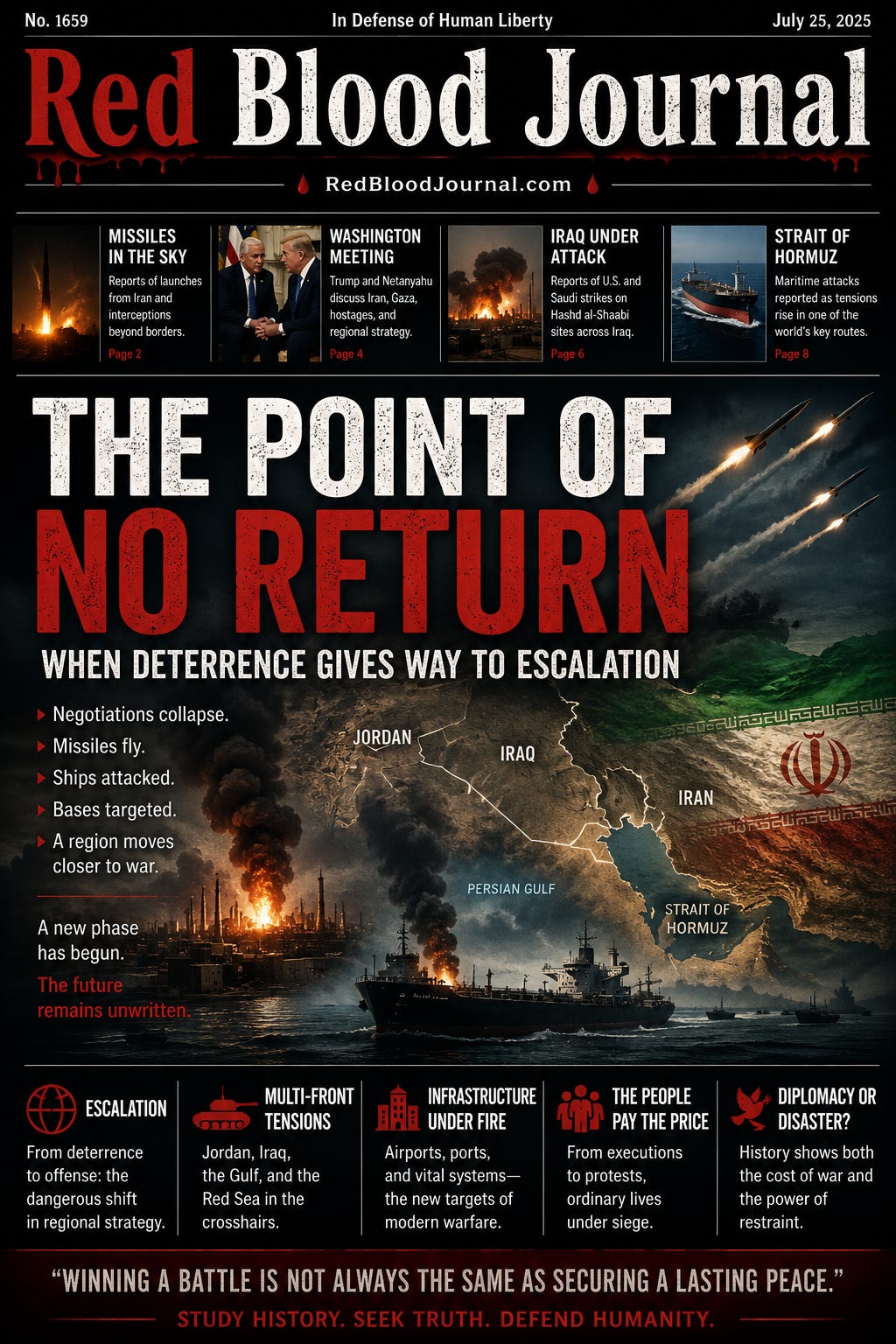
#1659 — Military & Geopolitical
The Point of No Return
When Deterrence Gives Way to Escalation
🩸 RedBloodJournal.com 🩸
For months, the Middle East has existed in a state of managed confrontation.
Missiles.
Proxy forces.
Economic pressure.
Political negotiations.
Strategic warnings.
Each side attempted to demonstrate strength while stopping short of triggering a conflict that neither publicly claimed to desire.
The latest series of reported military developments, however, suggests that the region may be approaching a different phase.
According to the material summarized in the source transcript, negotiations reportedly failed while military activity accelerated almost simultaneously across multiple fronts. Reports described missile launches, maritime attacks, retaliatory strikes, diplomatic meetings, renewed military deployments, and growing discussion about future military options.
Whether every battlefield claim ultimately proves accurate is less important than recognizing the broader strategic pattern emerging from the information environment.
Military conflicts rarely expand through one decisive event.
They expand through accumulation.
One action becomes another.
Each response creates a new justification.
Each justification becomes tomorrow’s escalation.
The Logic of Escalation
Throughout history, governments have often attempted to maintain deterrence by convincing opponents that further action would carry unacceptable consequences.
Deterrence works only while both sides believe the risks outweigh the rewards.
The moment one side concludes that waiting is more dangerous than acting, deterrence begins to erode.
At that point strategy changes.
Defensive signaling gradually transforms into offensive initiative.
The transcript reflects this transition by describing reported strikes beyond previous patterns while political statements simultaneously became more uncompromising.
Whether intentional or not, such combinations increase uncertainty throughout the region.
Geography Never Retires
Military strategy is ultimately governed by geography.
The Strait of Hormuz.
Jordan.
Iraq.
The Persian Gulf.
The Red Sea.
These locations are not simply names on maps.
They represent transportation routes, military logistics, energy supplies, trade corridors, and strategic depth.
Control—or even the perception of control—over these locations affects global markets as much as regional security.
History repeatedly demonstrates that geography often outlives politics.
Governments change.
Borders occasionally shift.
Geography remains.
The Importance of Political Signaling
Wars are fought with weapons.
They are also fought with messages.
Military actions frequently communicate political intent as much as military capability.
Meetings between national leaders, public statements, military exercises, and diplomatic announcements all become part of the strategic conversation.
The transcript highlights reports of high-level diplomatic meetings alongside military developments, illustrating how diplomacy and military signaling often occur simultaneously rather than separately.
Sometimes the most significant battlefield is not physical.
It is psychological.
Infrastructure as Strategy
Modern warfare increasingly extends beyond armies.
Airports.
Ports.
Communications.
Energy infrastructure.
Transportation.
Financial systems.
These become strategic targets because disrupting infrastructure can affect a nation’s operational capacity without necessarily requiring territorial occupation.
History suggests that attacks on infrastructure can produce consequences lasting years after military operations end.
Rebuilding often becomes more difficult than destruction itself.
The Superpower Question
Another recurring theme throughout military history concerns the limits of major powers.
Powerful nations often possess overwhelming military capability.
The greater challenge is deciding when and how to employ it.
History contains examples where restraint prevented wider wars.
It also contains examples where delayed decisions encouraged further escalation.
Determining where that balance exists is among the most difficult decisions any government faces.
Information as a Battlefield
Today’s conflicts unfold simultaneously across multiple domains.
Military.
Economic.
Diplomatic.
Cyber.
Media.
Social platforms.
Public perception now travels almost as quickly as missiles.
Information itself has become a strategic asset.
Conflicting narratives frequently emerge before independent verification becomes available.
Responsible analysis therefore distinguishes between reported claims and independently confirmed events while recognizing that perceptions themselves can influence political decisions.
The Broader Lesson
Military history repeatedly shows that wars are rarely planned exactly as they unfold.
Most participants expect limited objectives.
Few anticipate the full chain of consequences.
Escalation often occurs gradually until observers suddenly describe events as inevitable.
Yet history also reminds us that diplomacy has repeatedly interrupted conflicts that once appeared unstoppable.
The future remains unwritten.
Military capability may shape events.
Political judgment ultimately determines whether those capabilities are used—or restrained.
Perhaps the greatest geopolitical lesson is that every nation eventually discovers the same truth:
Winning a battle is not always the same as securing a lasting peace.
Subjects
Military & Geopolitical
Middle East Strategy
Escalation
Deterrence
Strait of Hormuz
Regional Security
Infrastructure Warfare
Military History
International Relations
Strategic Analysis
Tags
Middle East, Geopolitics, Military Strategy, Escalation, Deterrence, Iran, Jordan, Iraq, Strait of Hormuz, Diplomacy, Regional Conflict, Infrastructure, International Security, Red Blood Journal
🩸 As always, Red Blood Journal encourages readers to separate verified facts from reported claims, think critically, study history carefully, and remember that understanding is strongest when it is grounded in evidence rather than emotion. The greatest victory for humanity is not endless war, but the wisdom to prevent it. 🌊✨ Fantastic!
🌍
🌍 The Point of No Return: Middle East Strategic Escalation
Jul 29, 2026
This source examines the fragile state of Middle Eastern stability, suggesting that the region is shifting from controlled deterrence toward active military escalation. It highlights how the breakdown of diplomatic negotiations has coincided with multi-front missile strikes and threats to critical transportation and energy infrastructure. The text emphasizes that geography remains the ultimate governor of strategy, as control over vital maritime routes like the Strait of Hormuz impacts both regional security and global markets. Beyond physical combat, the analysis explores how information warfare and political signaling are used to shape public perception and strategic narratives. Ultimately, the material argues that while military capability can win individual battles, only wise political judgment and restraint can prevent a cycle of permanent regional conflict.


