


July 28, 2026
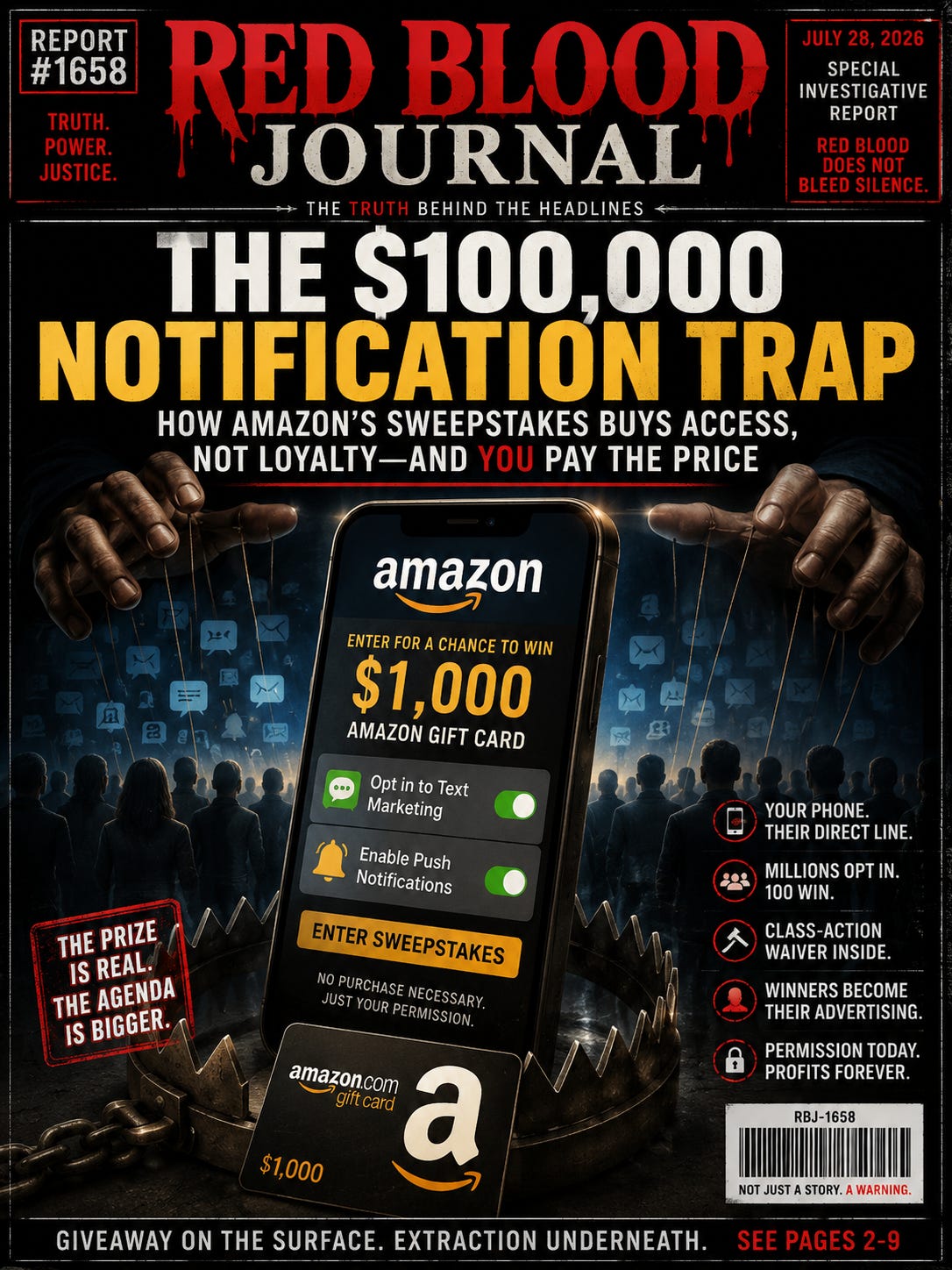
#1658— The $100,000 Notification Trap
What If the Sweepstakes Prize Is Not the Product?
🩸 RedBloodJournal.com 🩸
Amazon announces a sweepstakes.
One hundred winners.
One thousand dollars each.
$100,000 in prizes.
At first glance, the story is simple:
Amazon is giving away money.
But Red Blood Journal likes to ask the question hiding behind the obvious question.
What does Amazon receive?
Because corporations rarely spend money without expecting something valuable in return.
And buried inside the official rules is an interesting exchange.
The customer receives a chance to win $1,000.
Amazon receives something potentially much more valuable:
permission to reach the customer’s pocket.
Not metaphorically.
Literally.
The telephone.
The Lottery Where the Ticket Is Permission
There is no purchase necessary.
There is no $5 ticket.
There is no product that must be ordered.
Instead, the principal methods of entering are remarkably specific.
Opt into Amazon text marketing.
Or enable Amazon Shopping app push notifications.
That is the ticket.
The customer pays nothing in dollars.
The customer pays in access.
And suddenly the $100,000 prize pool begins looking less like generosity and more like customer-acquisition expenditure.
Imagine that millions participate.
Amazon does not have to convince millions of people to buy something immediately.
It merely has to persuade them to leave the door open.
A notification today.
A sale tomorrow.
Prime Day.
Christmas.
Black Friday.
A product recommendation.
A forgotten shopping cart.
A limited-time offer.
One tap.
Amazon has purchased the opportunity to knock on millions of digital doors.
The maximum advertised prize cost?
$100,000.
But It Gets More Interesting
The rules contain a fascinating provision.
People who were already opted into Amazon’s text or push marketing before the sweepstakes can receive an entry by remaining opted in through the end of the sweepstakes period.
Think about the psychology of that.
The promotion does not merely encourage:
SUBSCRIBE.
It can also encourage:
DON’T UNSUBSCRIBE YET.
Suddenly the sweepstakes serves two purposes.
Acquisition.
And retention.
The carrot works in both directions.
The Prize Is Certain. Your Prize Isn’t.
Amazon knows its maximum advertised prize obligation:
100 × $1,000 = $100,000.
The individual participant knows something very different.
Nothing.
The rules say the odds depend upon the number of eligible entries.
One million entries?
Approximately one chance in 10,000.
Ten million?
Approximately one chance in 100,000.
Twenty million?
Approximately one chance in 200,000.
Yet almost every entrant can potentially provide something useful to Amazon:
continued access through notifications or text marketing.
The corporation’s benefit can therefore scale with participation.
The individual’s probability moves in the opposite direction.
The more successful the promotion becomes, the worse each participant’s odds become.
That is the beautiful mathematics of a sweepstakes.
Now Let’s Go Down the Rabbit Hole
Suppose the $100,000 isn’t really the cost of the sweepstakes.
Suppose it is the advertising budget.
Then the campaign looks completely different.
Amazon isn’t spending $100,000 to make 100 people happy.
It could effectively be spending $100,000 to persuade a massive population to establish or preserve a direct communications channel.
Consider the hypothetical economics.
Suppose 2 million customers participate.
$100,000 ÷ 2,000,000 =
5 cents per participant.
At 10 million:
1 cent per participant.
Now ask:
What is the lifetime value of having permission to send marketing messages to an Amazon customer?
Probably more than a penny.
And Amazon doesn’t even necessarily incur the same economic cost as handing winners $100,000 in cash.
The prizes are Amazon gift cards.
The money returns to Amazon’s marketplace.
The winners cannot redeem those cards for cash under the sweepstakes terms.
So even the prize itself points the winner back toward Amazon.
The circle closes.
The Second Layer: The 48-Hour Clock
Then comes another curious provision.
Potential winners are notified by email.
They have 48 hours to respond.
Miss it?
The prize can be forfeited.
Fail verification?
Forfeited.
Required documents aren’t returned?
Forfeited.
Email gets overlooked?
Potentially forfeited.
And the rules provide for only one alternate drawing before remaining prizes may remain unawarded.
So thousands or millions can participate.
But winning the random drawing isn’t necessarily enough.
The winner must still notice the message, respond quickly and satisfy the verification requirements.
The sweepstakes has an enormous entrance door.
The prize-exit door is considerably narrower.
Then Comes the Legal Door
Here is where the innocent little giveaway becomes much more interesting.
Participation requires acceptance of official rules containing a class-action waiver.
Disputes arising from the sweepstakes are generally required to be pursued individually.
Washington law governs.
Venue is directed toward King County, Washington.
And, to the extent legally enforceable, the rules attempt to restrict various remedies and limit certain recoverable costs.
Think about that exchange philosophically.
A person enters hoping:
Maybe I’ll get $1,000.
At the same moment, that person accepts a substantial legal document governing disputes arising from the promotion.
How many entrants read it?
Probably considerably fewer than those who notice:
WIN $1,000.
That is not uniquely Amazon.
It is the architecture of modern digital agreements.
The attractive sentence is enormous.
The consequential sentences are tiny.
The Third Layer: The Winner Becomes Advertising
Winning can create another exchange.
Except where prohibited, the rules provide publicity rights involving things such as the winner’s:
name,
likeness,
biography,
statements,
voice,
and image.
Without additional compensation.
The winner receives $1,000 in Amazon purchasing power.
Amazon potentially receives a real human success story.
“I won.”
And few advertisements are more persuasive than someone who actually won.
The Conspiracy Doesn’t Require a Secret Room
This may be the most important point.
People imagine conspiracy as executives sitting around a dark table whispering:
How do we trick everyone?
Modern systems don’t require that.
The more sophisticated version is simply incentive engineering.
Marketing department wants subscribers.
Legal department wants protection.
Finance wants predictable cost.
The app team wants notifications enabled.
Customer-retention teams want fewer opt-outs.
Public relations wants engagement.
Someone creates one mechanism satisfying all of them.
A sweepstakes.
Nobody needs to whisper.
Everybody merely needs to do their job.
And the machine produces something that looks remarkably coordinated.
The Bigger Question
Perhaps the most valuable commodity of the twenty-first century isn’t money.
It is permission.
Permission to notify.
Permission to track engagement.
Permission to market.
Permission to appear on the screen.
Permission to remain inside the customer’s attention.
Companies once fought to put advertisements beside highways.
Then inside newspapers.
Then on television.
Then inside websites.
Now the ultimate billboard is carried voluntarily inside almost every person’s pocket.
The smartphone.
And perhaps the cheapest way to obtain access to that billboard is not to purchase advertising space at all.
Perhaps it is simply to say:
You could win $1,000.
The customer opens the gate.
The corporation doesn’t need to climb the fence.
The Red Blood Question
The official question is:
Who will win the $1,000?
The more interesting question may be:
What does Amazon win from everyone who doesn’t?
One hundred people may walk away with gift cards.
Millions could walk away with nothing.
But Amazon may walk away with something from an enormous portion of them:
permission to knock on the door again.
Perhaps the greatest sweepstakes prize isn’t the one advertised at the top.
Perhaps it is the enormous collection of tiny permissions accumulated underneath.
And perhaps that is the modern business model in miniature:
Give away something visible.
Collect something invisible.
🩸🌊✨ Fantastic!
Subjects: Amazon Sweepstakes · Digital Marketing · Push Notifications · Text Marketing · Attention Economy · Customer Acquisition · Consumer Psychology · Corporate Incentives · Privacy · Legal Agreements · Class-Action Waivers
Tags: Amazon, Sweepstakes, Marketing, Consumer Psychology, Attention Economy, Push Notifications, Text Marketing, Privacy, Corporate Strategy, Red Blood Journal
🩸 RedBloodJournal.com 🩸 — The $100,000 Notification Trap
What If the Sweepstakes Prize Is Not the Product?
🩸 RedBloodJournal.com 🩸
Amazon announces a sweepstakes.
One hundred winners.
One thousand dollars each.
$100,000 in prizes.
At first glance, the story is simple:
Amazon is giving away money.
But Red Blood Journal likes to ask the question hiding behind the obvious question.
What does Amazon receive?
Because corporations rarely spend money without expecting something valuable in return.
And buried inside the official rules is an interesting exchange.
The customer receives a chance to win $1,000.
Amazon receives something potentially much more valuable:
permission to reach the customer’s pocket.
Not metaphorically.
Literally.
The telephone.
The Lottery Where the Ticket Is Permission
There is no purchase necessary.
There is no $5 ticket.
There is no product that must be ordered.
Instead, the principal methods of entering are remarkably specific.
Opt into Amazon text marketing.
Or enable Amazon Shopping app push notifications.
That is the ticket.
The customer pays nothing in dollars.
The customer pays in access.
And suddenly the $100,000 prize pool begins looking less like generosity and more like customer-acquisition expenditure.
Imagine that millions participate.
Amazon does not have to convince millions of people to buy something immediately.
It merely has to persuade them to leave the door open.
A notification today.
A sale tomorrow.
Prime Day.
Christmas.
Black Friday.
A product recommendation.
A forgotten shopping cart.
A limited-time offer.
One tap.
Amazon has purchased the opportunity to knock on millions of digital doors.
The maximum advertised prize cost?
$100,000.
But It Gets More Interesting
The rules contain a fascinating provision.
People who were already opted into Amazon’s text or push marketing before the sweepstakes can receive an entry by remaining opted in through the end of the sweepstakes period.
Think about the psychology of that.
The promotion does not merely encourage:
SUBSCRIBE.
It can also encourage:
DON’T UNSUBSCRIBE YET.
Suddenly the sweepstakes serves two purposes.
Acquisition.
And retention.
The carrot works in both directions.
The Prize Is Certain. Your Prize Isn’t.
Amazon knows its maximum advertised prize obligation:
100 × $1,000 = $100,000.
The individual participant knows something very different.
Nothing.
The rules say the odds depend upon the number of eligible entries.
One million entries?
Approximately one chance in 10,000.
Ten million?
Approximately one chance in 100,000.
Twenty million?
Approximately one chance in 200,000.
Yet almost every entrant can potentially provide something useful to Amazon:
continued access through notifications or text marketing.
The corporation’s benefit can therefore scale with participation.
The individual’s probability moves in the opposite direction.
The more successful the promotion becomes, the worse each participant’s odds become.
That is the beautiful mathematics of a sweepstakes.
Now Let’s Go Down the Rabbit Hole
Suppose the $100,000 isn’t really the cost of the sweepstakes.
Suppose it is the advertising budget.
Then the campaign looks completely different.
Amazon isn’t spending $100,000 to make 100 people happy.
It could effectively be spending $100,000 to persuade a massive population to establish or preserve a direct communications channel.
Consider the hypothetical economics.
Suppose 2 million customers participate.
$100,000 ÷ 2,000,000 =
5 cents per participant.
At 10 million:
1 cent per participant.
Now ask:
What is the lifetime value of having permission to send marketing messages to an Amazon customer?
Probably more than a penny.
And Amazon doesn’t even necessarily incur the same economic cost as handing winners $100,000 in cash.
The prizes are Amazon gift cards.
The money returns to Amazon’s marketplace.
The winners cannot redeem those cards for cash under the sweepstakes terms.
So even the prize itself points the winner back toward Amazon.
The circle closes.
The Second Layer: The 48-Hour Clock
Then comes another curious provision.
Potential winners are notified by email.
They have 48 hours to respond.
Miss it?
The prize can be forfeited.
Fail verification?
Forfeited.
Required documents aren’t returned?
Forfeited.
Email gets overlooked?
Potentially forfeited.
And the rules provide for only one alternate drawing before remaining prizes may remain unawarded.
So thousands or millions can participate.
But winning the random drawing isn’t necessarily enough.
The winner must still notice the message, respond quickly and satisfy the verification requirements.
The sweepstakes has an enormous entrance door.
The prize-exit door is considerably narrower.
Then Comes the Legal Door
Here is where the innocent little giveaway becomes much more interesting.
Participation requires acceptance of official rules containing a class-action waiver.
Disputes arising from the sweepstakes are generally required to be pursued individually.
Washington law governs.
Venue is directed toward King County, Washington.
And, to the extent legally enforceable, the rules attempt to restrict various remedies and limit certain recoverable costs.
Think about that exchange philosophically.
A person enters hoping:
Maybe I’ll get $1,000.
At the same moment, that person accepts a substantial legal document governing disputes arising from the promotion.
How many entrants read it?
Probably considerably fewer than those who notice:
WIN $1,000.
That is not uniquely Amazon.
It is the architecture of modern digital agreements.
The attractive sentence is enormous.
The consequential sentences are tiny.
The Third Layer: The Winner Becomes Advertising
Winning can create another exchange.
Except where prohibited, the rules provide publicity rights involving things such as the winner’s:
name,
likeness,
biography,
statements,
voice,
and image.
Without additional compensation.
The winner receives $1,000 in Amazon purchasing power.
Amazon potentially receives a real human success story.
“I won.”
And few advertisements are more persuasive than someone who actually won.
The Conspiracy Doesn’t Require a Secret Room
This may be the most important point.
People imagine conspiracy as executives sitting around a dark table whispering:
How do we trick everyone?
Modern systems don’t require that.
The more sophisticated version is simply incentive engineering.
Marketing department wants subscribers.
Legal department wants protection.
Finance wants predictable cost.
The app team wants notifications enabled.
Customer-retention teams want fewer opt-outs.
Public relations wants engagement.
Someone creates one mechanism satisfying all of them.
A sweepstakes.
Nobody needs to whisper.
Everybody merely needs to do their job.
And the machine produces something that looks remarkably coordinated.
The Bigger Question
Perhaps the most valuable commodity of the twenty-first century isn’t money.
It is permission.
Permission to notify.
Permission to track engagement.
Permission to market.
Permission to appear on the screen.
Permission to remain inside the customer’s attention.
Companies once fought to put advertisements beside highways.
Then inside newspapers.
Then on television.
Then inside websites.
Now the ultimate billboard is carried voluntarily inside almost every person’s pocket.
The smartphone.
And perhaps the cheapest way to obtain access to that billboard is not to purchase advertising space at all.
Perhaps it is simply to say:
You could win $1,000.
The customer opens the gate.
The corporation doesn’t need to climb the fence.
The Red Blood Question
The official question is:
Who will win the $1,000?
The more interesting question may be:
What does Amazon win from everyone who doesn’t?
One hundred people may walk away with gift cards.
Millions could walk away with nothing.
But Amazon may walk away with something from an enormous portion of them:
permission to knock on the door again.
Perhaps the greatest sweepstakes prize isn’t the one advertised at the top.
Perhaps it is the enormous collection of tiny permissions accumulated underneath.
And perhaps that is the modern business model in miniature:
Give away something visible.
Collect something invisible.
🩸🌊✨ Fantastic!
Subjects: Amazon Sweepstakes · Digital Marketing · Push Notifications · Text Marketing · Attention Economy · Customer Acquisition · Consumer Psychology · Corporate Incentives · Privacy · Legal Agreements · Class-Action Waivers
Tags: Amazon, Sweepstakes, Marketing, Consumer Psychology, Attention Economy, Push Notifications, Text Marketing, Privacy, Corporate Strategy, Red Blood Journal
🩸 RedBloodJournal.com 🩸
🪤
🪤 The $100,000 Notification Trap
Jul 28, 2026
This analysis explores how an Amazon sweepstakes functions as a strategic tool for customer acquisition and retention rather than a simple act of corporate generosity. By requiring participants to enable push notifications or text marketing, the company effectively purchases direct digital access to millions of consumers for a relatively small prize pool. The text highlights that while winners receive gift cards that cycle money back into the marketplace, Amazon secures valuable publicity rights and significant legal protections, such as class-action waivers. Beyond the financial cost, the promotion serves to engineer consumer behavior by discouraging unsubscribing and establishing a permanent marketing presence on personal devices. Ultimately, the source argues that the true prize for the corporation is the invisible permission to inhabit a customer’s attention, which far outweighs the value of the advertised cash rewards.


