


July 28, 2026
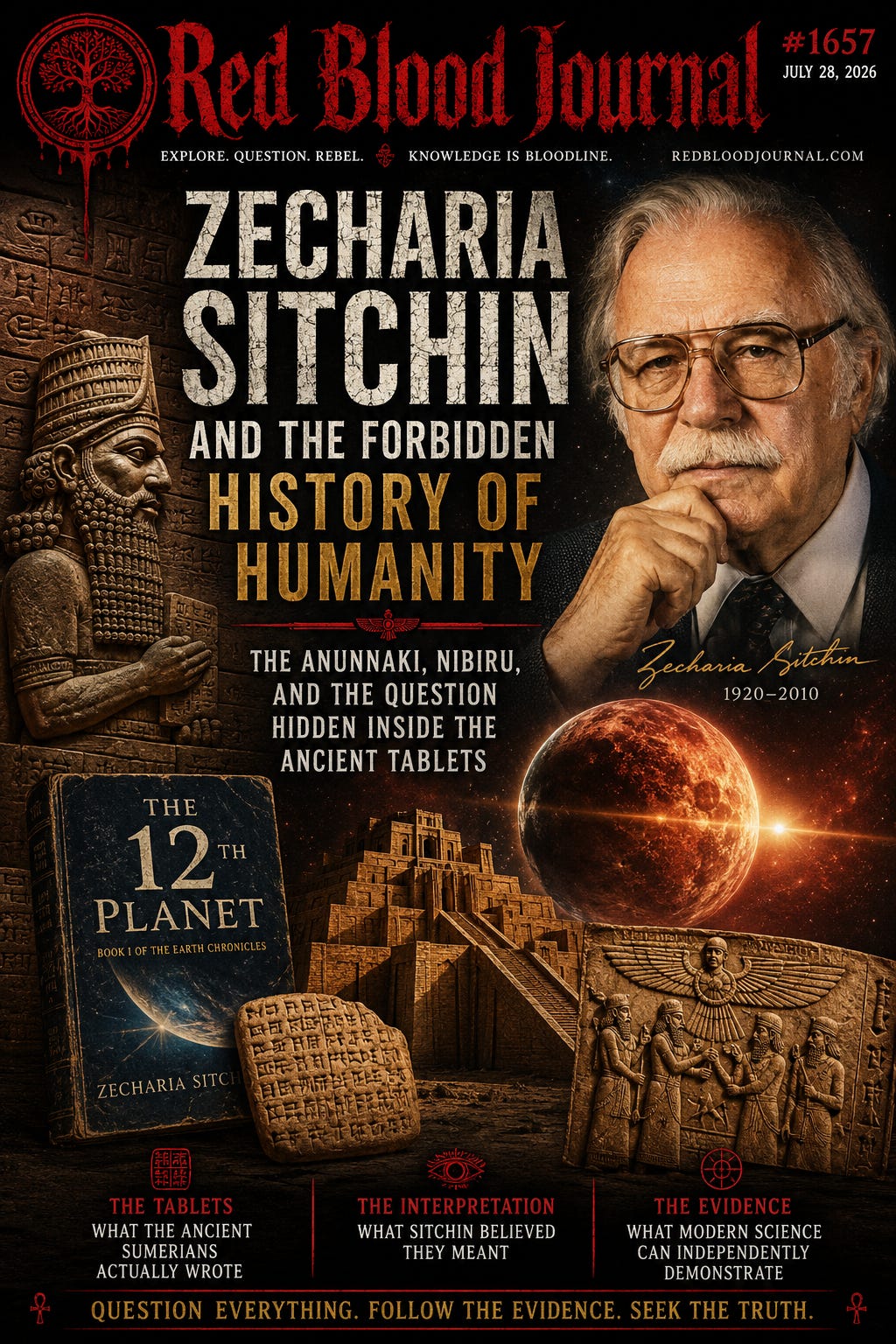
#1657 — Zecharia Sitchin and the Forbidden History of Humanity
The Anunnaki, Nibiru, and the Question Hidden Inside the Ancient Tablets
🩸 RedBloodJournal.com 🩸
Zecharia Sitchin spent decades advancing an extraordinary interpretation of ancient Mesopotamian civilization.
His argument was not merely that ancient people believed in gods.
It was that some of those gods might have represented physical beings.
Beings who came from somewhere else.
Sitchin focused particularly on the Anunnaki, divine figures appearing in ancient Mesopotamian traditions.
But he interpreted them very differently from conventional Assyriology.
The Twelfth Planet
In his 1976 book The 12th Planet, Sitchin proposed the existence of another world associated with what he called Nibiru.
According to his reconstruction, this world traveled on a highly elongated orbit and periodically entered the inner solar system.
Its inhabitants, the Anunnaki, supposedly reached Earth hundreds of thousands of years ago.
Then came the most controversial part of his theory.
Sitchin argued that the Anunnaki needed Earth’s resources—particularly gold—and eventually intervened in the development of human beings.
Humanity, in this interpretation, was not simply discovered by extraterrestrial visitors.
Humanity was altered by them.
Sitchin interpreted ancient stories about the creation of humans as distant memories of biological engineering.
What ancient civilizations called gods, he suggested, later generations may have misunderstood.
Perhaps they were technologically superior visitors whose abilities appeared divine to early humans.
When Technology Becomes Divinity
This raises a fascinating philosophical question independent of whether Sitchin’s interpretation is correct.
Imagine modern civilization traveling backward 10,000 years carrying helicopters, satellites, antibiotics, artificial intelligence, genetic engineering and nuclear technology.
What would ancient people call such visitors?
A person descending from the sky would appear supernatural.
A physician curing previously fatal disease might appear capable of miracles.
A geneticist manipulating life itself could appear to possess the power of creation.
Technology sufficiently beyond someone’s understanding can easily acquire the appearance of magic.
And enough technological superiority could acquire the appearance of godhood.
But What Do the Tablets Actually Say?
This is where Sitchin’s story becomes much more complicated.
The existence of ancient Mesopotamian traditions concerning the Anunnaki is real.
The ancient texts are real.
Mesopotamian astronomical knowledge is real.
But those facts do not automatically establish Sitchin’s interpretation.
Mainstream specialists in Sumerian and Akkadian languages have rejected important parts of his translations and conclusions.
Astronomers likewise do not accept his proposed astronomical model of Nibiru as an established planet repeatedly entering the inner solar system on the timetable he described.
And modern genetics does not provide evidence demonstrating that extraterrestrial beings engineered Homo sapiens.
Therefore three different things must remain separate:
What the ancient people actually wrote.
What Sitchin believed those writings meant.
What modern evidence can independently demonstrate.
Mixing those three together destroys the most interesting part of the investigation.
The Better Question
Perhaps the mistake is asking:
Was Sitchin right?
That forces an enormous collection of claims into a simple yes-or-no answer.
A better investigation asks:
Where did each claim originate?
Which tablet contains it?
What is the original word?
How do other translators render that word?
Did Sitchin translate something differently?
Was his interpretation linguistically possible but unconventional?
Or was an idea introduced that simply cannot be found in the surviving text?
Those questions can be investigated.
And that investigation is considerably more interesting than either believing everything Sitchin wrote or dismissing everything he wrote.
The Ancient Gods Deserve Another Look
Human civilization contains remarkably persistent stories of beings descending from the heavens.
Gods arrive.
Gods teach.
Gods create.
Gods fight.
Gods reproduce.
Gods become angry.
Gods establish kingdoms.
Gods disappear.
Similar themes appear across civilizations separated by enormous distances and periods of time.
That does not prove extraterrestrial contact.
Human beings also share similar fears, environments, astronomical observations and psychological tendencies.
Different societies can independently create similar mythology.
But the recurrence of these themes remains worthy of study.
Not because every ancient story must be literally true.
And not because every ancient god must have been an astronaut.
But because mythology may contain distorted memories of events whose original meaning disappeared long before the stories were finally written down.
The Most Important Legacy of Sitchin
Sitchin’s greatest contribution may therefore not be proving the Anunnaki came from another planet.
He did not establish that scientifically.
His greater contribution may have been forcing millions of people to look again at civilizations they had barely noticed.
Sumer.
Akkad.
Babylon.
Their tablets.
Their astronomy.
Their creation stories.
Their gods.
Their extraordinary understanding of mathematics and time.
Once someone begins looking backward far enough, something remarkable happens.
History stops appearing primitive.
The people living thousands of years ago were not unintelligent versions of modern humans.
They possessed the same fundamental human brain.
They observed.
Calculated.
Built.
Imagined.
Questioned.
And recorded their understanding of existence in clay so that fragments of their thoughts survived civilizations, wars, religions and empires.
Perhaps Sitchin interpreted some of those fragments incorrectly.
Perhaps some questions he raised deserve deeper investigation.
Both possibilities can exist simultaneously.
The Tablet Is More Important Than the Interpreter
That may ultimately be the lesson of Zecharia Sitchin.
Do not worship the conventional explanation.
But do not worship the alternative explanation either.
Return to the evidence.
Return to the artifact.
Return to the language.
Return to the tablet.
Because somewhere between unquestioning acceptance and automatic dismissal lies the territory where genuine curiosity survives.
Sitchin offered humanity an extraordinary possibility.
The ancient scribes left humanity something even more valuable:
the evidence from which everyone can continue asking the question.
And perhaps that is what the University of Life repeatedly teaches.
The answer handed to a student is never as valuable as learning how to investigate the question.
The ocean is large enough for science, mythology, imagination and doubt to coexist.
And curiosity does not require certainty.
It requires only the courage to keep looking.
🩸🌊✨ Fantastic!
Subjects: Zecharia Sitchin; Anunnaki; Nibiru; The 12th Planet; Sumerian Civilization; Mesopotamia; Ancient Astronaut Theory; Human Origins; Ancient Tablets; Creation Myths; Archaeology; Astronomy; Alternative History
Tags: Zecharia Sitchin, Anunnaki, Nibiru, Sumer, Mesopotamia, Ancient Civilizations, Ancient Astronauts, Human Origins, The 12th Planet, Archaeology, Ancient History, Red Blood Journal
🪐
🪐 Sitchin and the Divine Blueprint of the Anunnaki
Jul 28, 2026
Zecharia Sitchin’s controversial theories suggest that ancient Mesopotamian gods, known as the Anunnaki, were actually extraterrestrial visitors who used advanced technology to genetically engineer humanity. These claims, primarily detailed in his work The 12th Planet, propose that these beings arrived from a distant world called Nibiru to mine Earth’s resources. While mainstream scientists and linguists largely reject Sitchin’s specific translations and astronomical models, his work remains significant for sparking global interest in Sumerian and Akkadian history. The text emphasizes that regardless of Sitchin’s accuracy, the ancient clay tablets themselves offer a fascinating window into how early civilizations interpreted superior technology as divine power. Ultimately, the source encourages a critical investigation of historical artifacts that balances scientific skepticism with an appreciation for the enduring mysteries of human mythology.


