


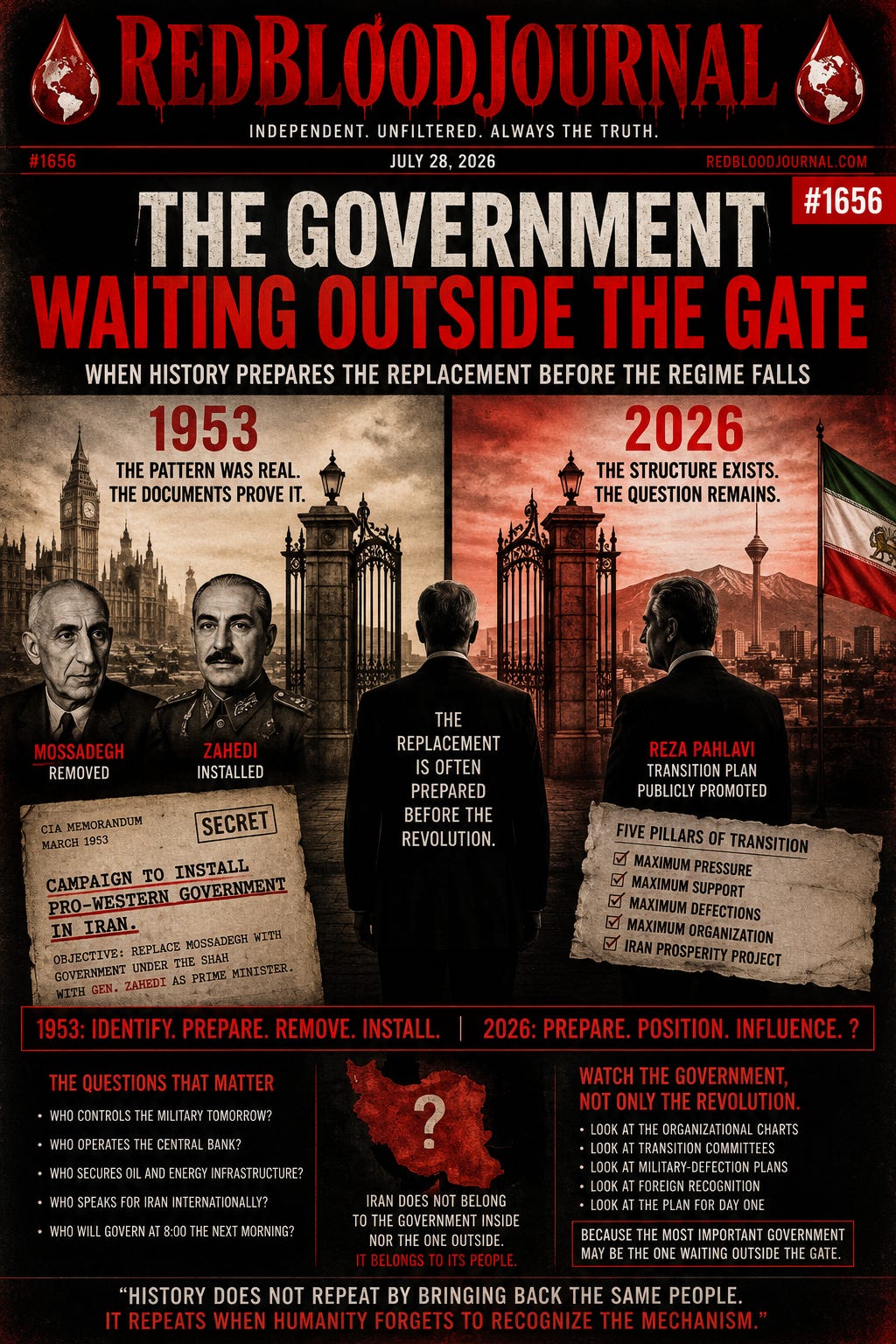
🩸 #1656 — The Government Waiting Outside the Gate
When History Prepares the Replacement Before the Regime Falls
July 28, 2026
🩸 RedBloodJournal.com 🩸
History usually tells the story of regime change backward.
First, a government falls.
Then chaos follows.
Then someone appears to restore order.
A general.
A monarch.
A revolutionary council.
An interim government.
A provisional authority.
A democratic coalition.
The public sees the replacement arrive after the collapse and naturally assumes that the replacement was created because of the collapse.
But history raises a more uncomfortable question.
What if the replacement existed before the collapse?
What if the people who would govern tomorrow were being identified, organized, financed, introduced, legitimized, or prepared somewhere else today?
That possibility is not merely theoretical.
History has examples.
And Iran has experienced one of the most important.
The Government Outside the Country
For centuries, powerful states have faced the same problem when confronting another government:
Destroying a government is relatively easy compared with replacing one.
A country cannot simply remain empty.
Someone must command the military.
Someone must control the borders.
Someone must operate the central bank.
Someone must keep electricity flowing.
Someone must manage oil production.
Someone must control government ministries.
Someone must communicate with foreign governments.
Someone must occupy the presidential palace the morning after the old government disappears.
This creates one of the least discussed components of regime change:
The replacement may need to be prepared before the existing government is removed.
Britain became particularly experienced with governments operating outside their countries.
During World War II, London hosted governments-in-exile from occupied European nations.
Those governments were fundamentally different from foreign-created replacement regimes: many represented legitimate governments displaced by Nazi occupation.
But the organizational concept demonstrated something important.
A government does not necessarily have to physically control its country to begin functioning politically.
Cabinets can meet abroad.
Diplomats can operate abroad.
Political legitimacy can be cultivated abroad.
Money can be raised abroad.
International recognition can be negotiated abroad.
Plans for returning home can be written abroad.
The government may be outside the gate long before the gate opens.
Iran — 1953
Iran provides one of history’s clearest examples of why the replacement question matters.
Prime Minister Mohammad Mossadegh had nationalized Iran’s oil industry, bringing his government into confrontation with British interests.
Britain sought his removal.
The United States eventually joined the operation.
What followed became known as Operation TPAJAX.
Today, declassified American documents allow something extraordinary to be seen.
The planning did not merely concern removing Mossadegh.
It concerned what came afterward.
A CIA planning document described a:
“CAMPAIGN TO INSTALL PRO-WESTERN GOVERNMENT IN IRAN.”
The proposed political outcome included General Fazlollah Zahedi becoming prime minister.
That matters enormously.
Because Zahedi did not magically emerge from the smoke after Mossadegh was removed.
He was part of the plan before Mossadegh fell.
The sequence therefore becomes very different when viewed from inside the planning room.
It was not simply:
Mossadegh falls.
↓
Zahedi appears.
It was:
Identify the desired political outcome.
↓
Prepare the replacement.
↓
Remove the existing government.
↓
Activate the replacement.
↓
Present the new government as the political reality.
That distinction changes how regime change should be studied.
The Morning After
Every serious attempt to remove a government eventually encounters the same question:
What happens at 8:00 the next morning?
Imagine Tehran suddenly without its present leadership.
Who controls the airports?
Who commands the army?
Who commands the Revolutionary Guard?
Who protects government buildings?
Who controls television and communications?
Who prevents competing armed factions from taking territory?
Who guarantees oil exports?
Who controls Iran’s foreign reserves?
Who tells provincial governors what government they now represent?
Who speaks internationally for nearly 90 million Iranians?
These questions cannot easily be answered after collapse.
They are usually considered beforehand.
And that brings the historical investigation into the present.
Iran — 2026
Today, substantial Iranian opposition activity exists outside Iran.
Among its most internationally visible figures is Reza Pahlavi.
His political organization openly discusses transition away from the Islamic Republic.
Its publicly described strategy includes pressure on the existing government, support for Iranians, encouraging defections from the existing system, organizing opposition, and planning for Iran after political transition.
That does not prove that Washington or London has selected Pahlavi as Iran’s future leader.
There is presently no publicly established equivalent of the documentary evidence that exists for the CIA and MI6 operation of 1953.
That distinction is essential.
But history suggests that another question deserves attention.
When does opposition become a government-in-waiting?
The Difference Between Opposition and Preparation
Opposition movements are normal.
Every government has opponents.
Exiles organize.
Activists hold conferences.
Political figures meet foreign officials.
Diaspora communities raise money.
None of those things independently proves foreign-directed regime change.
The historical alarm becomes more significant when something different begins appearing.
A complete transitional architecture.
A designated executive authority.
A finance ministry.
A foreign ministry.
A defense command.
Economic reconstruction plans.
Control arrangements for energy infrastructure.
Military defection channels.
International recognition.
Agreements concerning frozen national assets.
Plans for the first 30, 60 or 100 days.
At that point, the world is no longer looking merely at opposition.
It may be looking at a government waiting outside the gate.
The 1953 Test
Iran possesses an unusual advantage when examining the present.
It has already lived through the experiment.
Documents from 1953 can therefore become a template against which current developments are measured.
Ask the same questions.
Was a successor identified before the existing government disappeared?
In 1953:
Yes.
Were foreign governments involved?
Yes.
Were intelligence organizations involved?
Yes.
Was the desired political outcome discussed beforehand?
Yes.
Did the proposed replacement eventually assume power?
Yes.
Now ask those questions about 2026.
Is an Iranian opposition leadership operating abroad?
Yes.
Is planning for political transition taking place?
Yes.
Are opposition figures communicating with Western political institutions?
Yes.
But has evidence established that Britain and America have secretly selected Iran’s next government?
No.
Has a modern equivalent of Operation TPAJAX been demonstrated?
No.
Has the United States officially declared an Iranian government-in-exile to be Iran’s legitimate government?
No.
That leaves the most important part of the story unwritten.
History Does Not Have to Repeat Exactly
History rarely photocopies itself.
It updates its technology.
In 1953 there was radio.
Today there is social media.
In 1953 there were newspapers and intelligence networks.
Today there are satellite television, encrypted communication, influencers, cyber operations, financial sanctions and instantaneous global messaging.
Yesterday’s coup does not necessarily need to look like tomorrow’s regime change.
The actors can change.
The language can change.
The technology can change.
Even the stated political objectives can change.
But one question survives every generation:
Who is prepared to govern when the existing government disappears?
The Iranian Circle
There is an extraordinary historical symmetry surrounding Iran.
1953
Mossadegh
↓
Anglo-American intervention
↓
Zahedi
↓
Strengthened monarchy
1979
Monarchy
↓
Revolution
↓
Islamic Republic
2026
Islamic Republic
↓
?
↓
?
Those final two spaces should remain empty.
Not because nothing is happening.
But because history has not written them yet.
Filling them prematurely would transform investigation into prediction.
The more interesting approach is to watch who is preparing to fill them.
Watch the Government, Not Only the Revolution
When the world watches Iran, attention naturally goes toward protests, military strikes, sanctions, negotiations and statements from political leaders.
Perhaps attention should also look somewhere quieter.
Look at the organizational charts.
Look at transition conferences.
Look at economic reconstruction committees.
Look at military-defection programs.
Look at foreign diplomatic meetings.
Look at who is discussing Iran’s oil industry after transition.
Look at who is planning constitutional arrangements.
Look at who is preparing to administer the country.
Look at who foreign governments increasingly treat as representatives rather than activists.
Because the most important evidence of an approaching regime change may not necessarily appear inside the regime being challenged.
It may appear inside the structure being prepared to replace it.
The Government Waiting Outside the Gate
The lesson of 1953 is not that every Iranian opposition figure is secretly controlled by Britain or America.
That conclusion would go beyond the available evidence.
The lesson is considerably more important.
Never study only the government being removed.
Study the government that could replace it.
Study it before the revolution.
Study it before the coup.
Study it before the invasion.
Study it before international recognition.
Study it while almost everyone else is watching the government presently in power.
Because once the gate opens, the world may describe the person walking through it as the natural consequence of history.
Years later, when archives finally open, historians may discover something different.
Perhaps that person had been standing outside the gate for a very long time.
And Iran already knows what that discovery feels like.
🩸 Final Thought
History does not necessarily repeat itself by bringing back the same people.
It repeats when humanity forgets to recognize the mechanism.
The names change.
The uniforms change.
The slogans change.
The technology changes.
But understanding history means learning to recognize the machinery beneath the stage.
The objective should not be fear.
It should not be hatred.
And it should not be blind allegiance to one political camp or another.
It should be awareness.
Because ultimately Iran belongs neither to a government inside its borders nor to a government waiting outside them.
It belongs to its people.
And perhaps the greatest political wisdom is ensuring that whatever eventually walks through the gate arrives through the genuine will of those people rather than through a script written somewhere beyond it.
From an ocean of division, may understanding eventually return humanity to an ocean of love, wisdom and positivity.
🩸🌊✨ Fantastic!
🩸 RedBloodJournal.com 🩸
Subjects
Iran • Regime Change • Governments-in-Exile • Mohammad Mossadegh • Operation TPAJAX • 1953 Iranian Coup • Britain • United States • CIA • MI6 • Fazlollah Zahedi • Reza Pahlavi • Iranian Opposition • Transitional Government • Foreign Intervention • Political History • Government-in-Waiting
Substack Tags
Iran, Iranian History, Regime Change, Mohammad Mossadegh, 1953 Coup, CIA, Britain, United States, Reza Pahlavi, Geopolitics
🚪
🚪 The Architecture of Transition: Governments-in-Waiting
Jul 28, 2026
This text examines the historical and modern phenomenon of governments-in-waiting and their role in orchestrated regime change. Using the 1953 Iranian coup as a primary case study, the author illustrates how foreign powers often select and prepare a successor leadership well before an existing government is dismantled. The narrative connects these past events to the contemporary Iranian opposition, questioning whether current movements abroad represent a similar transitional architecture. By emphasizing the “machinery beneath the stage,” the source argues that political transitions are frequently planned in advance rather than being spontaneous reactions to a collapse. Ultimately, it serves as a cautionary analysis, urging observers to scrutinize the legitimacy and origins of those poised to take power during times of national upheaval.


