


🩸 RedBloodJournal.com
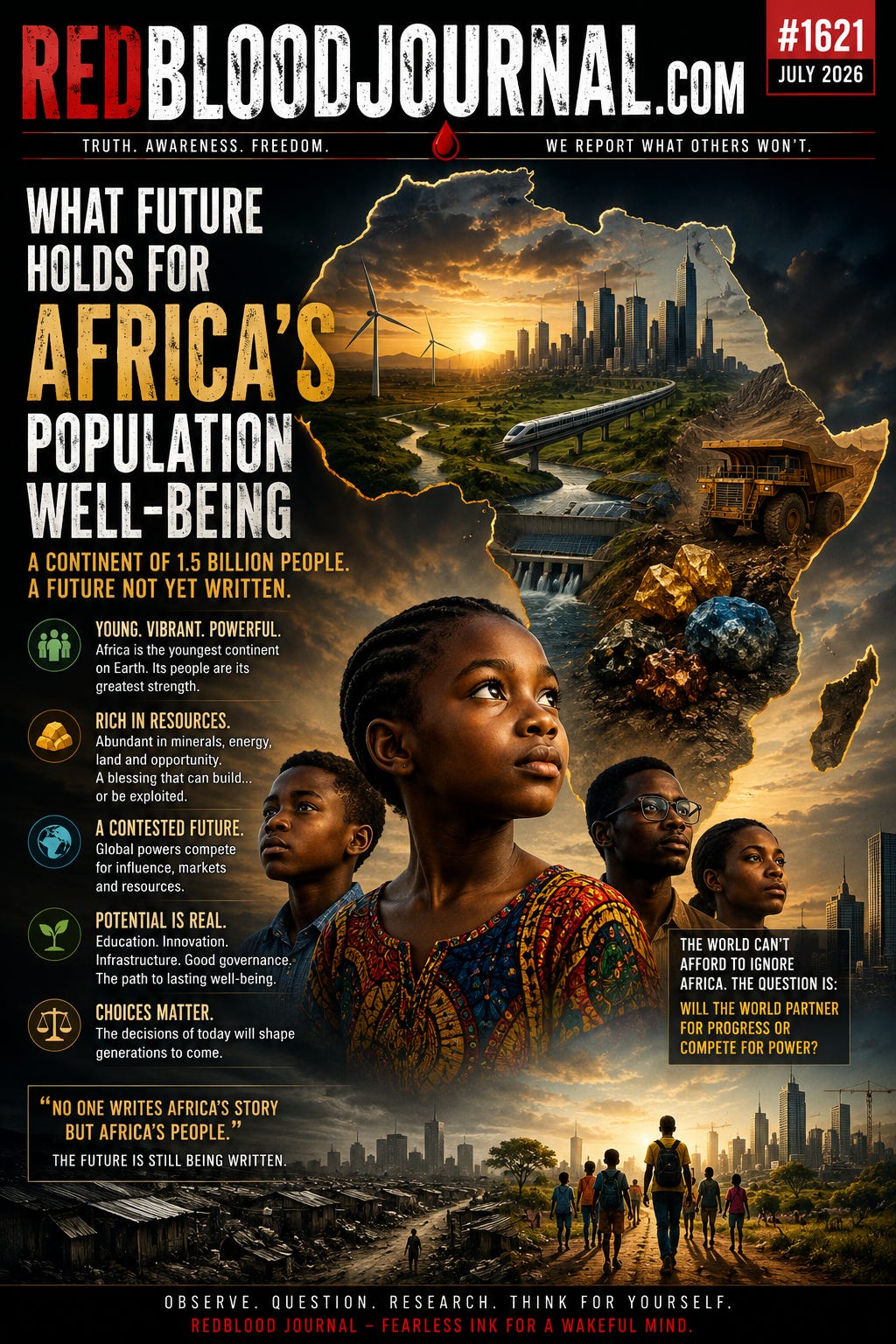
#1621 – What Future Holds for Africa’s Population Well-Being
An Opinion
By Red Blood
July 2026
Introduction
Africa is home to more than 1.5 billion people spread across 54 countries.
It is the youngest continent on Earth.
It possesses vast reserves of critical minerals, fertile agricultural land, abundant energy resources, and one of the fastest-growing populations in human history.
Yet, despite its importance, Africa often receives only brief moments of global attention before headlines move elsewhere.
This raises an important question:
What does the future hold for the well-being of Africa’s people?
No one can know with certainty.
The future has not been written.
But by observing history, economics, demographics, and geopolitics, we can consider several possible paths.
A Continent of Extraordinary Potential
Africa’s greatest resource is not found beneath the ground.
It is its people.
A young population represents an enormous opportunity.
If education, healthcare, infrastructure, and stable institutions continue to improve, Africa could become one of the world’s largest centers of innovation, manufacturing, agriculture, and entrepreneurship during the twenty-first century.
Many countries are already investing in technology, renewable energy, finance, and regional trade.
This future is entirely possible.
The Challenge of Resources
Throughout history, regions rich in natural resources have often attracted outside interest.
Oil.
Gold.
Diamonds.
Rare earth minerals.
Cobalt.
Lithium.
Copper.
These resources are essential to modern economies.
Some observers argue that resource wealth can become both a blessing and a challenge if institutions are weak, corruption grows, or external powers compete for influence without equally investing in the long-term well-being of local populations.
History offers examples supporting multiple outcomes.
The Competition for Influence
Africa today is becoming increasingly important to global powers.
Countries and international organizations invest through infrastructure projects, trade agreements, military partnerships, development programs, and private investment.
Some view this competition as an opportunity.
Others worry that outside interests may sometimes prioritize strategic or economic objectives over local needs.
Reality is often more complex than either extreme.
Population Growth
Africa’s population is expected to continue growing for decades.
This creates both opportunity and responsibility.
More workers.
More consumers.
More entrepreneurs.
But also greater demand for food, housing, education, employment, healthcare, clean water, and energy.
Whether population growth becomes an advantage or a burden depends largely on governance, investment, and the ability of societies to create opportunity for future generations.
The Media Lens
Many people observe that Africa appears less frequently in international headlines than other regions.
When coverage does occur, it often centers on conflict, famine, disease, or political instability.
Less attention is given to scientific achievements, growing cities, new businesses, educational progress, and everyday success stories.
Media attention does not define reality.
It only highlights selected parts of it.
Understanding any continent requires looking beyond headlines.
A Red Blood Journal Perspective
From the perspective of this publication, one question deserves continual reflection:
Who benefits when a region rich in people and resources remains known primarily through stories of crisis?
This article does not claim a single answer.
Instead, it encourages readers to ask questions, compare multiple sources, and examine how economic incentives, political interests, and media priorities influence the stories that become visible.
Healthy skepticism should be paired with careful evidence and an openness to revising conclusions when new information emerges.
The Future Is Still Being Written
Africa’s future is not predetermined.
It could become one of humanity’s greatest success stories.
It could continue to struggle with longstanding challenges.
Most likely, it will experience both remarkable progress and difficult setbacks, differing from country to country.
The choices made by African citizens, leaders, businesses, communities, and international partners will all help shape that future.
History shows that no civilization remains permanently in the background.
Every generation writes part of the story.
Africa’s next chapters will be written first and foremost by the people who call the continent home.
Opinion: This article reflects an interpretive viewpoint intended to encourage observation and discussion. Readers are encouraged to compare multiple sources, examine evidence critically, and form their own conclusions.
🌍 The Architecture of African Opportunity
Jul 8, 2026
This source examines the future trajectory of Africa, emphasizing that its greatest asset is a rapidly growing youth population. While the continent possesses immense natural wealth like critical minerals and fertile land, the author suggests that long-term prosperity depends on strong governance and infrastructure investment. There is a critical look at how global powers compete for influence and how international media often ignores African innovation in favor of focusing on crisis and instability. Ultimately, the text argues that Africa’s path is not fixed, as local leadership and international partnerships will determine if its resources become a blessing or a burden. The overarching message encourages readers to look beyond simplistic headlines to recognize a continent capable of becoming a global center for entrepreneurship.


