


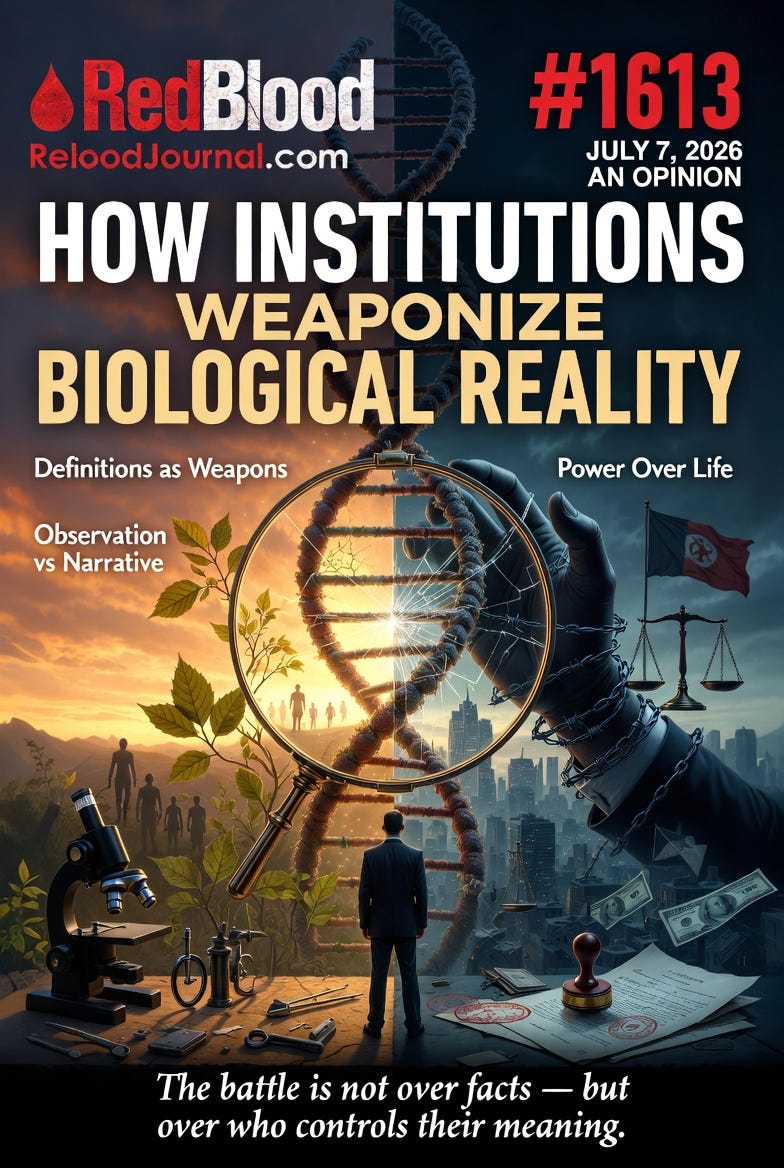
How Institutions Weaponize Biological Reality
How Institutions Redefine Biology for Power
🩸 RedBloodJournal.com
#1613 – How Institutions Weaponize Biological Reality
An Opinion
By Red Blood
July 7, 2026
Introduction
Knowledge has always been a source of power.
Throughout history, institutions have recognized that whoever shapes public understanding also shapes public behavior.
Religion, governments, corporations, universities, media organizations, and commercial interests have all, at different times, influenced how societies understand the world.
Biology is one of the most influential subjects because it touches every human life.
It influences medicine, reproduction, family, athletics, privacy, identity, inheritance, demographics, and public policy.
When discussions about biology become emotionally charged, societies often struggle to separate observable facts from political, ideological, economic, or cultural arguments.
This article explores the broader question of how institutions can use biological subjects to advance goals beyond biology itself.
Biology Is More Than a Science
Biology is not simply another academic discipline.
It affects:
Birth
Childhood
Health care
Reproduction
Family structures
Competitive sports
Military service
Population planning
Medical research
Legal systems
Because biology influences nearly every part of civilization, it naturally becomes a subject of political interest.
Whoever influences public understanding of biology may also influence many other areas of society.
The Power of Definitions
Institutions rarely need to change reality.
Often, they only need to influence how reality is described.
Words carry authority.
Definitions determine laws.
Policies determine behavior.
Changing terminology can sometimes shift public perception without changing the underlying biological observations themselves.
Language therefore becomes a powerful tool in shaping public discussion.
Confusion as a Form of Control
History shows that confusion can sometimes benefit institutions.
A population that constantly argues over definitions may spend less time questioning larger systems of power.
Whether intentionally created or naturally emerging, prolonged confusion can have consequences:
Public distrust.
Political polarization.
Emotional decision making.
Reduced confidence in institutions.
Endless cultural conflict.
Confusion itself can become a form of influence, regardless of who originally created it.
The Incentives Behind Every Institution
Every institution has incentives.
Governments seek stability.
Political parties seek votes.
Corporations seek profit.
Universities seek funding.
Media organizations seek attention.
Advocacy groups seek influence.
These incentives do not automatically mean deception.
However, incentives can shape which ideas receive greater visibility and which receive less.
Understanding incentives helps explain why biological topics sometimes become highly politicized.
Observation Comes Before Conclusion
Healthy inquiry begins with observation.
Observation alone does not answer every question.
Nor should observation be replaced by assumption.
The challenge is to avoid two opposite mistakes:
Ignoring observable evidence.
Or reaching conclusions beyond what the evidence can support.
A society functions best when people remain willing to observe carefully, ask questions respectfully, and revise conclusions when stronger evidence becomes available.
The Difference Between Biology and Policy
Biological observations and public policy are not identical.
Scientific descriptions explain aspects of the natural world.
Policy decisions involve ethical, legal, cultural, and social judgments that extend beyond science alone.
Recognizing this distinction can help reduce unnecessary conflict.
People may agree on many biological observations while disagreeing about how society should respond.
The Cost of Polarization
When every disagreement becomes a battle between competing identities, careful discussion becomes more difficult.
People may begin to fear asking honest questions.
Others may assume disagreement automatically implies hostility.
Neither reaction encourages better understanding.
A healthier society allows respectful debate while recognizing the dignity of every individual involved.
The Observer’s Responsibility
Institutions will always exist.
Experts will always exist.
Authorities will always exist.
But every individual also possesses the ability to observe.
Observation is not the enemy of expertise.
Nor is expertise the enemy of observation.
Both become stronger when they work together.
Critical thinking requires humility, patience, and a willingness to distinguish between what is directly observed, what is inferred, and what remains uncertain.
Final Thoughts
Biology should not become a battlefield where curiosity is replaced by fear or where disagreement automatically becomes hostility.
The strongest societies are not those that silence questions.
They are the ones that encourage careful observation, honest dialogue, and intellectual humility.
Institutions will continue to influence public understanding because influence is part of their nature.
The responsibility of every observer is not to abandon institutions entirely, nor to accept every claim without question.
It is to remain curious, to examine evidence carefully, to recognize the incentives that may shape public conversations, and to remember that understanding grows strongest when observation, compassion, and reason are allowed to coexist.
Only then can biology remain what it was always meant to be:
A study of life, rather than another arena for endless conflict.
🧬 The Institutional Weaponization of Biological Reality
Jul 7, 2026
This article examines how powerful organizations utilize biological concepts to influence public behavior and achieve broader political or economic goals. The author argues that because biology impacts essential human experiences like reproduction and health, institutions often manipulate language and definitions to reshape societal perceptions. Such tactics can lead to widespread social confusion and polarization, which frequently serve to distract the public from questioning established power structures. Every institution, from governments to corporations, is driven by specific incentives that dictate how they present scientific information to the masses. Ultimately, the text advocates for individual critical thinking and humble observation to distinguish between objective natural facts and the strategic narratives created by those in authority. By maintaining intellectual curiosity, citizens can better navigate the complex intersection of scientific reality and institutional policy.


