


Here’s the publication-ready version as Report #1610.
🩸 RedBloodJournal.com
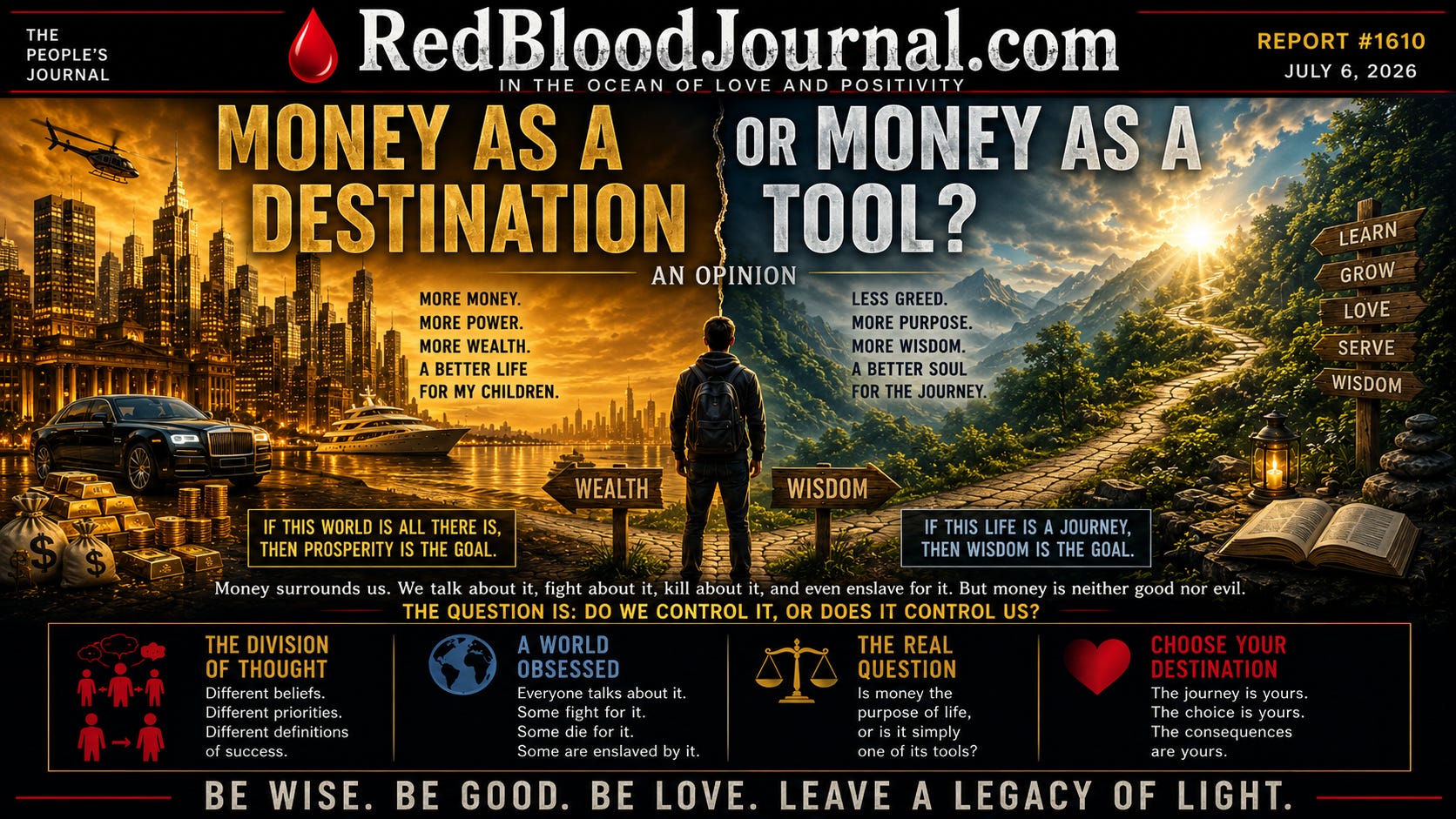
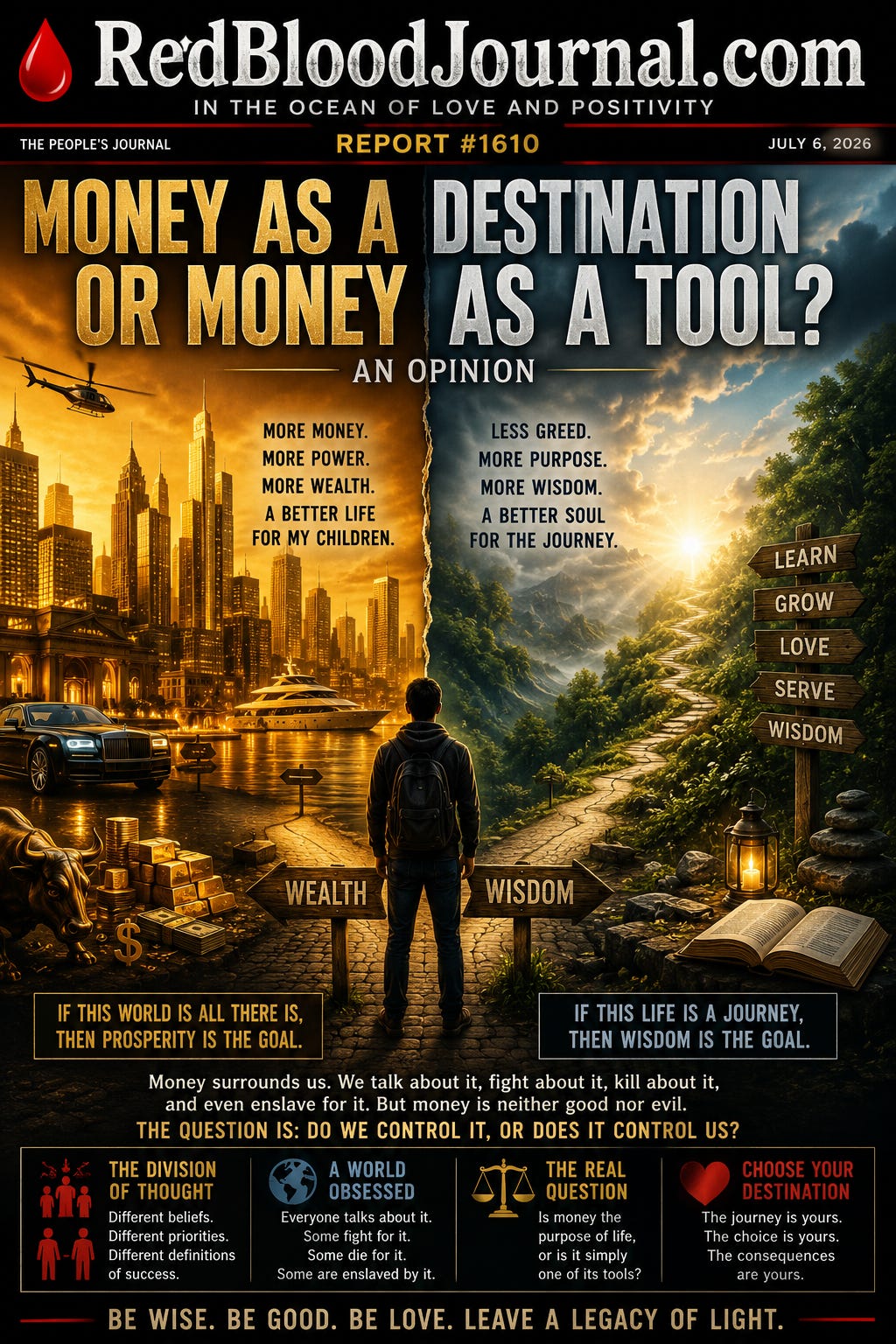
#1610 – Money as a Destination or Money as a Tool?
An Opinion
By Red Blood
July 6, 2026
Introduction
The more I observe politics, business, and society, the more I understand why some leaders focus almost entirely on economics. If someone believes that this material world is the only reality, then accumulating wealth, increasing production, expanding markets, and protecting financial interests naturally become the highest priorities.
From that perspective, I find it difficult to simply blame leaders such as Donald Trump for emphasizing money and economic growth. If one’s philosophy is that success is measured primarily by prosperity, then that approach is internally consistent.
For many people, that is exactly what they want.
If your greatest desire is financial security...
If your dream is to leave your children with greater wealth...
If you measure progress by larger bank accounts, stronger markets, and expanding businesses...
Then a leader whose primary focus is economic growth may represent your ideal vision.
There is nothing surprising about that worldview. It reflects the values held by millions.
A Different View of Life
Not everyone sees life through the same lens.
Some of us see this physical life as only one chapter in a much longer journey. We see this world as a temporary resting place—a classroom where we learn, mature, and eventually move on.
From that perspective, money is valuable.
But it is not the destination.
It is a tool.
This difference in outlook explains why people can witness the same events yet arrive at completely different conclusions.
One person asks:
“How can we become wealthier?”
Another asks:
“How can we become wiser?”
Neither question is meaningless.
They simply begin from different assumptions about what life is ultimately for.
The Power of Money
Money has an extraordinary influence over the human mind because it touches nearly every aspect of life.
People talk about it.
Work for it.
Fight over it.
Sacrifice relationships for it.
Commit crimes for it.
Even wage wars in pursuit of it.
Entire populations can be motivated through promises of prosperity or controlled through fear of financial hardship.
Money itself is neither good nor evil.
It is a remarkable invention that allows societies to exchange value efficiently.
The deeper question is whether we remain its master—or quietly become its servant.
Two Definitions of Success
When wealth becomes the highest measure of success, almost anything can eventually be justified in its pursuit.
Competition becomes ruthless.
Status begins replacing character.
People are increasingly valued for what they own rather than who they are.
For those who believe life extends beyond the material world, the priorities naturally shift.
Integrity becomes more valuable than possessions.
Wisdom outweighs status.
Compassion carries greater weight than profit.
Success is measured less by what we accumulate and more by who we become.
Final Thoughts
Perhaps this is why people can look at the same leader, the same policy, or the same economic achievement and sincerely disagree.
They are often not arguing over the same destination.
They are beginning from different beliefs about the purpose of life itself.
If this life is everything, then maximizing material success makes perfect sense.
If this life is only one step in a much larger journey, then money remains important—but it can never become the destination.
Perhaps one of the most important questions each of us can ask is not how much wealth we leave behind, but what kind of human being we become while earning it.
Because when the journey ends, it may not be our bank account that defines us.
It may be our character.
In the Ocean of Love and Positivity, money is a useful vessel—but never the shore.
⚖️ The Currency of Character: Wealth as a Vessel or Destination
Jul 6, 2026
This report examines the fundamental philosophical divide regarding the purpose of wealth in modern society and politics. The author suggests that an individual’s support for specific leaders or policies often depends on whether they view material prosperity as the ultimate goal or merely a temporary instrument. For those who believe the physical world is the only reality, economic growth and financial security become the primary benchmarks of success. Conversely, those who view life as a spiritual journey prioritize the cultivation of character and wisdom over the accumulation of assets. Ultimately, the text argues that while money is a functional tool for exchange, its true value is determined by whether it serves a person’s integrity or consumes their identity. The piece concludes that our legacy is defined not by our financial status, but by the moral quality of the human beings we become.
#RedBloodJournal #Money #Wealth #PurposeOfLife #Philosophy #Spirituality #PersonalGrowth #Character #Wisdom #Materialism #Economics #Success #Integrity #OceanOfLove #MoneyAsATool


