


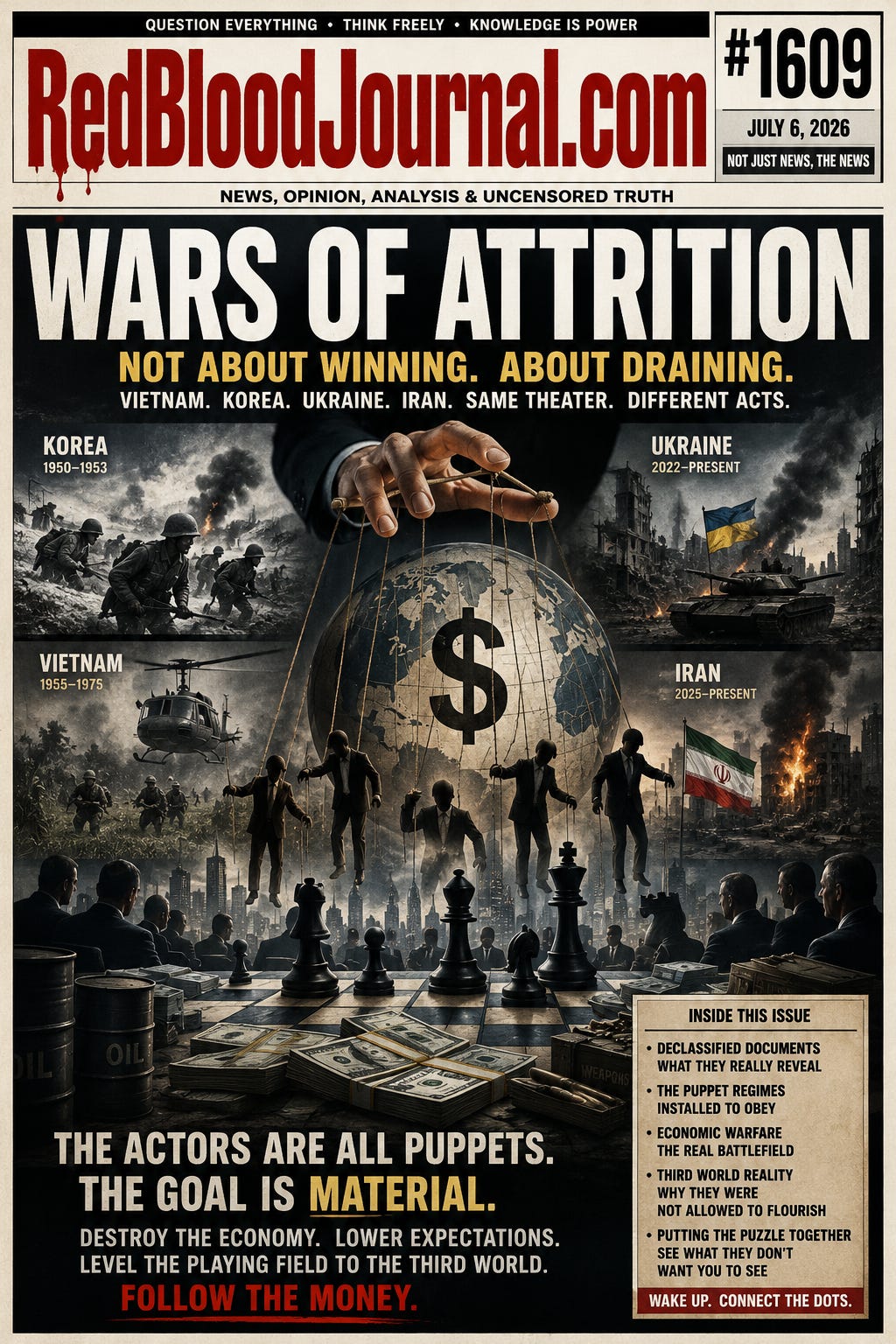
🩸 RedBloodJournal.com
#1609 – Wars of Attrition: An Opinion on Power, Resources, and the Material World
An Opinion
By Red Blood
July 6, 2026
Introduction
History is often presented as a series of victories and defeats.
One nation wins.
Another nation loses.
Borders change.
Treaties are signed.
Generals become heroes.
Yet another way of looking at history is to ask a different question:
What if the real objective was never simply to win the war?
This report presents an opinion that many of the world’s major conflicts may be better understood by examining the long-term movement of money, resources, political power, and public perception rather than only the battlefield itself.
Looking Back
When looking at conflicts such as the Korean War, the Vietnam War, the wars in the Middle East, the war in Ukraine, and the recent confrontation involving Iran, one pattern stands out to some observers.
Years after these conflicts, governments often release declassified documents showing that public explanations did not always tell the entire story. Intelligence operations, geopolitical calculations, economic interests, and strategic objectives sometimes played larger roles than citizens understood while the conflicts were taking place.
This naturally raises questions.
Were these wars only about military victory?
Or were they also about maintaining a global balance of power and directing enormous flows of resources?
A Different Interpretation
The opinion presented here is that many modern wars resemble long-term strategic contests of attrition rather than straightforward campaigns to conquer territory as quickly as possible.
Under this interpretation, military capability alone does not explain the duration of a conflict.
Instead, prolonged wars consume:
National wealth
Industrial production
Government budgets
Public confidence
Political stability
Human lives
The battlefield becomes only one part of a much larger economic and political system.
The Material World
Whether one agrees or disagrees with this interpretation, modern civilization operates largely through material incentives.
Economies.
Resources.
Debt.
Production.
Energy.
Technology.
Money.
If the material world is where governments compete for influence, then wars can also be viewed as competitions over economic endurance rather than simply military strength.
Governments as Actors
This perspective further suggests that governments often behave like actors within a larger international system.
Every nation appears to pursue its own interests, yet alliances shift, negotiations continue even during conflict, and long-term geopolitical structures often survive changes in leadership.
From this viewpoint, countries may appear to be opponents on one stage while simultaneously participating in a broader global system whose incentives encourage continued competition instead of permanent resolution.
This interpretation remains speculative, but it invites readers to consider whether international politics is more interconnected than it appears.
Military Capability Versus Political Decisions
Some observers argue that powerful militaries possess the capability to achieve rapid battlefield objectives in certain conflicts.
If that is true, an obvious question follows:
Why do some wars continue for years?
One possible answer is that political objectives are not always identical to military objectives.
Governments may weigh diplomacy, alliances, international law, humanitarian concerns, economic consequences, domestic politics, and the risks of wider escalation alongside military considerations.
Others believe these prolonged conflicts primarily reflect corruption, competing interests, or deliberate strategic choices by governments.
Whatever conclusion one reaches, the distinction between what is militarily possible and what political leaders choose to do remains an important question.
The Third World
Having served in the military or traveled extensively through developing countries often changes how people see the world.
Poverty is rarely just a statistic.
It becomes visible.
Entire societies possess intelligent, hardworking people who nevertheless struggle because of historical circumstances, weak institutions, corruption, foreign interference, debt, conflict, or limited economic opportunity.
This observation leads some to wonder whether global economic inequality is merely an accident of history or partly the result of political systems that have evolved over generations.
Different people reach different conclusions, but the question itself deserves thoughtful examination.
A Larger Puzzle
From this perspective, today’s conflicts are not isolated events.
They become individual pieces of a much larger puzzle.
The wars.
The economic crises.
Inflation.
Debt.
Energy shortages.
Political polarization.
Military expansion.
International negotiations.
Viewed separately, each event appears independent.
Viewed together, some observers believe they form a broader pattern that cannot easily be explained by chance alone.
Whether that pattern reflects deliberate coordination, structural incentives within the international system, or simply the complexity of global politics is open to debate.
Conclusion
This report does not claim to possess final answers.
It offers an opinion intended to encourage readers to examine history through multiple lenses.
Wars undoubtedly involve real suffering, real destruction, and real human loss.
At the same time, history reminds us that governments often pursue objectives extending far beyond what is immediately visible on the battlefield.
Understanding those broader objectives—whether economic, political, strategic, or ideological—may provide a deeper appreciation of how the modern world functions.
The purpose of questioning is not to arrive at predetermined conclusions.
It is to remain curious enough to continue asking thoughtful questions while recognizing the difference between established evidence, informed interpretation, and personal opinion.
⚖️ The Architecture of Attrition:
War as a Material System
Jul 6, 2026
This source presents a theoretical framework that views modern warfare as a complex material system rather than a simple quest for battlefield victory. The author suggests that prolonged conflicts often serve as strategic contests of attrition designed to redistribute global resources, wealth, and political influence. By examining historical patterns, the text argues that governmental objectives frequently prioritize long-term economic endurance and geopolitical stability over rapid military resolution. This perspective encourages readers to see international crises not as isolated incidents, but as interconnected pieces of a larger global puzzle driven by material incentives. Ultimately, the report challenges the public to look beyond official narratives to understand the underlying structures that sustain perpetual competition between nations.
#RedBloodJournal #WarsOfAttrition #ArchitectureOfAttrition #ModernWarfare #WarAndPower #WarAndEconomics #Geopolitics #GlobalPower #MilitaryStrategy #StrategicAttrition #EconomicWarfare #ResourceWars #GlobalResources #PoliticalPower #GovernmentPower #MilitaryIndustrialComplex #WarEconomy #GlobalEconomy #NationalDebt #EnergyPolitics #InternationalRelations #ForeignPolicy #GlobalConflict #HistoryAndPower #BehindTheNarrative #QuestionTheNarrative #DeclassifiedHistory #PoliticalStrategy #EconomicEndurance #MaterialWorld #GlobalInequality #DevelopingWorld #ThirdWorld #PowerAndResources #PerpetualWar #WarAndProfit #HumanCostOfWar #PublicPerception #PoliticalDecisions #MilitaryCapability #GlobalSystem #OceanOfLoveAndPositivity #RedBlood #1609


