


🩸 RedBloodJournal.com
#1601 – Humility Begins in Childhood
An Opinion
By Red Blood
July 5, 2026
Introduction
One of the greatest lessons a child can learn is that there is no shame in humility.
Modern society often teaches children to become confident, outspoken, and independent. These qualities certainly have value, but they become far more meaningful when balanced with humility.
Many traditional cultures have long understood that respect is not merely taught through words—it is taught through repeated actions.
Respect as a Lesson
In many Middle Eastern families and other traditional societies, children are encouraged from an early age to show respect toward their elders.
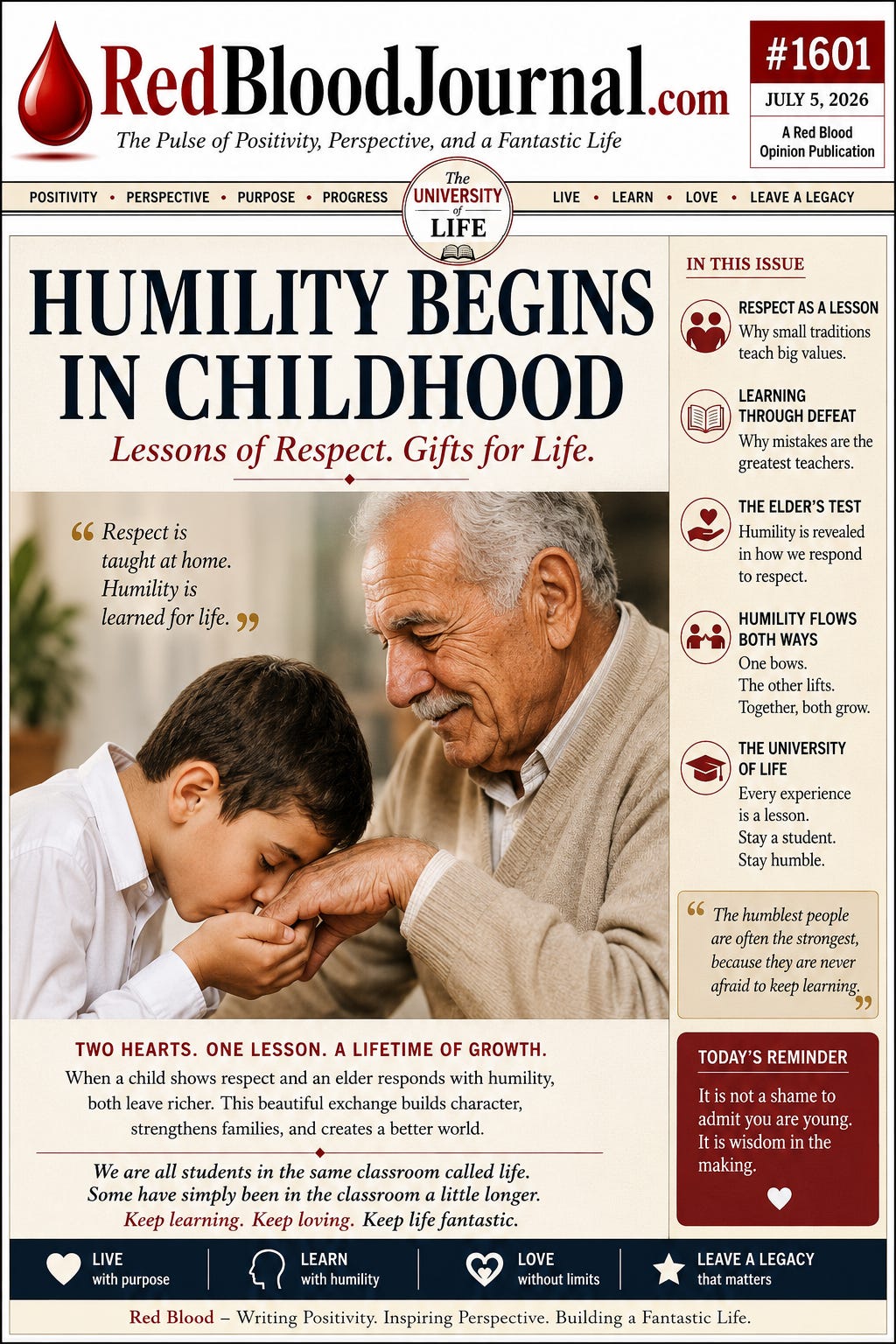
One well-known custom is for a child to greet grandparents or older relatives by kissing their hand.
To someone unfamiliar with the tradition, it may appear to be a simple greeting.
From an educational perspective, however, it carries a deeper lesson.
Without saying a word, the child learns that it is acceptable to recognize that someone else has lived longer, accumulated more experience, and may possess wisdom gained through decades of life.
The gesture quietly teaches that there is no shame in learning from those who came before us.
Rather than diminishing the child, it encourages openness to growth.
Learning Through Defeat
Life’s greatest lessons rarely come from our victories.
They come from our mistakes.
They come from failure.
They come from being corrected.
A child who learns that admitting, “I do not know,” is not a weakness but the beginning of wisdom develops a mindset that remains open throughout life.
Humility allows knowledge to enter.
Pride often closes the door before the lesson can even begin.
The Elder’s Test
The tradition also reveals something about the elder.
When someone reaches to kiss an elder’s hand, two very different responses are possible.
One elder may simply extend the hand, believing the gesture is something naturally deserved.
Another may gently pull the hand away, place it gently upon the child’s head, embrace the child, or kiss them on the forehead or cheek instead.
Without speaking, the elder communicates:
“Thank you for your respect, but I am no greater than you.”
At that moment, both people receive a lesson.
The child practices respect.
The elder practices humility.
One bows.
The other lifts.
Together they create something far greater than a tradition—they create love expressed through humility.
The University of Life
Imagine life as the greatest university ever created.
Every experience is a lesson.
Every failure is an examination.
Every success is simply confirmation that a previous lesson has been understood.
In such a university, there is no shame in not knowing.
The only shame would be refusing to learn.
Humility is what allows the student to enter the classroom with an open mind.
Pride convinces the student that graduation has already been achieved.
Yet no one truly graduates while there is still something left to learn.
Humility Creates Fantastic Human Beings
A fantastic human being is not someone who wins every argument.
It is not someone who accumulates the most wealth.
It is not someone who possesses the most titles or power.
A fantastic human being is someone who can look another person in the eyes and genuinely say,
“Teach me something I do not yet know.”
That sentence requires courage.
It requires confidence.
Most importantly, it requires humility.
Ironically, the humblest people are often the strongest because they are never afraid to continue learning.
Conclusion
Perhaps one of the greatest gifts parents can give their children is not endless praise, but the confidence to admit when they are wrong, the courage to ask questions, and the humility to keep learning throughout life.
Whether respect is shown through kissing an elder’s hand, a bow, standing when someone enters the room, or simply listening before speaking, the outward gesture matters far less than the inward transformation it inspires.
The purpose is not submission.
The purpose is education.
The child learns that wisdom exists beyond themselves.
The elder remembers that wisdom without humility becomes pride.
When both understand this, respect is no longer a social obligation.
It becomes an expression of love.
Perhaps that is why the happiest societies are not those where everyone tries to stand above everyone else, but those where people willingly lift one another higher.
Because in the end, we are all students attending the same University of Life.
Some have simply been in the classroom a little longer than others.
And perhaps the true measure of graduation is not how much knowledge we have accumulated, but how much love, humility, and kindness we have learned to share with one another.
Only then does life become truly...
Fantastic.
🙇 The University of Life: Lessons in Humility and Respect
Jul 5, 2026
The provided text explores the essential role of humility in personal development, framing life as an ongoing educational journey where wisdom is gained through openness rather than pride. It highlights how traditional customs, such as children showing physical signs of respect to elders, serve as practical exercises that foster mutual grace and lifelong learning. By prioritizing the ability to admit ignorance over the desire for dominance, individuals can transform social obligations into expressions of love. Ultimately, the author suggests that true strength is found in the courage to remain a student of the world, regardless of one’s age or status. The narrative concludes that a meaningful life is measured not by accumulated power, but by the kindness and humility shared between generations.


