


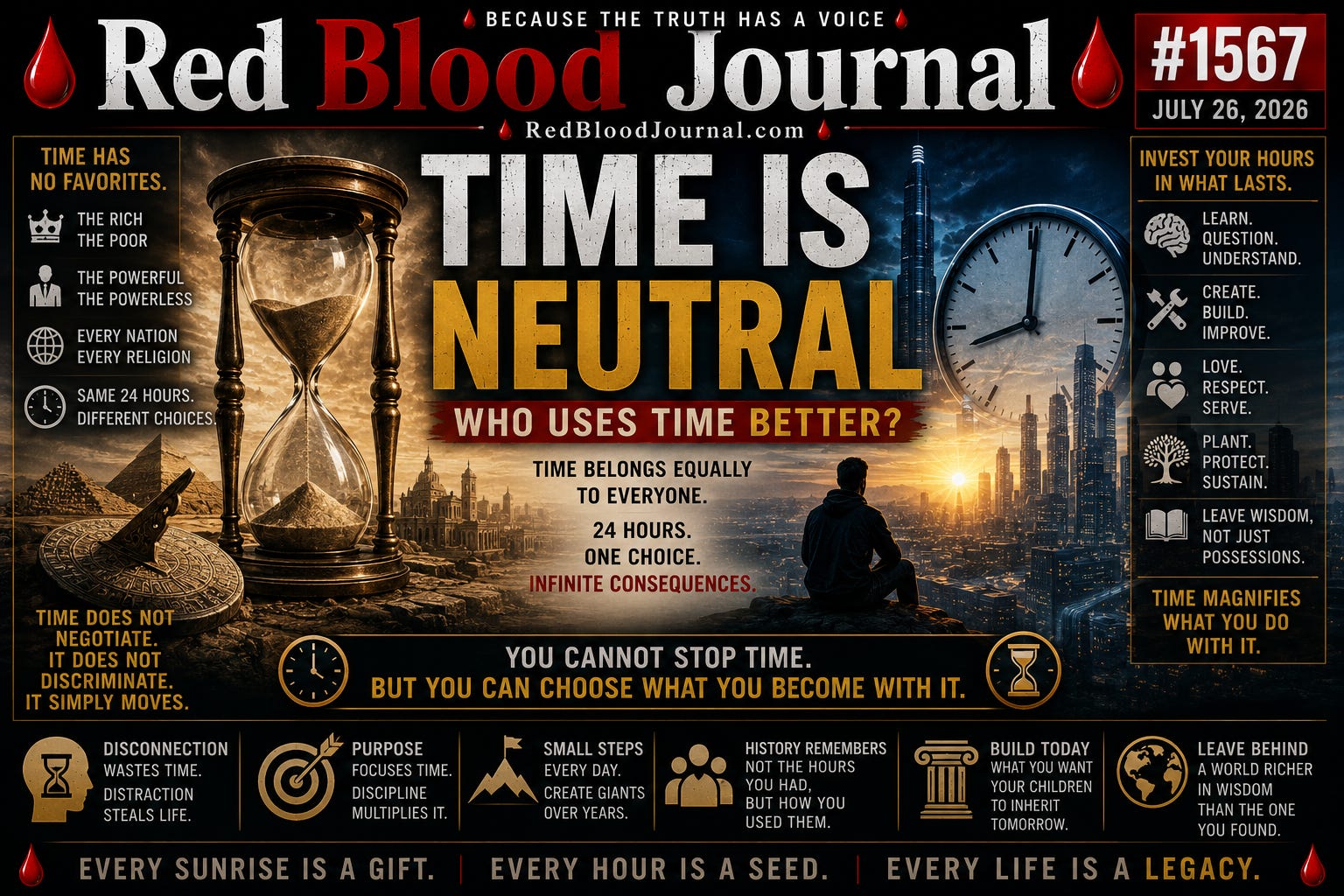
#1567 — Time Is Neutral
Who Uses Time Better?
🩸 RedBloodJournal.com 🩸
Humanity has measured time for thousands of years.
Sundials.
Water clocks.
Hourglasses.
Mechanical clocks.
Atomic clocks.
Calendars.
Digital countdowns.
Yet perhaps the greatest mystery is not how accurately we measure time.
It is how differently we use it.
Time belongs to no nation.
No religion.
No government.
No empire.
It belongs equally to every human being.
Twenty-four hours.
Given freely.
Spent differently.
Time Has No Favorites
The richest person receives the same twenty-four hours as the poorest.
A president receives no extra minutes.
A prisoner loses no additional seconds.
Time does not negotiate.
It does not discriminate.
It simply moves.
The difference between individuals, institutions, and civilizations is often not the amount of time they possess, but the choices they make while it passes.
The Two Investments
Every hour can be invested in one of two directions.
Consumption.
Or creation.
One consumes what already exists.
The other builds what has never existed before.
Entire civilizations have risen because enough people chose to create.
Knowledge.
Art.
Medicine.
Engineering.
Music.
Agriculture.
Science.
Families.
Communities.
The future is built one hour at a time.
The Slow Victories
History often celebrates dramatic moments.
Declarations.
Revolutions.
Battles.
Elections.
Yet the greatest achievements usually emerge quietly.
A child learns to read.
A craftsman improves a skill.
A scientist repeats another experiment.
A teacher explains one more lesson.
A farmer plants another season.
These victories appear small.
Over decades, they transform nations.
Governments and Clocks
Political leaders often think in election cycles.
Businesses may think in quarterly reports.
Financial markets react in seconds.
Civilizations think in generations.
A nation that plans only for tomorrow may survive.
A nation that plans for grandchildren may flourish.
The longest vision often produces the strongest foundation.
The Enemy Called Distraction
Modern civilization competes constantly for attention.
News.
Entertainment.
Advertising.
Notifications.
Endless information.
Attention has become one of the world’s most valuable resources.
Because attention determines where time is invested.
Whoever controls attention influences the future.
The greatest loss is not money.
It is years spent without purpose.
Patience Is Also Action
Many people mistake patience for inactivity.
History suggests otherwise.
Patience is disciplined movement toward a worthwhile goal.
A tree grows slowly.
Knowledge accumulates gradually.
Trust develops over years.
Strong institutions are rarely built overnight.
The greatest accomplishments often require those willing to continue long after excitement disappears.
The Mirror of Time
Time reveals character.
Not through words.
Through repetition.
Anyone can perform one generous act.
Character appears when generosity becomes a habit.
Anyone can tell the truth once.
Integrity appears when honesty continues despite inconvenience.
Time transforms isolated actions into identity.
The Legacy We Leave
Every generation inherits time from those before it.
Not literally.
But through the consequences of their choices.
Roads.
Universities.
Books.
Laws.
Forests.
Technologies.
Traditions.
Debts.
Wars.
Peace.
Future generations inherit what previous generations built—or neglected to build.
Time compounds every decision.
History’s Quiet Teacher
History does not rush.
It patiently observes.
Empires rise.
Empires decline.
Ideas spread.
Ideas disappear.
Technology changes.
Human nature changes far more slowly.
Every century repeats familiar questions.
How shall we live?
What truly matters?
What will we leave behind?
Time patiently waits for our answer.
Final Thoughts
Perhaps the greatest gift ever given to humanity is not wealth, knowledge, or power.
It is another sunrise.
Another opportunity.
Another day.
Time itself is neither friend nor enemy.
It is neutral.
It simply magnifies whatever we choose to place within it.
Fear grows when fed.
Wisdom grows when practiced.
Hatred grows when repeated.
Compassion grows when shared.
The clock judges no one.
It merely records what every generation decides to become.
May we spend our hours creating more than consuming, building more than destroying, and leaving behind a world richer in wisdom than the one we inherited.
For in the end, history may remember not how much time we were given—
but how faithfully we used it.
Subject: Time Is Neutral — Who Uses Time Better?
Tags: Time, Philosophy, Civilization, History, Human Nature, Productivity, Wisdom, Legacy, Personal Responsibility, Red Blood Journal
🩸 RedBloodJournal.com 🩸
🩸🌊✨ Fantastic!
⏳
⏳ The Neutral Mirror:
How Humanity Invests Its Hours
Jul 27, 2026
The provided text explores the impartial nature of time, emphasizing that it is a universal resource distributed equally regardless of status or wealth. Because time is inherently neutral, the ultimate value of a life or a civilization depends entirely on whether minutes are spent on active creation or passive consumption. The author suggests that meaningful legacies are not formed through sudden events but through the disciplined accumulation of habits and long-term vision. Modern distractions are identified as significant threats that divert attention away from purposeful investment and character building. Ultimately, time acts as a magnifier of human choice, reflecting back the wisdom or folly of how each generation elects to use its daily allotment. This philosophical overview serves as a call to prioritize patient growth and the construction of a better future for those who follow.


