


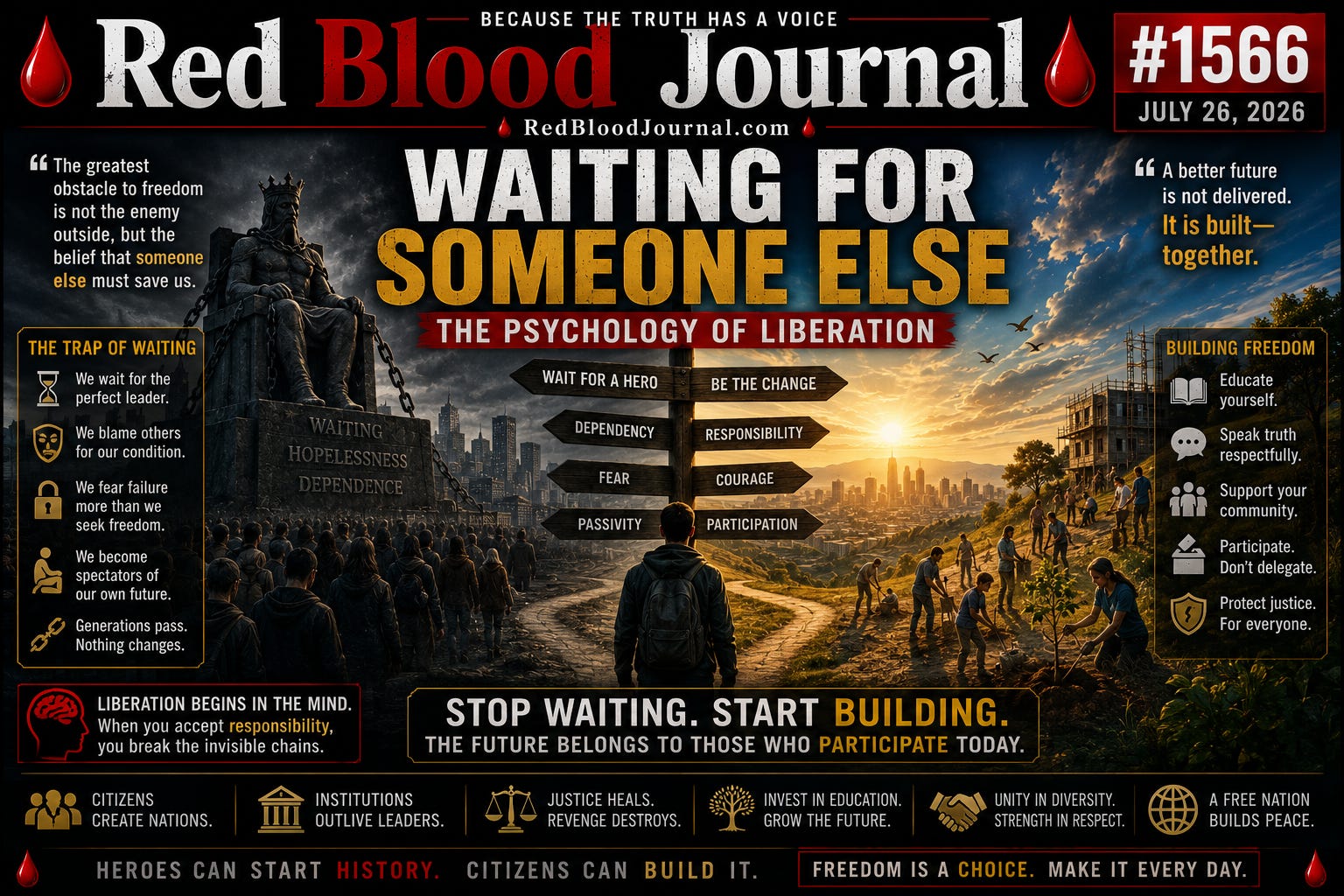
#1566 — Waiting for Someone Else
The Psychology of Liberation
🩸 RedBloodJournal.com 🩸
Throughout history, civilizations have often waited for a single person.
A king.
A prophet.
A revolutionary.
A general.
A president.
A philosopher.
A hero.
Human beings have long searched for someone who would arrive, solve the problems, defeat the enemy, remove corruption, and restore justice.
Sometimes such individuals appeared.
Sometimes they changed history.
But perhaps history also asks another question.
What if the greatest obstacle to freedom is waiting for someone else to deliver it?
The Hero Story
Nearly every culture tells stories about heroes.
The lone warrior.
The wise leader.
The fearless reformer.
The great liberator.
These stories inspire courage.
They also carry a hidden danger.
If one person is expected to rescue everyone, then everyone else may quietly accept becoming spectators.
History becomes something watched instead of something lived.
The Comfort of Waiting
Waiting can feel safer than acting.
If another person succeeds, everyone benefits.
If another person fails, the responsibility belongs to them.
Waiting removes risk.
It also removes participation.
Entire generations can spend decades expecting that tomorrow’s leader will solve problems that today’s citizens quietly avoid confronting.
Freedom Begins Before Victory
Many people imagine that freedom starts after a political transformation.
History often suggests the opposite.
Freedom begins when individuals accept responsibility before circumstances become ideal.
Long before elections.
Long before constitutions change.
Long before governments rise or fall.
Freedom first appears within the decisions ordinary people make every day.
Honesty.
Responsibility.
Respect.
Curiosity.
Integrity.
No government can permanently create these qualities.
No government can permanently eliminate them.
The Invisible Prison
Not every prison has walls.
Some exist only in the mind.
Fear.
Hopelessness.
Dependency.
The belief that individual actions no longer matter.
These invisible prisons often survive even after physical chains disappear.
Political liberation without psychological liberation may simply exchange one dependency for another.
The scenery changes.
The habits remain.
Learned Dependence
Psychologists have long studied situations in which repeated failure causes individuals to stop attempting change, even when opportunities later appear.
Communities may experience similar patterns.
After years of believing that nothing changes, participation declines.
People stop voting.
Stop questioning.
Stop imagining alternatives.
Eventually, they no longer require censorship.
They censor themselves.
The habit becomes stronger than the restriction.
Building Citizens, Not Followers
Every successful society eventually faces a choice.
Does it educate followers?
Or does it educate citizens?
Followers wait for instruction.
Citizens accept responsibility.
Followers ask:
Who will lead us?
Citizens ask:
How can we contribute?
One builds dependency.
The other builds resilience.
The Psychology of Responsibility
Responsibility often appears less exciting than revolution.
It receives fewer headlines.
Yet civilizations are sustained not by moments of excitement but by millions of ordinary acts performed honestly every day.
Teachers teaching.
Engineers building.
Doctors healing.
Parents raising children.
Neighbors helping one another.
These quiet actions create the foundation upon which freedom survives.
Preparing Before the Change
History repeatedly demonstrates that political transformation succeeds most often where citizens have already begun preparing themselves.
Learning.
Debating respectfully.
Creating local organizations.
Supporting independent institutions.
Developing professional expertise.
Building trust.
The future is strongest when preparation begins before opportunity arrives.
The Mirror
Every generation eventually looks into history searching for someone to blame.
History quietly places a mirror in return.
The mirror asks a different question.
What kind of citizen did you become while waiting for better leaders?
Did you strengthen your community?
Did you protect truth?
Did you help those around you?
Did you prepare the next generation?
Or did you simply wait?
History remembers leaders.
Civilization is built by citizens.
Liberation of the Mind
Perhaps the first revolution every nation must experience is invisible.
The realization that responsibility cannot be permanently delegated.
Governments matter.
Institutions matter.
Leaders matter.
But none can permanently replace the daily choices made by millions of ordinary people.
The strongest societies emerge when citizens understand that they are participants rather than spectators.
Final Thoughts
Every generation dreams of a better future.
Some wait for it.
Others prepare for it.
The difference is profound.
Waiting places hope in another person.
Preparation places hope within ourselves.
Perhaps the greatest act of liberation is not removing a government.
It is removing the belief that someone else must always rescue us.
For the strongest nation is not one blessed with extraordinary leaders.
It is one filled with ordinary citizens who no longer wait for heroes before deciding to become responsible human beings themselves.
The morning freedom truly begins is the morning a people stop asking,
“Who will save us?”
and begin asking,
“How shall we build together?”
Subject: Waiting for Someone Else — The Psychology of Liberation
Tags: Psychology, Freedom, Responsibility, Citizenship, Society, Democracy, Leadership, Nation Building, Human Nature, Red Blood Journal
🩸 RedBloodJournal.com 🩸
🩸🌊✨ Fantastic!
🪞
🪞 The Psychology of Liberation:
From Spectators to Citizens
Jul 27, 2026
The provided text argues that the true attainment of liberty depends on individual psychological liberation rather than the arrival of a heroic leader. It explores the danger of learned dependence, where citizens become passive spectators who wait for a savior instead of taking personal responsibility for their society. By shifting from a mindset of following to one of active citizenship, people can break internal chains of hopelessness and fear. The author suggests that meaningful change begins with daily acts of integrity and preparation before any political transformation occurs. Ultimately, the source posits that a nation’s strength is found when ordinary people stop asking to be saved and instead choose to build together.


