


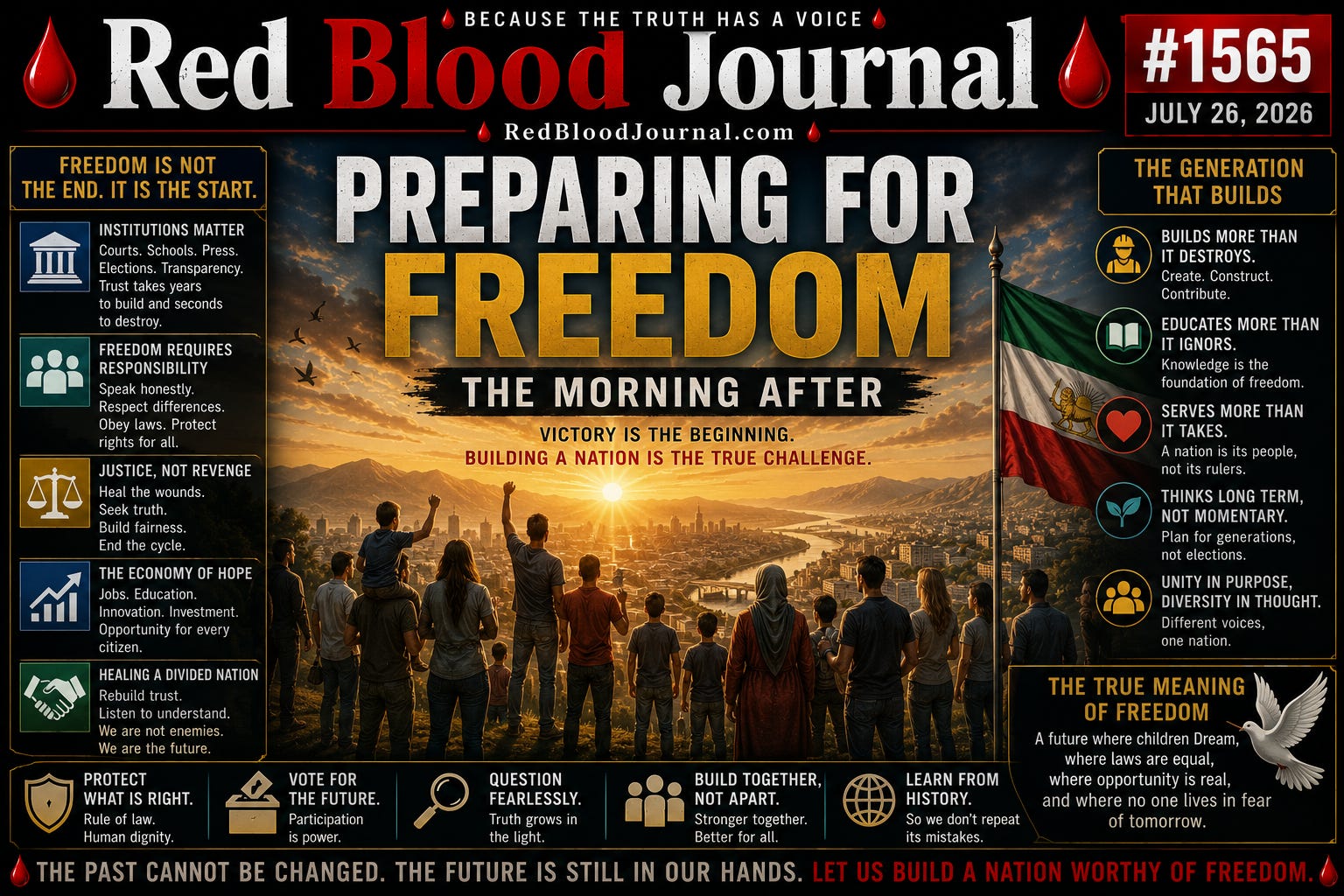
#1565 — Preparing for Freedom
The Morning After
🩸 RedBloodJournal.com 🩸
History often celebrates the day a government falls.
Crowds gather.
Flags appear.
Statues come down.
Prison gates open.
The world watches the moment.
Yet history teaches another lesson.
Removing a government is one event.
Building a nation is another.
The first may take days.
The second may take generations.
The true test of freedom begins the morning after.
Victory Is Not the Destination
Many revolutions begin with extraordinary unity.
People from different backgrounds stand together because they share a common objective.
Once that objective is achieved, a more difficult question appears.
Now what?
History shows that many revolutions succeed in removing an old system only to struggle with creating a better one.
The excitement of victory must eventually give way to the discipline of rebuilding.
Institutions Matter
Roads can be repaired.
Buildings can be rebuilt.
Bridges can be reconstructed.
Institutions require something far more difficult.
Trust.
Courts.
Schools.
Universities.
Independent journalism.
Professional civil services.
Transparent financial systems.
Fair elections.
Local government.
Each takes years to develop.
None can simply be declared into existence.
Freedom Requires Responsibility
Many people imagine freedom as the absence of restriction.
History suggests another definition.
Freedom is the opportunity to accept responsibility.
To speak honestly.
To respect differences.
To obey laws that apply equally to everyone.
To protect the rights of people whose opinions differ from our own.
Freedom survives only when citizens choose to protect it.
Revenge or Justice?
Every nation emerging from conflict eventually faces a difficult choice.
Revenge.
Or justice.
Revenge satisfies emotion.
Justice strengthens institutions.
Revenge often creates another cycle of conflict.
Justice creates confidence that disputes can be resolved without violence.
The future depends upon which path becomes stronger.
The Temptation of New Power
History repeatedly warns that those who overthrow concentrated power may later become attracted to it themselves.
The slogans change.
The flags change.
The faces change.
The temptation remains the same.
Every new government eventually asks itself:
Are we serving the people?
Or
Are the people serving us?
The answer determines whether history repeats itself.
The Economy of Hope
Political freedom alone cannot rebuild a nation.
Employment.
Investment.
Education.
Agriculture.
Industry.
Healthcare.
Transportation.
Technology.
Small businesses.
Innovation.
These become the foundations of long-term stability.
People require more than promises.
They require opportunity.
Healing a Divided Nation
Every prolonged political conflict leaves wounds.
Families become divided.
Communities lose trust.
Neighbors stop speaking.
Healing cannot be commanded by law.
It develops slowly through fairness, honesty, accountability, and equal treatment.
Nations heal when citizens begin seeing one another not as permanent enemies but as fellow builders of a shared future.
Learning From History
History provides many examples.
Some nations emerged from dictatorship and built durable democratic institutions.
Others exchanged one authoritarian system for another.
The difference often depended less upon the moment of victory than upon the quality of preparation before victory.
The future is easier to build when it has already been imagined.
The Generation That Builds
Every revolution has two generations.
The generation that changes history.
And the generation that builds it.
The builders rarely receive the same attention.
Yet they create the schools.
The businesses.
The scientific discoveries.
The legal systems.
The infrastructure.
The prosperity.
History remembers the revolution.
Civilization remembers the builders.
Beyond Politics
No nation can live permanently through politics alone.
Eventually citizens wish to return to ordinary life.
Families.
Education.
Work.
Art.
Music.
Science.
Business.
Friendship.
These quiet achievements often strengthen nations more than political speeches ever can.
The Real Meaning of Freedom
Freedom is not measured only by the ability to vote.
It is measured by confidence that tomorrow can become better than today.
That effort will be rewarded.
That laws apply equally.
That children may dream without fear.
That disagreement does not require hatred.
That government belongs to the people rather than the people belonging to government.
Final Thoughts
The morning after every great political transformation becomes the first page of another history book.
The old chapter has ended.
The new one has not yet been written.
That blank page belongs to ordinary citizens far more than to politicians.
They will decide whether institutions become stronger than personalities.
Whether justice becomes stronger than revenge.
Whether opportunity becomes stronger than fear.
Whether future generations inherit peace instead of repeating conflict.
Perhaps the greatest victory is not the fall of one government.
It is the successful birth of a society where no future generation feels compelled to repeat the same struggle.
May every nation preparing for freedom remember that lasting prosperity is built not only by removing what was broken, but by patiently creating what has never existed before.
Subject: Preparing for Freedom — The Morning After
Tags: Freedom, Democracy, Nation Building, Iran, Political Transition, Justice, Institutions, Civil Society, History, Red Blood Journal
🩸 RedBloodJournal.com 🩸
🩸🌊✨ Fantastic!
🏗️
🏗️ Architects of the Morning After
Jul 27, 2026
The provided text emphasizes that toppling a regime is merely the first step toward achieving a sustainable society, as the true challenge lies in the arduous process of nation-building. Lasting liberty requires the establishment of trusted institutions, such as fair courts and transparent financial systems, which cannot be created overnight. The author argues that true freedom is defined by civic responsibility and the choice of impartial justice over emotional revenge. Success depends on transitioning from the initial excitement of revolution to the disciplined reconstruction of infrastructure, education, and the economy. Ultimately, a country’s future is secured when citizens prioritize long-term stability and mutual cooperation over the allure of new political power. Real victory is achieved only when a society creates a durable peace that prevents future generations from needing to repeat the same struggle.


