


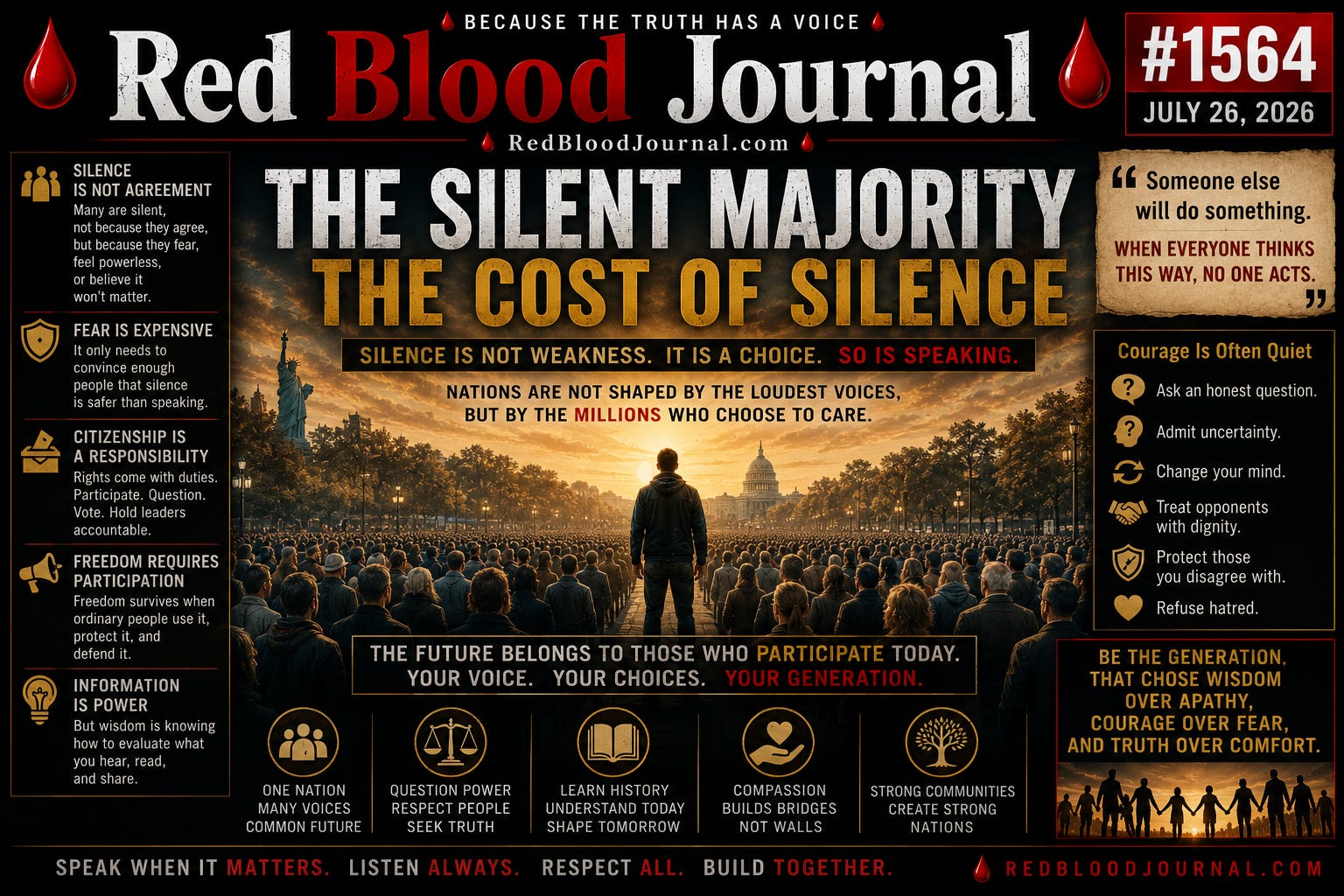
#1564 — The Silent Majority
The Cost of Silence
🩸 RedBloodJournal.com 🩸
History often remembers the names of kings.
Generals.
Presidents.
Revolutionaries.
Yet history is lived by millions whose names are never recorded.
Farmers.
Teachers.
Mechanics.
Doctors.
Parents.
Workers.
Students.
They form what is often called the silent majority.
Not because they have no opinions.
But because most simply wish to live peaceful lives.
Raise families.
Build careers.
Protect those they love.
The question history repeatedly asks is this:
What happens when the majority remains silent while a determined minority shapes the future?
Silence Is Not Agreement
One of history’s greatest misunderstandings is assuming that silence means consent.
Sometimes people remain silent because they agree.
Sometimes because they fear consequences.
Sometimes because they believe speaking will accomplish nothing.
Sometimes because survival feels more important than confrontation.
Silence has many causes.
History often records only the outcome.
The Weight of One Voice
Every significant social change began with very few people.
A scientist challenging accepted knowledge.
A journalist publishing uncomfortable facts.
A philosopher asking forbidden questions.
A citizen refusing to accept injustice.
At the beginning, they usually appeared insignificant.
Only later did history recognize their influence.
The majority often joins after the danger has already passed.
Fear Is Expensive
Governments understand fear.
Corporations understand fear.
Religions understand fear.
Armies understand fear.
Fear rarely needs to imprison every citizen.
It only needs to convince enough people that speaking carries greater risk than remaining silent.
When fear becomes normal, silence becomes ordinary.
When silence becomes ordinary, power often grows without resistance.
The Responsibility of Citizenship
Every society grants rights.
Every society also depends upon responsibilities.
Voting.
Learning.
Questioning.
Participating.
Helping neighbors.
Respecting differences.
Protecting lawful institutions.
Holding leaders accountable.
Citizenship is more than receiving benefits.
It is participating in the maintenance of society itself.
Waiting for Someone Else
Perhaps the most common sentence in history has never been written.
Someone else will do something.
Someone else will speak.
Someone else will investigate.
Someone else will solve the problem.
When millions think this way simultaneously, no one acts.
Leadership does not always fail because leaders become corrupt.
Sometimes leadership fails because good people quietly withdraw from public life.
Freedom Requires Participation
Freedom is often imagined as something governments grant.
History suggests another possibility.
Freedom survives because citizens continuously exercise it.
Speaking respectfully.
Listening honestly.
Questioning peacefully.
Accepting disagreement.
Protecting the rights of opponents as carefully as those of friends.
Freedom unused gradually weakens.
The Gray Majority
Public discussion often divides society into two loud extremes.
One side.
The other side.
Reality is usually different.
Most people occupy the middle.
They work.
Raise children.
Care for aging parents.
Pay bills.
Dream about better futures.
They rarely dominate headlines.
Yet they determine elections.
Markets.
Communities.
And ultimately the direction of nations.
Information and Responsibility
Modern technology has transformed communication.
Every individual now possesses the ability to publish ideas to audiences that previous generations could scarcely imagine.
This creates extraordinary opportunity.
It also creates responsibility.
Information can educate.
It can mislead.
It can unite.
It can divide.
The challenge is no longer merely obtaining information.
It is learning how to evaluate it carefully.
Courage Is Often Quiet
History frequently celebrates dramatic acts of courage.
Sometimes courage appears much smaller.
Asking an honest question.
Admitting uncertainty.
Changing one’s opinion after discovering new evidence.
Treating opponents with dignity.
Refusing hatred.
Protecting someone with whom one disagrees.
Quiet courage often sustains civilization more effectively than loud anger.
The Cost of Silence
Every generation eventually faces moments when remaining silent appears easier than speaking.
Some choose silence.
Some choose participation.
Neither choice remains private forever.
Each gradually shapes the society inherited by the next generation.
Silence has consequences.
So do words.
Wisdom lies in knowing when each serves the greater good.
Final Thoughts
The silent majority possesses extraordinary influence.
Not because it shouts louder than everyone else.
Because it is larger than everyone else.
History repeatedly demonstrates that civilizations change when ordinary people decide their voices matter.
Not through violence.
Not through hatred.
But through thoughtful participation.
Respectful dialogue.
Personal responsibility.
And the quiet courage to remain truthful even when truth is unpopular.
The strongest nation is not the one with the loudest voices.
It is the one where ordinary citizens understand that freedom is not a gift permanently received.
It is a responsibility continually renewed.
May every generation discover that silence has its place, but wisdom knows when conscience must speak.
Subject: The Silent Majority — The Cost of Silence
Tags: Society, Democracy, Freedom, Civic Responsibility, Leadership, Citizenship, Public Participation, History, Conscience, Red Blood Journal
🩸 RedBloodJournal.com 🩸
🩸🌊✨ Fantastic!
🗣️
🗣️ The Cost of Silence and the Weight of Participation
Jul 27, 2026
This text explores the critical influence of the “silent majority” and the hidden dangers associated with widespread public withdrawal. While many people remain quiet to seek peace or avoid risk, the author argues that civic participation is essential to prevent a determined minority from unchecked control. True freedom and democracy are presented not as permanent gifts, but as active responsibilities that require individuals to engage in honest dialogue and hold leaders accountable. The passage emphasizes that quiet courage, such as questioning misinformation or treating opponents with dignity, is what ultimately sustains a healthy civilization. Ultimately, the source serves as a call for ordinary citizens to recognize that their collective voice is the most powerful force in shaping a nation’s future.


