


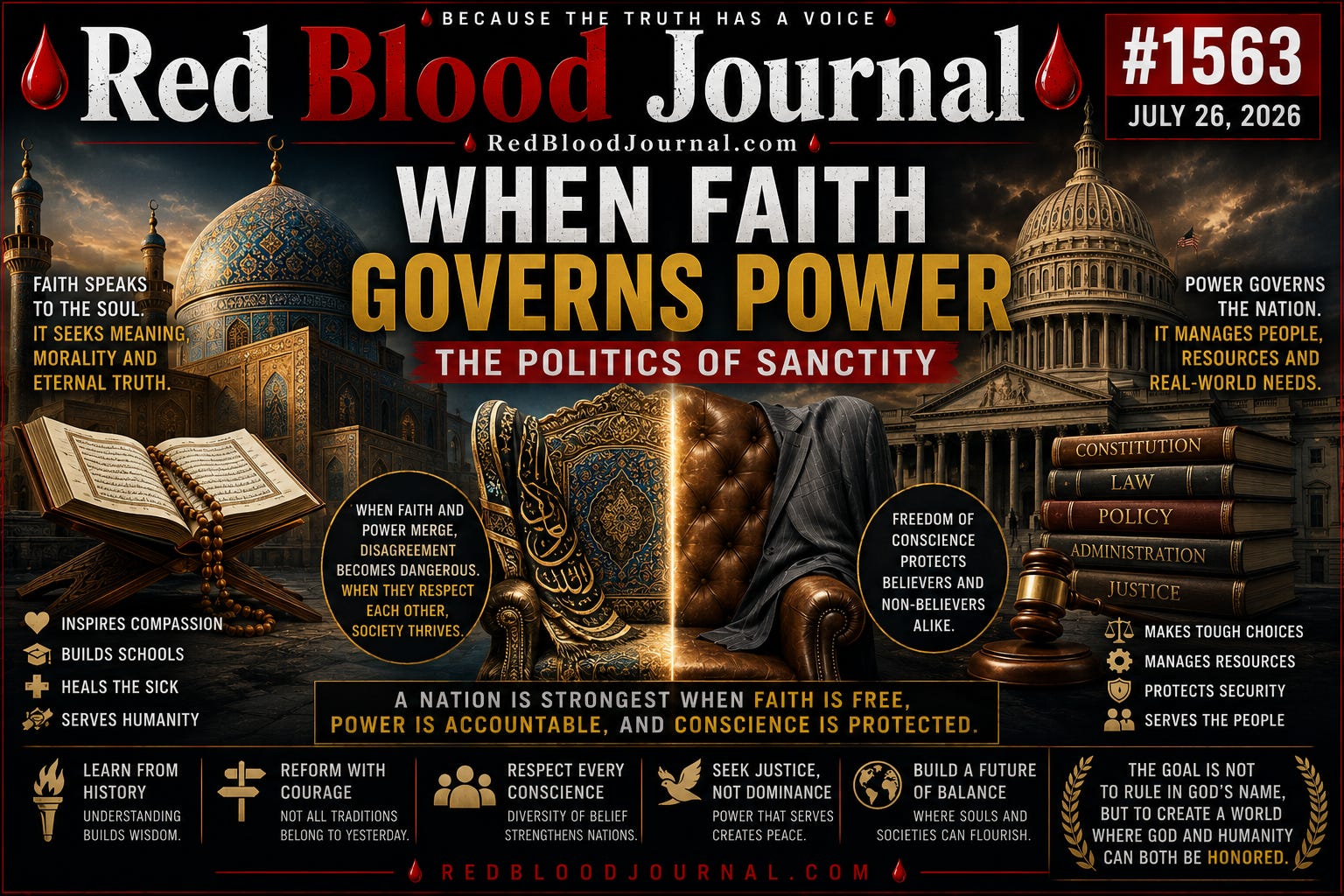
#1563 — When Faith Governs Power
The Politics of Sanctity
🩸 RedBloodJournal.com 🩸
Throughout history, nearly every civilization has wrestled with the same question.
Who should rule?
The warrior?
The king?
The philosopher?
The elected representative?
Or the one believed to speak on behalf of God?
The answer has shaped empires.
It has inspired extraordinary acts of compassion.
It has also justified wars, persecution, and revolutions.
Perhaps the question itself has never disappeared.
It has merely worn different clothing throughout history.
The Language of Heaven
Religion speaks a language unlike politics.
Politics negotiates.
Religion proclaims.
Politics accepts compromise.
Religion often speaks in absolutes.
Politics measures success in years.
Religion frequently measures success in eternity.
Neither language is inherently wrong.
They were simply created for different purposes.
One governs society.
The other seeks to guide the human soul.
When Two Worlds Become One
History shows recurring moments when religious institutions gained political authority.
Sometimes this occurred because kings sought legitimacy.
Sometimes because religious leaders believed political power could better protect moral values.
Sometimes because revolutions removed one authority and replaced it with another.
The result was often the same.
Government began borrowing the authority of faith.
Faith began carrying the responsibilities of government.
The line between the two became increasingly difficult to see.
Sacred Authority
Governments normally derive authority from constitutions, laws, elections, hereditary succession, military control, or other political arrangements.
Religious authority is different.
Its legitimacy often comes from sacred texts, traditions, scholarship, and the confidence of believers.
When these two forms of authority become united, disagreement changes character.
Political disagreement may be interpreted as moral disagreement.
Administrative criticism may be viewed as criticism of sacred principles.
The discussion itself becomes more difficult.
The Strength of Belief
Faith has inspired remarkable achievements.
Hospitals.
Schools.
Charities.
Universities.
Works of art.
Music.
Architecture.
Acts of courage.
Countless individuals have sacrificed personal comfort to help others because of deeply held religious convictions.
History cannot honestly describe religion without recognizing its enormous contribution to civilization.
The question is not whether faith possesses value.
The question is whether governing millions of people requires different tools than guiding individual conscience.
The Burden of Government
Government must solve practical problems.
Budgets.
Transportation.
Healthcare.
Trade.
Defense.
Infrastructure.
Agriculture.
Justice.
Disaster response.
Every decision produces winners and losers.
Compromise becomes unavoidable.
No government satisfies every citizen.
Politics lives within imperfection.
The Burden of Religion
Religion asks different questions.
Why are we here?
How should we treat one another?
What is justice?
What gives life meaning?
How should human beings respond to suffering?
These questions rarely have simple administrative answers.
They belong to philosophy, spirituality, and conscience.
When governments inherit these questions, they often discover that political institutions cannot answer them completely.
The Risk of Fusion
When political authority and religious authority become inseparable, each inherits the weaknesses of the other.
Political mistakes may weaken confidence in religious institutions.
Religious disagreements may become national political disputes.
Changes in government may influence public attitudes toward faith itself.
The institutions become connected.
Their successes become shared.
So do their failures.
History’s Many Examples
History offers many different models.
Some societies placed religion entirely under government.
Others placed government under religion.
Some attempted cooperation.
Others adopted institutional separation while protecting religious freedom.
Each model reflected its own historical circumstances.
Each produced different strengths and different challenges.
No civilization has entirely escaped the tension between spiritual authority and political authority.
Freedom of Conscience
One principle has appeared repeatedly across many modern constitutional systems.
Every individual should remain free to believe.
Or not believe.
To worship.
Or not worship.
Without fear of political punishment.
Freedom of conscience protects believers.
It also protects those who hold different convictions.
Faith chosen freely often possesses greater strength than faith imposed by authority.
The Nation and the Soul
A nation governs territory.
A religion often speaks to the individual soul.
The nation asks for obedience to law.
Faith often asks for transformation of character.
One organizes society.
The other seeks to transform the individual from within.
Confusing these two responsibilities may burden both.
Looking Forward
Every generation inherits institutions built by previous generations.
Some deserve preservation.
Others deserve reform.
The purpose of history is not to condemn the past.
It is to understand how present realities emerged.
Only then can future generations decide which traditions should continue, which should evolve, and which no longer serve the society they hope to build.
Final Thoughts
The relationship between faith and government will likely remain one of humanity’s oldest conversations.
It is unlikely ever to disappear.
For many people, faith provides meaning beyond politics.
For governments, practical administration requires decisions affecting citizens of many beliefs.
Perhaps the greatest challenge is preserving both.
A society where faith remains free.
Government remains accountable.
Conscience remains protected.
And neither seeks absolute control over the other.
The strongest civilization may not be the one where religion rules politics or politics rules religion.
It may be the one where both inspire humanity to become wiser, more compassionate, and more respectful of the dignity that belongs to every individual.
For when power serves the people, and faith serves the soul, both become stronger without needing to dominate the other.
Subject: When Faith Governs Power — The Politics of Sanctity
Tags: Religion, Government, Politics, History, Iran, Faith, Political Philosophy, Freedom of Conscience, Civilization, Red Blood Journal
🩸 RedBloodJournal.com 🩸
🩸🌊✨ Fantastic!
⚖️
⚖️ The Politics of Sanctity: Faith and the State
Jul 27, 2026
The provided text explores the historical and philosophical tension between religious authority and political governance. It highlights how faith focuses on the soul and absolute truths, while government manages practical societal needs through compromise and law. When these two spheres merge, the author argues that political failures can damage spiritual credibility, and religious disputes can destabilize the state. The narrative emphasizes that freedom of conscience is vital for protecting both the believer and the integrity of the nation. Ultimately, the source suggests that society flourishes most when power and sanctity remain distinct, allowing each to serve its unique purpose without seeking to dominate the other.


