


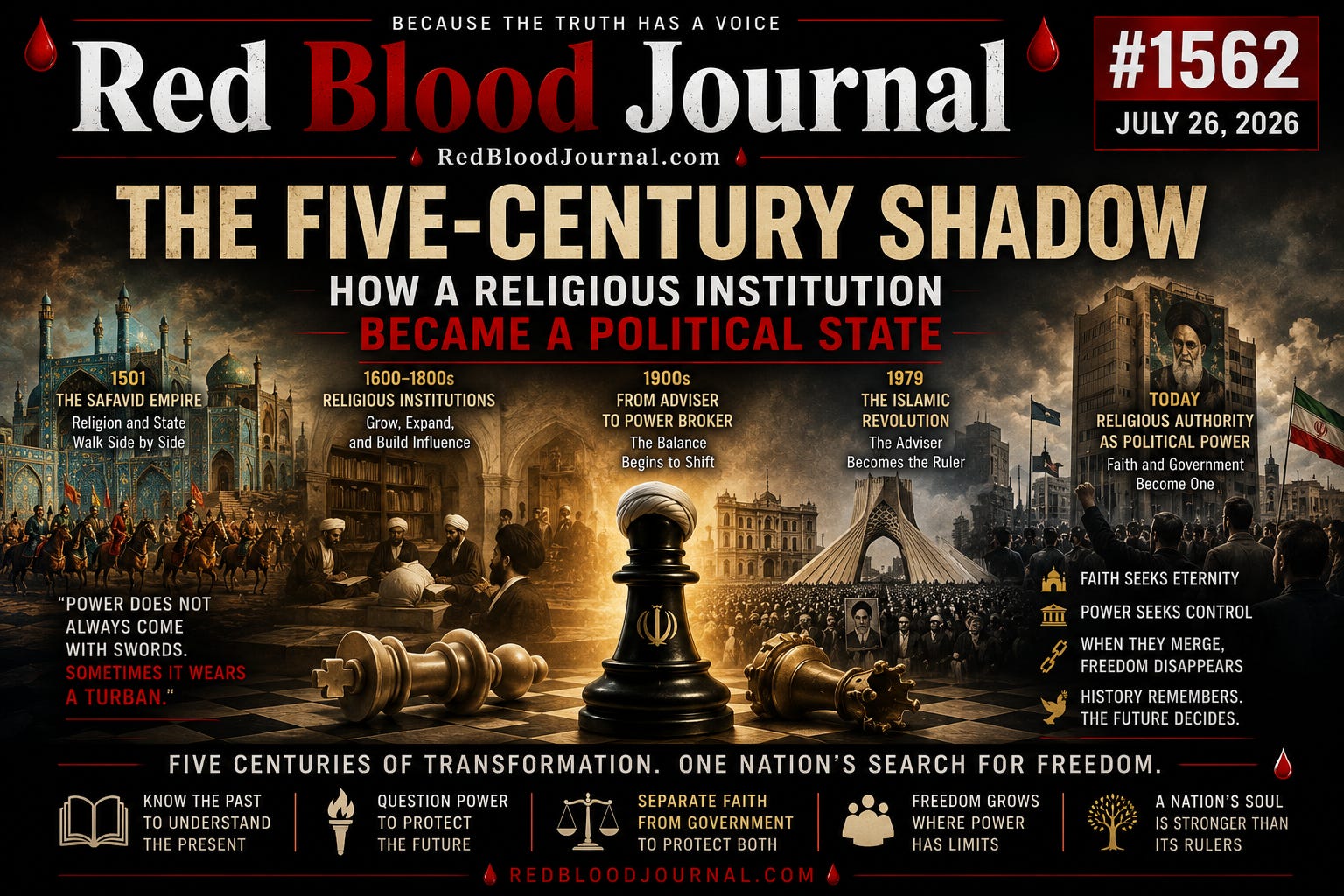
#1562 — The Five-Century Shadow
How a Religious Institution Became a Political State
🩸 RedBloodJournal.com 🩸
History rarely changes direction overnight.
Most civilizations are shaped by ideas that begin almost unnoticed.
A teacher gathers a handful of students.
A scholar writes a book.
A ruler grants influence to a trusted advisor.
A tradition slowly becomes an institution.
An institution gradually becomes authority.
Authority eventually becomes power.
Power often begins to believe it was always meant to rule.
Perhaps that is the story of many civilizations.
Perhaps it is also one way to understand five centuries of Iranian history.
Before the Throne
Religious scholars have existed throughout human history.
In almost every civilization they have advised kings, interpreted laws, preserved traditions, and guided communities.
Most remained beside power.
Few attempted to become power.
History often shows a delicate balance between spiritual authority and political authority.
When those two remain separate, each limits the other.
When they merge, both begin to change.
Religion begins speaking the language of politics.
Politics begins speaking the language of heaven.
A Turning Point
During the Safavid period, Twelver Shi’ism became the official religion of Persia.
To build new religious institutions, scholars from regions including Jabal Amel in present-day southern Lebanon were invited to Persia.
They helped establish religious schools, legal traditions, and theological institutions that became increasingly influential over the centuries.
At first, these institutions existed alongside political authority.
The king ruled.
The scholars advised.
Each occupied a different chair.
History would eventually ask whether those chairs could remain separate forever.
The Slow Transfer of Power
Power rarely changes hands in a single moment.
It moves gradually.
One generation expands influence.
The next builds institutions.
Another acquires wealth.
Another develops independent authority.
Eventually an institution no longer depends upon the throne.
The throne begins depending upon the institution.
The relationship quietly reverses.
When that happens, many observers fail to notice.
The buildings appear the same.
The ceremonies continue.
The titles remain familiar.
Only the direction of power has changed.
From Adviser to Ruler
For centuries, religious authority and political authority lived beside one another.
Sometimes they cooperated.
Sometimes they competed.
Eventually, following the Iranian Revolution of 1979, political leadership became inseparable from religious legitimacy within the structure of the Islamic Republic.
The adviser had become the ruler.
What had once offered guidance now carried executive authority.
The institution that once interpreted political decisions now possessed the power to make them.
History had completed a journey measured not in years, but in centuries.
When Faith Meets Government
Faith and government pursue different objectives.
Faith often speaks to eternity.
Government must solve tomorrow morning’s problems.
Faith asks how people should live.
Government asks how millions of people can live together despite disagreeing.
One searches for absolute truth.
The other often survives through compromise.
When these responsibilities become united, each begins carrying burdens it was never originally designed to bear.
Political failures may become interpreted as religious failures.
Religious disagreement may become political opposition.
Criticism of government may be viewed as criticism of faith itself.
The distinction slowly disappears.
The Weight of Sacred Authority
Political systems normally expect criticism.
Governments change.
Parties lose elections.
Policies fail.
Mistakes are corrected.
Religion functions differently.
Many believers view sacred teachings as permanent rather than temporary.
When governments borrow sacred authority to strengthen political power, ordinary political disagreement may acquire moral or theological significance.
Support becomes virtue.
Opposition becomes more complicated.
The language of politics gradually changes.
So does the language of religion.
The Shadow Across Generations
Five hundred years is longer than the lifespan of any government.
Longer than any constitution.
Longer than any political party.
Ideas surviving for centuries reshape cultures far more deeply than elections.
Children inherit traditions they did not create.
Parents defend institutions they themselves inherited.
Eventually many people can no longer distinguish between history and nature.
The existing order simply appears normal.
The shadow becomes invisible because it has always been there.
Can History Change Direction?
History suggests that it can.
Every civilization has experienced moments when long-established institutions were questioned.
Some adapted peacefully.
Others resisted.
Some collapsed.
Some reformed.
The future is never guaranteed by the past.
But neither is it completely separated from it.
Understanding how institutions developed helps societies understand what may need to change—and what should be preserved.
Separating Faith from Power
Separating religion from government does not require rejecting religion.
Nor does it require abandoning moral values.
Many democratic societies protect both religious freedom and political freedom simultaneously.
Citizens may believe deeply.
They may worship freely.
They may disagree peacefully.
Government protects those freedoms rather than defining them.
Faith becomes a personal conviction rather than a political requirement.
In such a system, belief is strengthened by freedom rather than enforced by authority.
The Shadow and the Light
Every civilization inherits shadows.
Some are created by conquest.
Some by empire.
Some by ideology.
Some by fear.
But shadows exist only where light also exists.
Understanding history does not imprison the future.
It illuminates it.
The purpose of studying five centuries is not to assign permanent blame.
It is to recognize long patterns before repeating them.
Final Thoughts
Perhaps the greatest lesson of history is that institutions are created by human beings.
What human beings build, human beings can improve.
The strongest nations are not those that refuse to examine their past.
They are those willing to learn from it.
Five centuries may explain how one political system emerged.
They do not dictate what the next five centuries must become.
Every generation receives history.
Every generation also writes history.
May future generations build societies where faith remains free, government remains accountable, and neither seeks to dominate the other.
For when spiritual conviction grows from freedom rather than political power, both the soul and the nation stand on stronger foundations.
Subject: The Five-Century Shadow — How a Religious Institution Became a Political State
Tags: Iran, Persian History, Safavid Empire, Jabal Amel, Shi’a Islam, Political History, Religion and State, Islamic Republic, Governance, Red Blood Journal
🩸 RedBloodJournal.com 🩸
🩸🌊✨ Fantastic!
⚖️
The Five-Century Shadow:
From Faith to State Authority
Jul 26, 2026
This text examines the five-century evolution of Iran’s governance, tracing the gradual transformation of religious institutions into a centralized political state. It details how the Safavid era initiated a merger between faith and authority, eventually leading to the 1979 Revolution where spiritual advisors officially became executive rulers. The author explores the complex consequences of uniting sacred legitimacy with government power, noting that such a union often turns political dissent into a theological conflict. By highlighting the historical shift from two separate spheres of influence to a singular entity, the narrative illustrates how inherited traditions shape modern national identity. Ultimately, the source advocates for the separation of religion and state to ensure both personal freedom and government accountability.


