


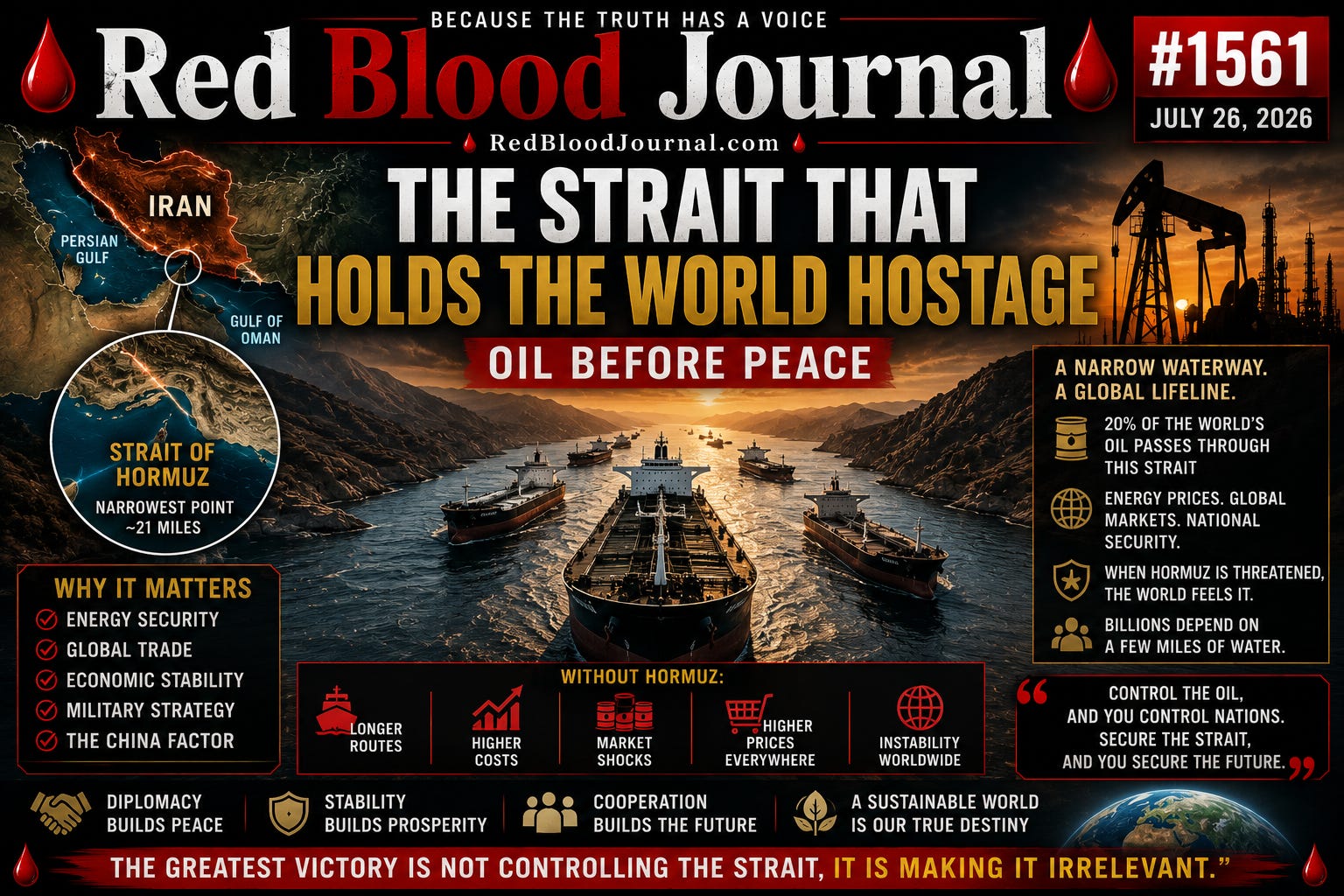
#1561 — The Strait That Holds the World Hostage
Oil Before Peace
🩸 RedBloodJournal.com 🩸
Throughout history, civilizations have depended upon something that keeps everything moving.
Wood.
Coal.
Steam.
Electricity.
Oil.
Today, despite rapid advances in renewable energy, petroleum remains one of the foundations of the global economy.
It fuels aircraft.
Ships.
Military vehicles.
Factories.
Agriculture.
Emergency services.
The transportation of nearly every product that reaches a store shelf.
And much of that energy passes through one remarkably narrow waterway.
The Strait of Hormuz.
A Narrow Passage with Global Consequences
At its narrowest navigable shipping lanes, the Strait of Hormuz is only a few miles wide in each direction.
Yet every day, millions of barrels of crude oil and petroleum products move through this maritime corridor.
It connects the Persian Gulf to the Gulf of Oman and ultimately to the Indian Ocean.
Without it, energy must find longer, more expensive alternatives.
Few places on Earth possess so much influence while occupying so little physical space.
Geography Creates Leverage
Some nations possess vast natural resources.
Others possess geography.
Iran possesses both.
Its coastline overlooks one side of the Strait of Hormuz.
That geographic reality exists regardless of which government occupies Tehran.
Empires have changed.
Kings have disappeared.
Governments have risen and fallen.
The coastline has remained exactly where nature placed it.
Geography often outlives politics.
Oil Is More Than Fuel
Many people think of oil simply as gasoline.
Modern civilization depends upon far more than fuel.
Petrochemicals help produce:
Plastics
Medical equipment
Fertilizers
Pharmaceuticals
Electronics
Synthetic clothing
Paints
Lubricants
Packaging
Aviation fuel
Interruptions in energy markets therefore influence almost every industry.
Oil prices affect transportation.
Transportation affects food.
Food affects inflation.
Inflation affects politics.
Everything becomes connected.
The World’s Insurance Policy
The Strait of Hormuz is not only about oil.
It is about confidence.
Shipping companies.
Insurance firms.
Commodity traders.
Governments.
Financial markets.
All attempt to calculate risk.
Sometimes the threat of disruption influences markets almost as much as actual disruption.
A rumor can move prices.
A military exercise can raise insurance costs.
An exchange of threats can influence global investment.
Confidence has economic value.
The Military Dimension
For decades, major naval powers have maintained a presence near the Persian Gulf.
Not simply because of one nation.
Because of one waterway.
Freedom of navigation has become a strategic objective for many countries that depend upon uninterrupted global commerce.
Merchant vessels.
Naval escorts.
Reconnaissance aircraft.
Satellite surveillance.
Missile defense.
Each reflects the importance attached to maintaining open sea lanes.
The China Connection
Energy flowing through the Persian Gulf does not travel only westward.
Much moves east.
China has become one of the world’s largest energy consumers.
Japan.
South Korea.
India.
Other Asian economies also depend heavily upon imported energy.
A prolonged disruption in Hormuz would therefore affect manufacturing, transportation, and economic growth across much of Asia.
The consequences would extend far beyond the Middle East.
Why America Watches
Some observers ask why the United States devotes such attention to the Persian Gulf.
One answer lies in the structure of the global economy.
The United States benefits from stable international trade.
Its allies depend upon secure energy supplies.
Global financial markets respond rapidly to energy uncertainty.
Even countries producing their own energy often experience price fluctuations because oil is traded internationally.
Regional instability therefore becomes a global concern.
Oil Before Peace
History sometimes suggests a difficult question.
Which comes first?
Peace?
Or energy security?
Governments often argue that protecting energy supplies helps preserve global stability.
Critics argue that competition over energy has itself contributed to instability.
Both perspectives continue to shape international policy.
The relationship between energy and security remains one of the defining strategic questions of the modern world.
Beyond Oil
The future may gradually reduce dependence upon petroleum.
Electric vehicles.
Nuclear energy.
Hydrogen.
Renewable electricity.
Advanced battery technology.
New transportation systems.
Yet transitions require time.
Even optimistic projections anticipate decades rather than years before oil loses much of its strategic significance.
Until then, waterways like Hormuz remain central to international planning.
The Human Cost
Behind every discussion of oil prices stand ordinary families.
Higher transportation costs.
Higher food prices.
Higher utility bills.
Economic uncertainty.
Lost employment.
Inflation.
Strategic competition ultimately reaches dinner tables.
Citizens often experience geopolitical decisions long before they understand their causes.
Final Thoughts
The Strait of Hormuz demonstrates one of history’s enduring lessons.
Small places sometimes shape great civilizations.
A narrow channel influences continents.
A few miles of water affect billions of people.
Geography grants opportunity.
Human decisions determine whether that opportunity becomes cooperation or confrontation.
Perhaps one day humanity will reduce its dependence upon strategic chokepoints.
Perhaps technology will eventually make energy abundance available to every nation.
Until then, the Strait of Hormuz will remain one of the world’s most closely watched waterways—not because it belongs to one nation, but because its stability affects nearly everyone.
The greatest achievement will not be controlling the Strait.
It will be creating a world where no nation feels compelled to threaten it, and no civilization fears the consequences of peace.
Subject: The Strait That Holds the World Hostage — Oil Before Peace
Tags: Strait of Hormuz, Persian Gulf, Oil, Energy Security, Iran, Global Economy, Shipping, Geopolitics, International Trade, Red Blood Journal
🩸 RedBloodJournal.com 🩸
🩸🌊✨ Fantastic!
🛢️
🛢️ Hormuz: The Geography of Global Leverage
Jul 27, 2026
The Strait of Hormuz serves as a vital artery for the global economy, acting as a narrow but essential corridor for the world’s petroleum and energy supplies. This geographic chokepoint holds immense geopolitical leverage because a disruption there would trigger a massive ripple effect, impacting everything from food prices to international financial stability. While modern nations are transitioning toward renewable energy, the source emphasizes that global commerce still relies heavily on the oil passing through these restricted waters. Consequently, major world powers maintain a constant military and diplomatic presence in the region to ensure freedom of navigation and protect against market volatility. Ultimately, the text illustrates how a small strip of water remains a central focus of international security and a primary driver of global inflation and political strategy.


