


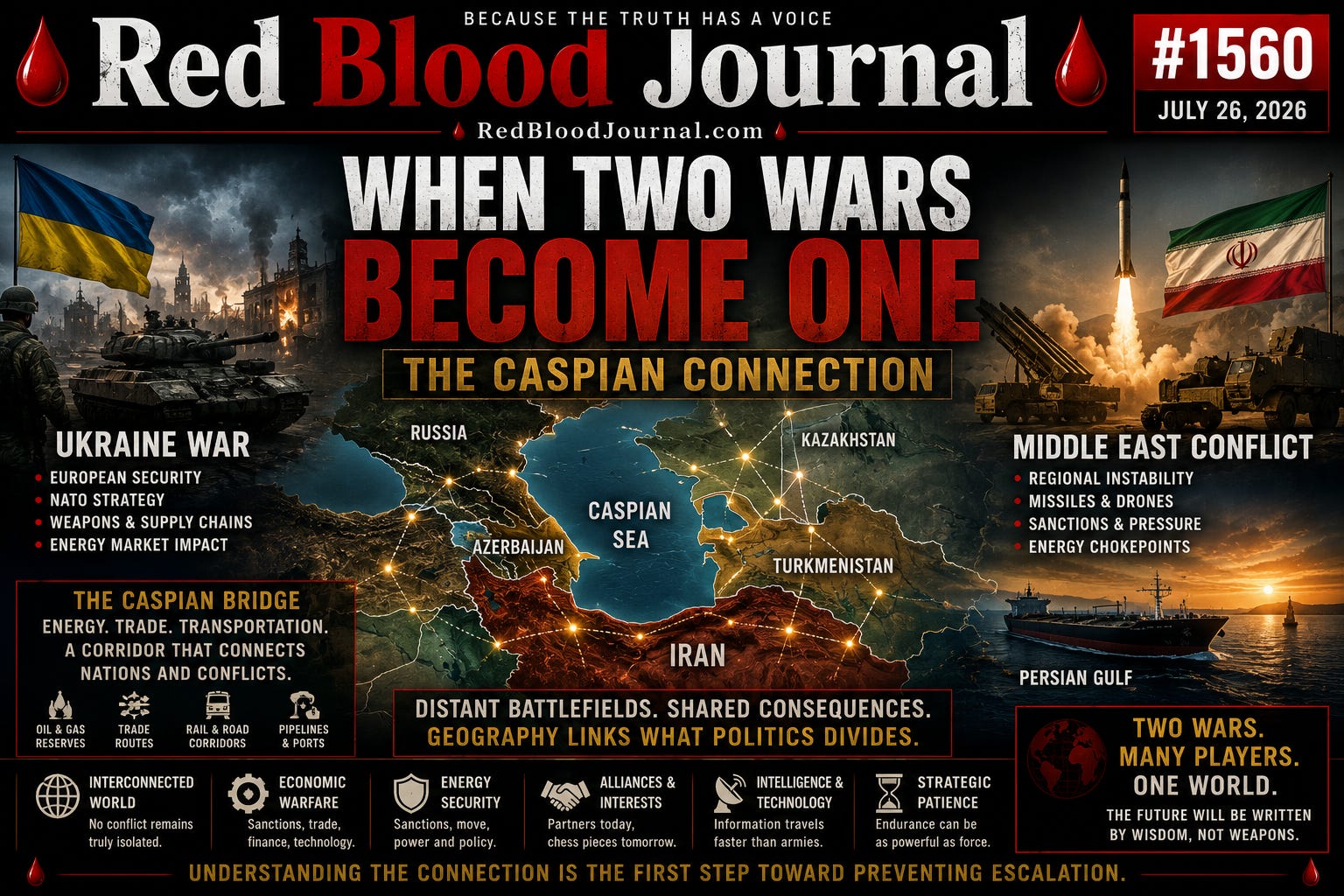
#1560 — When Two Wars Become One
The Caspian Connection
🩸 RedBloodJournal.com 🩸
Wars are often described as separate events.
One begins.
Another ends.
Each receives its own name.
Its own history.
Its own battlefield.
Reality is rarely that simple.
Modern conflicts increasingly overlap.
Weapons developed for one war appear in another.
Economic sanctions imposed for one dispute influence distant regions.
Supply chains cross continents.
Military doctrines spread between allies.
Political decisions made in one capital reshape calculations thousands of miles away.
The world has become less like a collection of separate battlefields and more like a single strategic board.
Beyond Borders
Maps encourage the illusion that conflicts remain confined within national borders.
Reality ignores those lines.
Energy moves across oceans.
Technology crosses continents in seconds.
Financial systems operate continuously.
Military intelligence is shared among allies.
Trade routes connect nations that may never exchange a single shot.
No major conflict remains isolated for long.
Its effects spread through economics, diplomacy, transportation, manufacturing, and global markets.
The Caspian Bridge
Between Eastern Europe and the Middle East lies a body of water that receives far less public attention than the Persian Gulf.
The Caspian Sea.
It borders Russia, Iran, Kazakhstan, Turkmenistan, and Azerbaijan.
For centuries it has served as both a natural barrier and a strategic bridge.
Today it connects energy resources, transportation corridors, and regional security interests that extend well beyond its shoreline.
Its importance is not measured by headlines.
It is measured by what moves across it.
When Ukraine Meets the Middle East
At first glance, Ukraine and Iran appear to belong to different strategic worlds.
Different histories.
Different alliances.
Different wars.
Yet modern geopolitics often links distant conflicts.
Military production.
Economic sanctions.
Drone technology.
Air-defense systems.
Energy exports.
International diplomacy.
Each influences the calculations of governments far beyond its immediate region.
Events in Eastern Europe can alter strategic choices in the Persian Gulf.
Developments in the Middle East can reshape priorities in Europe.
The conflicts remain distinct.
Their consequences increasingly overlap.
Energy and Geography
Energy has long influenced international politics.
Oil.
Natural gas.
Electricity.
Shipping lanes.
Pipelines.
Ports.
Each represents infrastructure that affects nations far beyond the country in which it exists.
The Caspian region contains significant energy resources.
The Persian Gulf remains one of the world’s principal energy corridors.
Together they form part of a much larger network connecting producers, consumers, investors, and governments.
Disruption in one region often influences markets elsewhere.
Modern Alliances
Military alliances today extend beyond traditional treaties.
Governments cooperate through intelligence sharing.
Technology transfers.
Joint military exercises.
Industrial production.
Financial coordination.
Cybersecurity.
Diplomatic support.
Each partnership changes strategic calculations for every other participant.
The world has become increasingly interconnected.
Not every nation fights.
Many influence outcomes without firing a single shot.
Economics as a Battlefield
Modern competition is conducted not only with armies.
It is also conducted through:
Sanctions.
Export controls.
Shipping insurance.
Banking restrictions.
Technology access.
Investment.
Critical minerals.
Industrial manufacturing.
Economic pressure can alter military capability without a battlefield ever changing.
Financial decisions increasingly influence strategic outcomes.
The Invisible Corridors
The public often notices tanks.
Aircraft.
Missiles.
Naval fleets.
Far less visible are the corridors through which food, medicine, electronics, industrial components, fuel, and information travel.
Modern civilizations depend upon uninterrupted logistics.
Protecting these networks has become as important as defending traditional borders.
Strategic Patience
Some governments seek rapid victory.
Others seek endurance.
History demonstrates that prolonged conflicts often become contests of resilience rather than decisive military triumph.
Economic stability.
Industrial production.
Political unity.
Public confidence.
Diplomatic relationships.
Each becomes part of the battlefield.
Victory may depend less upon destroying an opponent than remaining capable of continuing.
Lessons From Interconnection
Perhaps the greatest lesson of the twenty-first century is that no major nation exists entirely alone.
Every economy influences another.
Every conflict produces international consequences.
Every alliance affects governments beyond its membership.
Distance no longer guarantees separation.
Technology has shortened geography.
Economics has connected continents.
Information travels faster than armies.
Final Thoughts
History once separated wars by geography.
Modern history increasingly connects them through infrastructure, economics, technology, and diplomacy.
Understanding one conflict now requires understanding many others.
The Caspian Sea reminds us that geography is more than maps.
It is a network of relationships.
The Persian Gulf reminds us that energy shapes decisions far beyond the region.
Ukraine reminds us that European security influences global stability.
Together they demonstrate a simple reality:
In an interconnected world, two wars can remain different while becoming strategically linked.
The greatest challenge for future generations is not merely preventing one conflict.
It is preventing local confrontations from expanding into global systems of competition where every nation, directly or indirectly, becomes involved.
Peace in one region increasingly depends upon wisdom in all regions.
Subject: When Two Wars Become One — The Caspian Connection
Tags: Caspian Sea, Russia, Ukraine, Iran, Middle East, Geopolitics, Energy Security, Global Trade, Military Strategy, International Relations, Red Blood Journal
🩸 RedBloodJournal.com 🩸
🩸🌊✨ Fantastic!
🌐
🌐 The Caspian Connection:
Geopolitics of Interconnected Conflict
Jul 27, 2026
The provided text explores how modern global conflicts are no longer isolated events but are instead interconnected through technology, economics, and logistics. It highlights the Caspian Sea as a vital strategic bridge linking the wars in Ukraine and the Middle East, demonstrating how energy corridors and military hardware flow between distant regions. The author argues that traditional borders are increasingly irrelevant because economic sanctions, supply chains, and digital intelligence weave separate battlefields into a single global theater. By examining the relationship between Russia, Iran, and Europe, the source illustrates that victory now depends more on industrial resilience and diplomatic endurance than on localized military triumphs. Ultimately, the text serves as a meditation on how geography has been compressed by an integrated world, meaning a disturbance in one area inevitably reshapes the security of the entire planet.


