


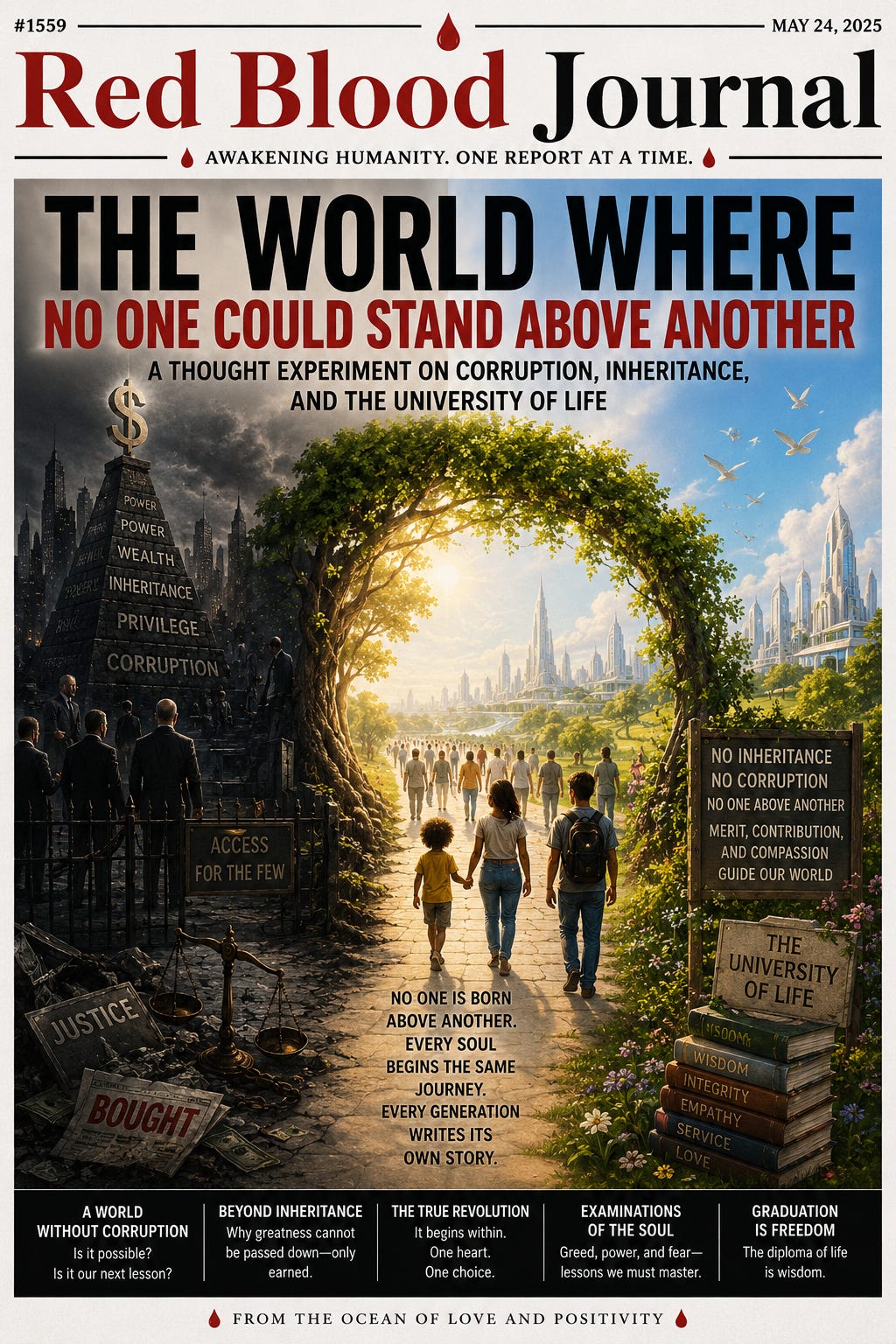
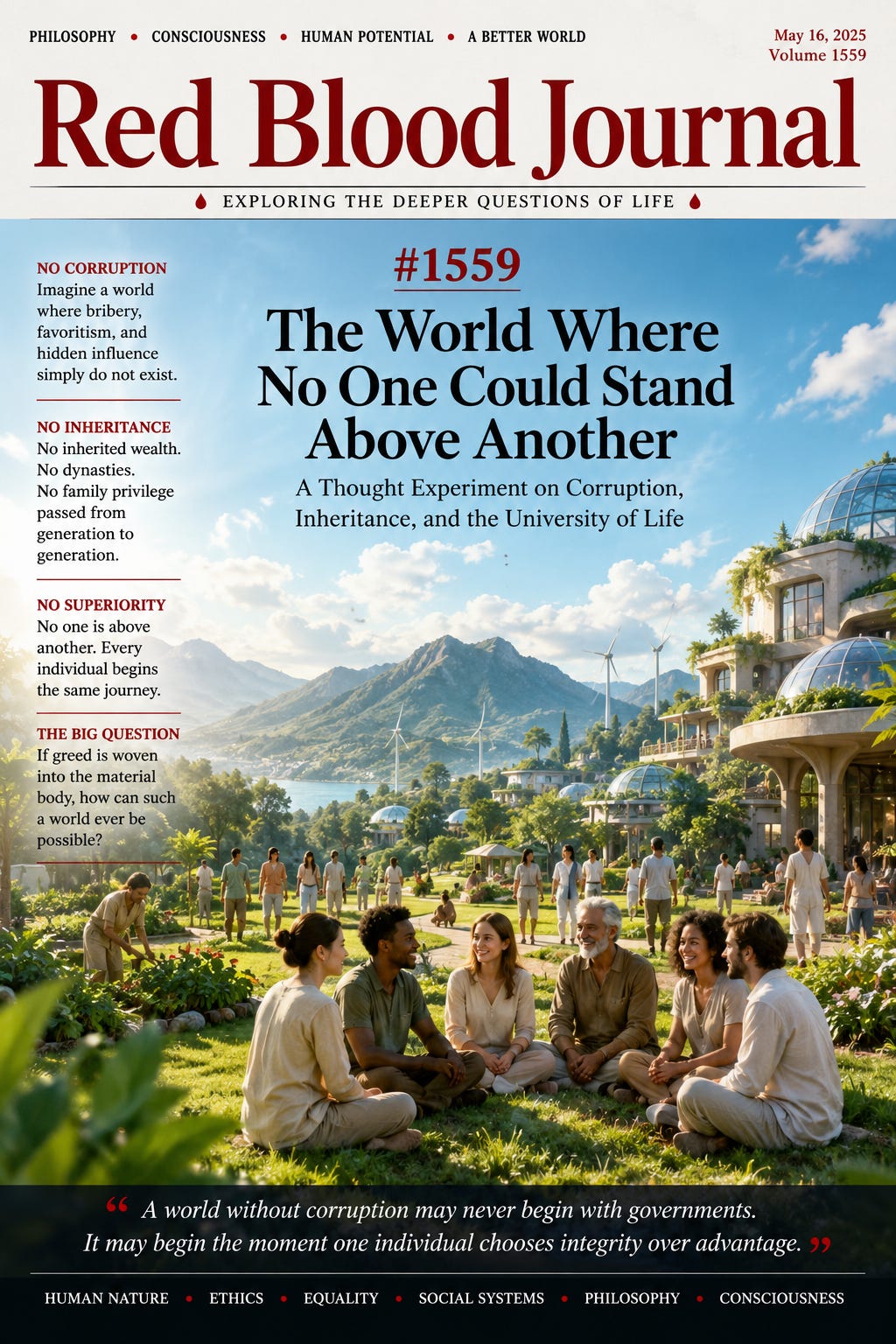
#1559 — The World Where No One Could Stand Above Another
A Thought Experiment on Corruption, Inheritance, and the University of Life
🩸 RedBloodJournal.com 🩸
Imagine a world unlike any humanity has ever known.
A world where no person could permanently place themselves above another.
No inherited fortunes.
No political dynasties.
No royal bloodlines.
No monopolies passed from parent to child.
No family accumulating power generation after generation.
Every human being would begin the same journey.
Every generation would write its own story.
Not because success was forbidden.
But because ownership of success could not outlive the one who earned it.
Imagine further that corruption simply did not exist.
No bribery.
No hidden influence.
No buying of laws.
No selling of justice.
No special doors opening for a chosen few.
Every decision would stand on its own merit.
Every individual would be measured by their actions rather than by the wealth or power of those who came before them.
What kind of civilization would emerge?
Would innovation slow...
...or would it flourish because every generation would once again become explorers instead of inheritors?
Would people work less...
...or would purpose become greater because meaning could no longer be purchased?
Perhaps the greatest question is not about economics.
Perhaps it is about human nature.
The material body seeks comfort.
It seeks security.
It seeks accumulation.
It fears loss.
If greed is woven into the biological instincts of survival, then corruption may not simply be a political problem.
It may be one of the examinations given by the University of Life.
Perhaps corruption is not merely something outside us.
Perhaps it begins the moment the desire to possess becomes greater than the desire to understand.
If that is true, then no law alone can eliminate corruption.
A law may punish the action.
It cannot erase the temptation.
Only the individual can confront that examination.
Perhaps this is why every civilization eventually faces the same challenge.
Systems change.
Governments change.
Currencies change.
Empires rise and fall.
Yet the examination remains exactly the same.
Will the individual govern the material body...
...or will the material body govern the individual?
Maybe the perfect society is impossible while human beings remain students.
Or perhaps perfection is not the objective.
Perhaps the objective is to keep learning.
A world without corruption may never begin with governments.
It may begin the moment one individual chooses integrity over advantage.
Then another.
Then another.
Not because they were forced.
But because they had already graduated from that particular lesson.
Perhaps the true revolution is not political.
Perhaps it is educational.
An education that no institution can award.
An education earned only in the University of Life.
Subjects: Human Nature, Corruption, Inheritance, Equality, Philosophy, Consciousness, Ethics, University of Life
Tags: corruption, philosophy, inheritance, equality, ethics, human nature, university of life, consciousness, civilization, redbloodjournal
🩸🌊✨ Fantastic! Whether humanity ever creates such a world remains unknown, but every act of integrity is a small step toward it. May each lesson learned bring us closer to an ocean where wisdom, rather than power, becomes the greatest inheritance of all.
⚖️
⚖️ The University of Life:
Graduation from Greed
Jul 25, 2026
This text explores a philosophical thought experiment centered on a civilization where inherited power and systemic corruption are entirely nonexistent. By imagining a society where every individual must earn their own status rather than inheriting wealth or influence, the author questions whether human innovation would thrive or stagnate. The narrative suggests that greed and corruption are not merely political failures but are actually internal biological tests rooted in human nature. Ultimately, the source argues that a fairer society cannot be mandated by law alone; it requires a personal evolution in integrity and consciousness. This shift is described as a graduation from the “University of Life,” where wisdom replaces material accumulation as the ultimate goal. The passage concludes that true revolution is an educational journey of the soul rather than a structural change in government.


