


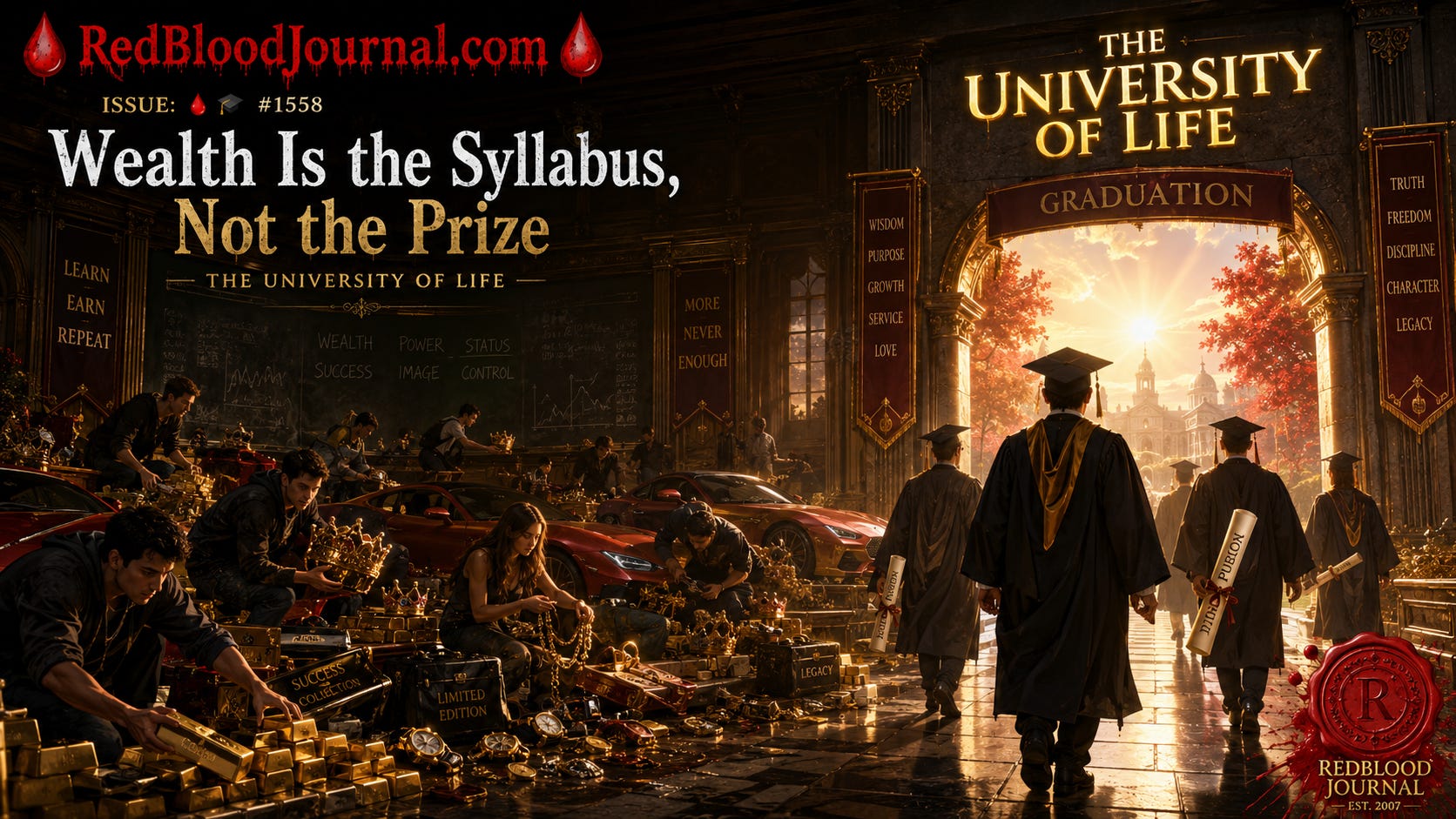
#1558 — The Birth of a Philosophy
Can an Old Idea Become New Again?
🩸 RedBloodJournal.com 🩸
Every philosophy begins with a question.
Not every answer is completely new.
Gravity existed long before Newton.
Evolution existed long before Darwin.
The stars filled the night sky long before astronomy gave them names.
The discovery belongs not only to the one who first sees something, but often to the one who finally arranges scattered observations into a framework that allows others to see them differently.
Perhaps philosophy works the same way.
Throughout history, many thinkers have suggested that adversity builds character.
Others warned that attachment to wealth can distract from deeper purpose.
Some taught that wisdom cannot be inherited.
Others believed every individual must walk their own path.
None of these ideas stand alone.
They are pieces of a much larger puzzle.
The question is not whether every individual piece has existed before.
The question is whether the completed picture has.
Imagine assembling a thousand familiar stones into a cathedral that has never before existed.
The stones are ancient.
The cathedral is new.
Perhaps ideas work exactly the same way.
The philosophy presented throughout these reports proposes a different way of viewing human life.
Life is not merely survival.
It is not simply the pursuit of comfort.
It is not the endless accumulation of possessions.
Life is a university.
Every experience is a lesson.
Every temptation is an examination.
Every disappointment is a classroom.
Every success is another test.
The material world is not necessarily the reward.
It is the curriculum.
Within this framework, wealth itself is neither good nor evil.
It is simply another examination.
If used wisely, it becomes a tool for learning.
If worshipped, it becomes another distraction.
This perspective leads to another possibility.
Parents often spend their entire lives accumulating wealth so their children will never struggle.
It is one of humanity’s greatest acts of love.
Yet if struggle is one of life’s greatest teachers, then removing every obstacle may also remove many of life’s most valuable lessons.
A dynasty may preserve financial wealth for centuries while unknowingly delaying the inner education of every generation that follows.
No parent can graduate on behalf of a child.
No inheritance can replace wisdom.
No fortune can purchase understanding.
Every generation must eventually attend the University of Life for itself.
Perhaps this is why history repeatedly shows great fortunes rising and disappearing.
The lesson was postponed.
Not eliminated.
The classroom patiently waits for every student.
This philosophy does not argue against success.
It does not condemn wealth.
It asks only a different question.
What if the greatest inheritance is not money?
What if the greatest inheritance is teaching the next generation how to graduate?
Every philosophy begins somewhere.
Rarely by inventing entirely new ideas.
More often by arranging familiar truths into a pattern that reveals something previously unseen.
If this framework helps even one person look beyond accumulation toward understanding, then perhaps another classroom door has quietly opened.
Perhaps humanity has spent centuries trying to inherit comfort.
Perhaps it was always meant to inherit wisdom.
Subjects: Philosophy, Original Thought, Wealth, Dynasties, University of Life, Wisdom, Consciousness, Human Purpose
Tags: philosophy, university of life, wealth, inheritance, dynasties, wisdom, consciousness, purpose, spiritual growth, redbloodjournal
🩸🌊✨ Fantastic! Every generation receives an opportunity greater than an inheritance—the chance to discover that the richest graduation is not measured by what we possess, but by who we become. From the Ocean of Love and Positivity, may every soul find the courage to earn its own diploma in the University of Life.
🎓
🎓 The University of Life:
From Inheritance to Wisdom
Jul 27, 2026
This source introduces a new philosophical framework that views human existence as a “University of Life” where every experience serves as a vital lesson. Rather than focusing on the accumulation of material wealth, the text suggests that life’s true purpose is the attainment of wisdom through personal struggle and growth. It argues that while parents often provide financial legacies out of love, removing all obstacles can inadvertently hinder a child’s development by shielding them from necessary challenges. Consequently, true inheritance is redefined not as money, but as the preparation of the next generation to navigate their own spiritual and intellectual journey. The author maintains that ancient truths can be reassembled into this modern perspective to help individuals prioritize character over comfort. Ultimately, the philosophy encourages a shift from merely surviving to actively participating in the world as a classroom for the soul.


