


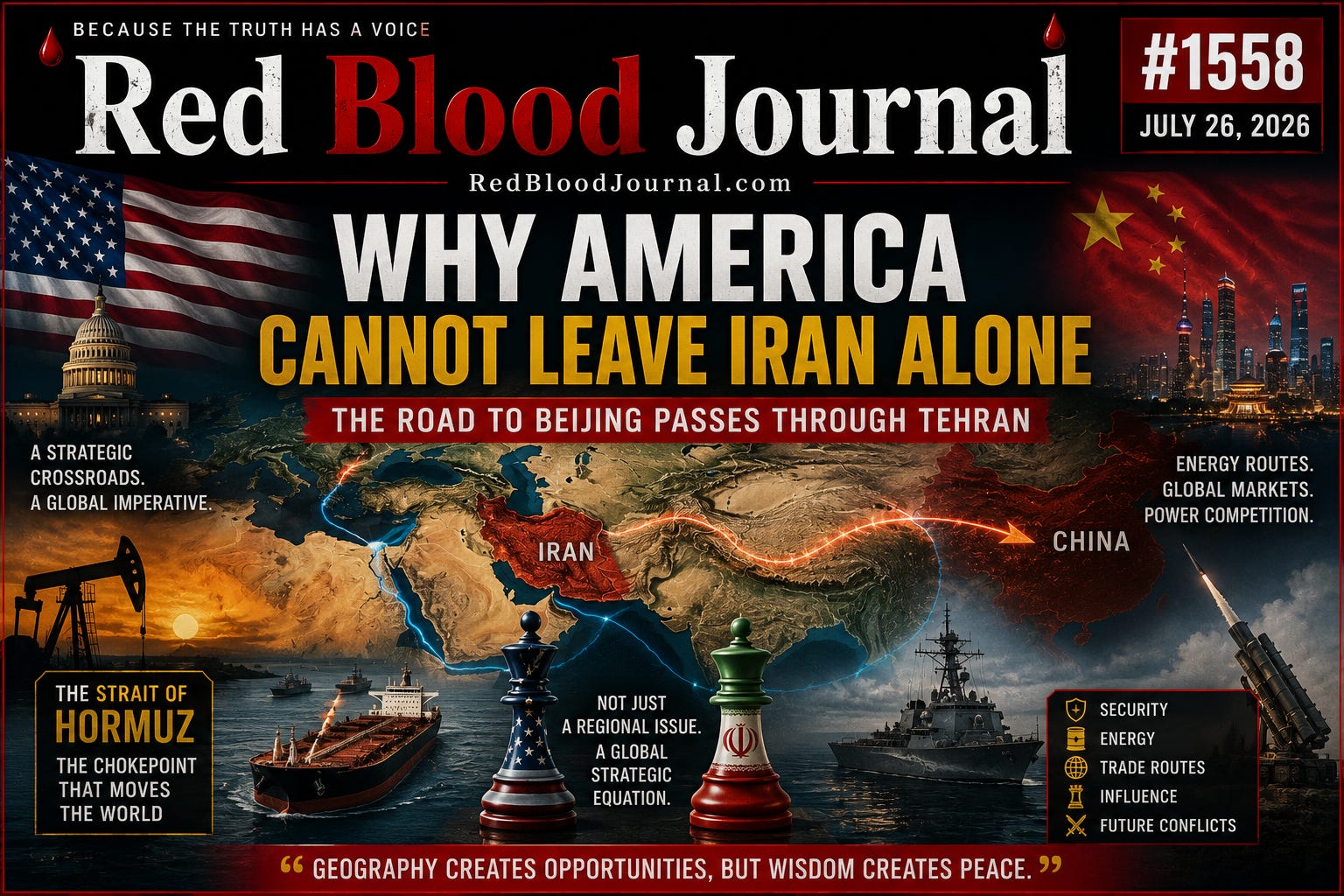
#1558 — Why America Cannot Leave Iran Alone
The Road to Beijing Passes Through Tehran
🩸 RedBloodJournal.com 🩸
For decades, many people have viewed the relationship between the United States and Iran as a dispute centered almost entirely on ideology.
Others see it primarily through the lens of nuclear technology.
Still others focus on sanctions, terrorism, or regional conflicts.
Each explanation contains part of the picture.
But perhaps none of them, by themselves, explain why the relationship has remained one of the defining geopolitical confrontations of the modern era.
The deeper question may be much simpler.
What makes Iran strategically difficult to ignore?
Geography Never Retires
Governments change.
Leaders come and go.
Political systems rise and fall.
Geography remains.
Iran occupies one of the world’s most strategically significant locations.
To its south lies the Persian Gulf and the Strait of Hormuz, through which a substantial share of the world’s seaborne oil trade passes.
To its north lie the Caucasus and the Caspian region.
To the east sits South Asia.
To the west is the Middle East.
For centuries, major empires have competed for influence over this crossroads.
The names have changed.
The geography has not.
More Than Oil
Oil has shaped global politics for more than a century.
But energy is only one layer.
Iran also sits near transportation corridors linking Asia, Europe, and the Middle East.
It borders countries that have long been central to regional security.
Its coastline overlooks one of the world’s most important maritime chokepoints.
Control is not always required.
Influence alone can affect shipping costs, insurance markets, military planning, and energy prices.
The China Question
Many strategic analysts argue that long-term competition between the United States and China is becoming the defining geopolitical challenge of the twenty-first century.
If that assessment is correct, then stability along major energy routes becomes increasingly important.
China imports significant quantities of energy that travel through maritime routes connected to the Persian Gulf.
Any disruption in those routes has consequences far beyond the Middle East.
From this perspective, Iran is not viewed only as a regional actor.
It becomes part of a much larger global strategic equation.
A Different Kind of Chessboard
Classical warfare focused on territory.
Modern competition often focuses on influence.
Trade.
Technology.
Energy.
Supply chains.
Shipping lanes.
Financial systems.
Information.
Military positioning.
Each move affects several others simultaneously.
A decision made in the Persian Gulf may influence markets in Europe, manufacturing in Asia, and security planning in Washington.
The board has become global.
The Strait of Hormuz
Few waterways carry as much strategic importance as the Strait of Hormuz.
Even temporary disruption can affect energy prices, shipping schedules, insurance premiums, and financial markets.
Because of this, governments around the world closely monitor developments in the region.
The waterway represents not merely a regional concern but a global economic interest.
The Cost of Miscalculation
History demonstrates that misunderstandings can sometimes become more dangerous than deliberate plans.
Each government interprets the other’s actions through its own assumptions.
Military exercises.
Sanctions.
Diplomatic statements.
Naval deployments.
Missile testing.
Negotiations.
Each action may be interpreted either as preparation for conflict or preparation for compromise.
Small errors in judgment can produce large consequences.
Why the Situation Persists
Many observers ask why tensions continue decade after decade.
One possible answer is that neither side considers the underlying strategic questions fully resolved.
The United States continues to pursue its regional security objectives.
Iran continues to pursue its own security interests and regional influence.
As long as both sides believe those objectives remain vital, the relationship is unlikely to become simple.
Beyond Governments
While governments debate strategy, ordinary people often desire something much less complicated.
Security.
Opportunity.
Stable employment.
Education.
Freedom to build families.
A peaceful future.
These aspirations are remarkably similar regardless of nationality.
Geopolitical competition is conducted by states.
Its consequences are experienced by citizens.
Looking Beyond the Headlines
Daily news often focuses on immediate events.
Missile launches.
Sanctions.
Diplomatic meetings.
Military deployments.
Yet these events usually represent individual chapters within a much longer historical story.
Understanding the larger framework helps explain why seemingly isolated events continue to return to the same regions generation after generation.
Final Thoughts
Perhaps the most important lesson is that geography creates opportunities, but it does not determine destiny.
Nations make choices.
Leaders make decisions.
Citizens shape cultures.
History provides context but not certainty.
The relationship between the United States and Iran will likely continue to evolve as technology, energy systems, economics, and international alliances change.
Whether future generations inherit continued confrontation or lasting cooperation will depend not only upon military strength or political strategy, but upon wisdom, restraint, and the willingness to recognize that every nation ultimately shares the same planet.
The greatest strategic victory is not controlling another nation.
It is building a future in which geography becomes a bridge rather than a battlefield.
Subject: Why America Cannot Leave Iran Alone
Tags: Iran, United States, China, Persian Gulf, Strait of Hormuz, Geopolitics, Energy Security, International Relations, Global Strategy, Red Blood Journal
🩸 RedBloodJournal.com 🩸
🩸🌊✨ Fantastic!
🗺️
🗺️ The Road to Beijing Passes Through Tehran
Jul 26, 2026
The provided text explores the persistent geopolitical friction between the United States and Iran, suggesting the conflict is rooted more in permanent geography than temporary political ideologies. Iran serves as a critical global crossroads, sitting atop vital trade routes and the Strait of Hormuz, a maritime chokepoint essential to the world’s energy supply. The source argues that Iran is a central piece in a larger strategic competition involving China, as disruptions in the region have immediate effects on global markets and security. Ultimately, the passage posits that while geographic location dictates Iran’s international importance, future stability depends on whether leaders choose to view these lands as battlefields or bridges. This analysis moves beyond daily headlines to examine the long-term historical framework of a relationship defined by energy, influence, and the high cost of potential miscalculation.


