


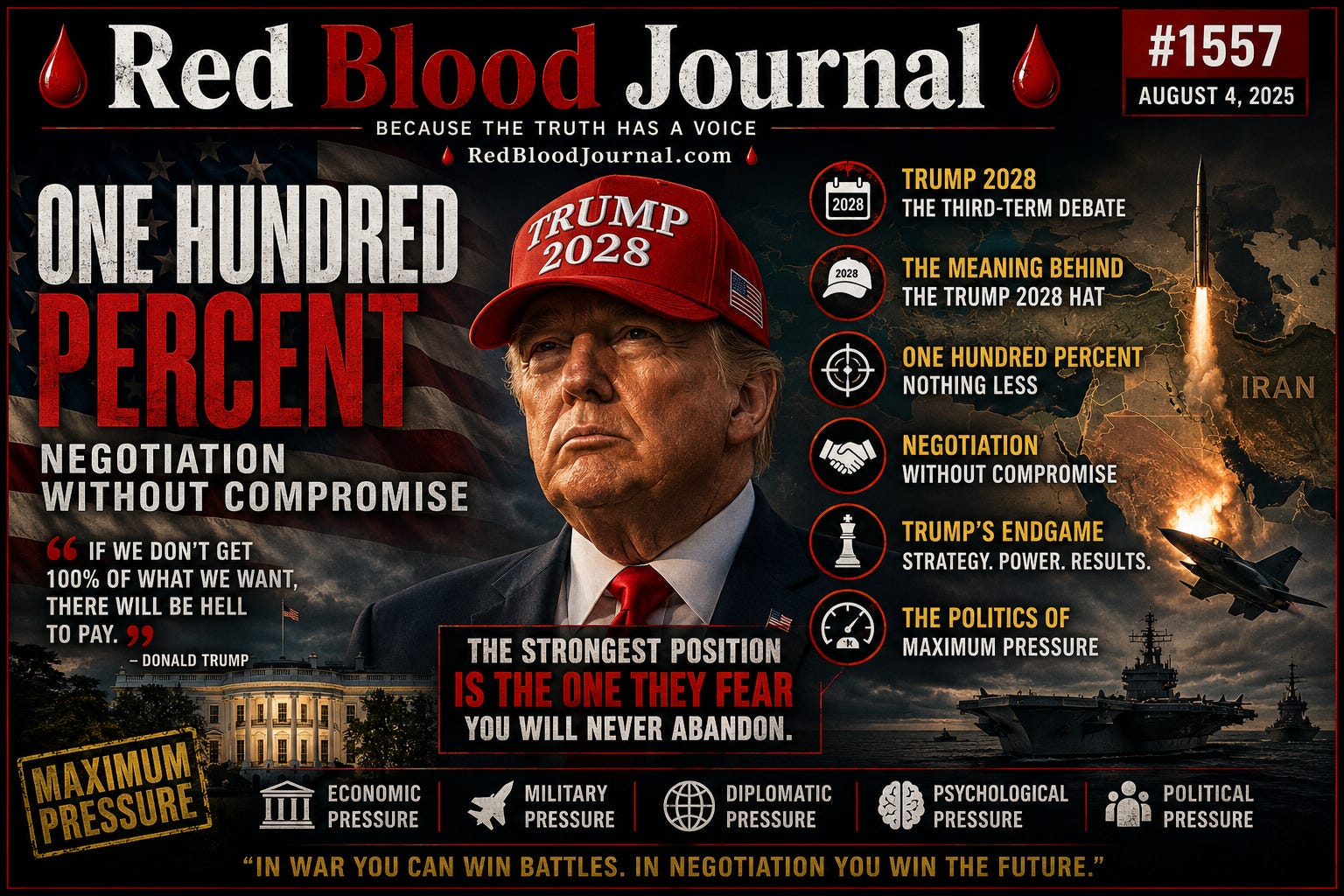
#1557 — One Hundred Percent
Negotiation Without Compromise
🩸 RedBloodJournal.com 🩸
Traditional diplomacy begins with an assumption:
Neither side will receive everything it wants.
One side presents its demands.
The other side presents its own.
Negotiators search for the narrow space where both can claim enough success to sign an agreement.
But Donald Trump has rarely presented negotiation as a search for the middle.
His method is built around pressure.
Begin with the largest possible demand.
Convince the other side that refusal will become increasingly expensive.
Treat every concession not necessarily as the end of the negotiation, but as evidence that another concession may still be obtained.
This is negotiation transformed into a test of endurance.
And in the confrontation between the United States and the present leadership of Iran, the most important number may no longer be fifty-fifty.
It may be:
One hundred percent.
The Meaning of One Hundred Percent
The source material behind this report describes Trump as saying that renewed large-scale military action would be certain unless the United States received 100 percent of what it wanted.
The exact boundaries of that reported “100 percent” remain unclear.
It could refer to some combination of:
ending Iran’s nuclear-weapons pathway,
restricting or dismantling nuclear infrastructure,
reducing missile and drone capabilities,
limiting the power of the Revolutionary Guard,
ending support for regional armed groups,
protecting American forces and allies,
and preventing the Strait of Hormuz from becoming an instrument of pressure.
The phrase matters because it changes the meaning of negotiation.
A normal negotiation asks:
What can each side accept?
A maximal negotiation asks:
How much can the stronger side extract before the weaker side refuses?
In July 2026, Trump publicly confirmed that Washington and Tehran were still talking, while saying Iran was not yet ready to complete an agreement. That confirms the existence of diplomacy, but not that either side is close to accepting the other’s final conditions.
The conversation may therefore continue while the definition of an acceptable result remains completely different for each side.
When Concessions Increase the Demand
The uploaded transcript presents a revealing account attributed to Iranian journalist and economist Saeed Laylaz.
According to the account, Iranian and American representatives reportedly approached an understanding through French mediation. When the proposal reached Trump, he allegedly considered it insufficient and added another demand.
The Iranian side accepted.
Trump reportedly asked for more.
The Iranian side accepted again.
Trump again sought another concession.
If the account is accurate, two interpretations are possible.
The first is that Trump never truly intended to reach an agreement and used negotiations to gather information, gain time, divide the other side, or prepare for further military action.
The second is more consistent with his public negotiating persona:
He discovered that every increase in pressure produced another Iranian retreat.
Therefore, each concession did not satisfy him.
It encouraged him.
In ordinary diplomacy, a concession brings the parties closer.
In maximum-pressure diplomacy, a concession may persuade the stronger party that the weaker one still has more to surrender.
The negotiation does not approach its conclusion.
The appetite grows.
Trump’s Endgame
Trump’s political method has frequently depended on uncertainty.
He often leaves several outcomes alive at the same time.
Agreement remains possible.
Escalation remains possible.
A threat may be genuine.
It may also be intended to force movement without requiring the threat to be carried out.
This uncertainty is not necessarily a weakness in the strategy.
It may be the strategy.
The opposing side cannot confidently determine whether Trump’s final objective is:
a negotiated settlement,
complete strategic submission,
regime weakening,
regime transformation,
or the creation of conditions under which the other side collapses through its own internal pressures.
When the endgame is unclear, every government involved must prepare for the most dangerous interpretation.
That uncertainty increases the psychological cost of resistance.
But it also carries a danger.
If the opponent concludes that no concession will ever be enough, it may stop making concessions entirely.
A government that believes surrender will not guarantee survival may decide that prolonged resistance is its only remaining option.
Trump 2028
The transcript also describes Trump joking about—or politically advertising—the possibility of another presidential campaign while wearing a Trump 2028 hat.
The image is powerful even if the constitutional road is extremely difficult.
Trump was elected president in 2016 and again in 2024. The Twenty-Second Amendment states that no person may be elected president more than twice.
The amendment was ratified in 1951 after Franklin D. Roosevelt won third and fourth terms, ending the earlier tradition rather than constitutional requirement that presidents voluntarily leave after two elected terms.
Therefore, under the ordinary and overwhelmingly accepted reading of the Constitution, Trump cannot simply run for and be elected to a third presidential term.
Yet there is a narrow constitutional debate.
The Twenty-Second Amendment speaks specifically of being elected more than twice. The Twelfth Amendment says that a person constitutionally ineligible to be president cannot serve as vice president. Some theorists have questioned whether a twice-elected former president is completely ineligible to hold the office or merely ineligible to be elected again.
The Constitution Annotated acknowledges that this interaction between the Twelfth and Twenty-Second Amendments has never been definitively tested in such a case. It does not establish a lawful path for a third term; it identifies an unresolved question that would almost certainly produce an extraordinary constitutional confrontation.
For the present leadership of Iran, however, the legal details may be less important than the political message.
The hat says:
Do not assume that waiting until January 2029 will end Trump’s influence.
Even if Trump cannot personally remain president, he may seek to choose a political successor committed to continuing his policies.
The individual could leave.
The doctrine could remain.
The Hat as Psychological Warfare
Political clothing is rarely accidental when worn before cameras.
A campaign hat can be merchandise.
A joke.
A provocation.
A test of public reaction.
Or a message to allies and enemies.
The Trump 2028 hat does not need to produce an actual candidacy to have strategic value.
Its immediate purpose may be to disturb every plan based on the assumption that Trump’s political clock is running out.
The present leadership of Iran may believe it does not need to defeat the United States.
It may believe it only needs to endure.
Absorb the attacks.
Protect enough missiles and drones to remain dangerous.
Stretch negotiations.
Increase global oil prices.
Create political fatigue inside the United States.
Then wait for a different president.
The hat attacks that assumption.
It declares that the waiting game may not bring relief.
The Politics of Maximum Pressure
Maximum pressure is larger than sanctions.
It is the coordinated use of nearly every available form of leverage:
Economic pressure
Restricting trade, banking, exports, oil revenue, insurance, transportation, and access to international financial systems.
Military pressure
Using airstrikes, naval power, surveillance, missile defense, covert operations, and the possibility of limited ground action.
Diplomatic pressure
Reducing the opponent’s international support and forcing neutral governments to choose sides.
Psychological pressure
Convincing decision-makers that conditions will become worse if they delay.
Political pressure
Making clear that a future administration may continue the same policy rather than reverse it.
The strength of maximum pressure is that it can force rapid concessions without requiring total occupation.
Its weakness is that pressure can eventually stop producing submission and begin producing desperation.
A cornered government may become more dangerous, not less.
Negotiation Without Compromise
There is an important difference between strength and inflexibility.
Strength allows a nation to negotiate without fear.
Inflexibility may prevent it from recognizing an agreement that serves its actual interests.
Demanding 100 percent can be effective when the opponent believes resistance is hopeless.
But when both sides consider their core demands matters of survival, a demand for total acceptance can turn diplomacy into a temporary pause between military operations.
One side says:
We will stop when we receive everything.
The other says:
We will survive until political conditions change.
Neither position contains a natural stopping point.
That is how limited conflicts become wars of attrition.
The Danger of Misreading Retreat
Every retreat does not mean collapse.
A government may surrender one position in order to preserve another.
It may accept restrictions publicly while rebuilding capabilities secretly.
It may enter negotiations not to make peace, but to reorganize damaged forces.
It may agree to inspections while preserving networks of knowledge that cannot be bombed out of existence.
The stronger party may interpret concessions as evidence that more pressure will produce complete surrender.
The weaker party may interpret the same concessions as temporary sacrifices that purchase survival.
Both may believe time is working in their favor.
Both cannot be correct forever.
One Hundred Percent of What?
The central weakness of the phrase “one hundred percent” is that it sounds precise while remaining politically undefined.
One hundred percent of what?
If the goal is preventing an Iranian nuclear weapon, an agreement may be measurable.
If the goal is eliminating every missile threat, every proxy relationship, every hostile ideology, and every instrument of regional influence, the objective becomes much larger.
If the true objective is political transformation inside Iran, then no arms agreement alone can produce 100 percent.
A government can sign away uranium enrichment.
It cannot easily sign away the worldview that created its foreign policy.
A military can destroy installations.
It cannot bomb an idea into extinction.
The broader the definition of victory becomes, the more difficult it becomes to know when victory has arrived.
The Risk to America
Maximum pressure also places pressure on the nation applying it.
Wars consume weapons, money, political attention, military readiness, alliances, and public patience.
They influence energy prices.
They create casualties.
They generate unforeseen enemies.
They can begin with limited objectives and gradually accumulate new ones.
Recent reporting describes continuing American military operations, congressional funding debates, regional retaliation, and growing concern over the civilian and economic consequences of the Iran conflict.
A strategy based on waiting for Iran to break must also consider how long the American public will accept the cost of trying to break it.
Maximum pressure is therefore a contest between two forms of endurance.
Iranian governmental endurance.
American political endurance.
The Third-Term Debate Is Not the Main Story
The most dramatic headline may be whether Trump could somehow remain in power after his current term.
But that may not be the most important issue.
The deeper story is whether Trumpism has become larger than Trump.
Can maximum pressure survive through a chosen successor?
Can the Republican Party institutionalize the doctrine?
Can future presidents politically afford to reverse it?
Can an American administration negotiate a compromise after the public has been told that anything less than 100 percent is failure?
Once a government defines total success as the only acceptable outcome, compromise becomes politically dangerous.
A future leader who accepts less may be accused of surrendering what military pressure had nearly achieved.
The slogan can therefore outlive the person who spoke it.
Trump’s Real Weapon
Donald Trump’s most powerful weapon may not be the missile, sanction, aircraft carrier, or campaign hat.
It may be his ability to convince opponents that he has no predictable limit.
That reputation can produce concessions before force is used.
But unpredictability has two faces.
It can frighten an opponent into agreement.
It can also frighten an opponent into believing that agreement offers no protection.
A negotiation succeeds when both sides believe compliance will end the pressure.
A negotiation fails when one side believes that every concession will merely produce the next demand.
Final Thoughts
“One hundred percent” is more than a number.
It is a philosophy of power.
It says the stronger side should not accept half of what it can possibly obtain.
It says patience is not always a virtue when pressure is working.
It says compromise may reward resistance, while escalation may expose weakness.
But history also teaches that total demands can create total resistance.
There is a point at which pressure no longer bends an opponent.
It hardens it.
The challenge for Trump is not merely to prove that the United States can demand everything.
It is to determine which demands are essential, which are negotiable, and which could transform a winnable confrontation into an endless war.
The challenge for Iran is not merely to survive Trump.
It is to understand that waiting for a different American president may no longer restore the world that existed before the conflict.
And the challenge for humanity is to remember that behind every grand strategy are ordinary people who receive none of the power, make none of the decisions, and pay nearly all of the price.
The strongest victory is not obtaining 100 percent of an enemy’s surrender.
It is creating a peace in which 100 percent of the children on both sides are permitted to live, grow, imagine, and discover that they were never born to inherit the hatred of governments.
Subject: Donald Trump, Iran and the Strategy of Maximum Pressure
Tags: Donald Trump, Trump 2028, Iran, United States, Maximum Pressure, Negotiation, Third-Term Debate, Twenty-Second Amendment, Foreign Policy, Military Strategy, Geopolitics, Red Blood Journal
🩸 RedBloodJournal.com 🩸
🩸🌊✨ Fantastic!
💯
💯 One Hundred Percent:
The Doctrine of Absolute Pressure
Jul 26, 2026
The provided text analyzes Donald Trump’s “maximum pressure” strategy toward Iran, characterized by a refusal to compromise and a demand for “one hundred percent” of American objectives. This approach replaces traditional diplomacy with a test of endurance, where every Iranian concession is met with further demands to exploit perceived weakness. Strategic uncertainty is central to this method, leaving opponents unsure if the ultimate goal is a negotiated settlement or total regime collapse. The source also discusses the psychological impact of the “Trump 2028” concept, suggesting that the president’s influence and hardline doctrines may persist beyond his constitutional term limits. Ultimately, the narrative warns that while extreme pressure can extract gains, it risks turning limited conflicts into endless wars by leaving the opponent with no path but desperate resistance. This overview highlights the tension between achieving total victory and the high political and human costs of refusing to find a middle ground.


