


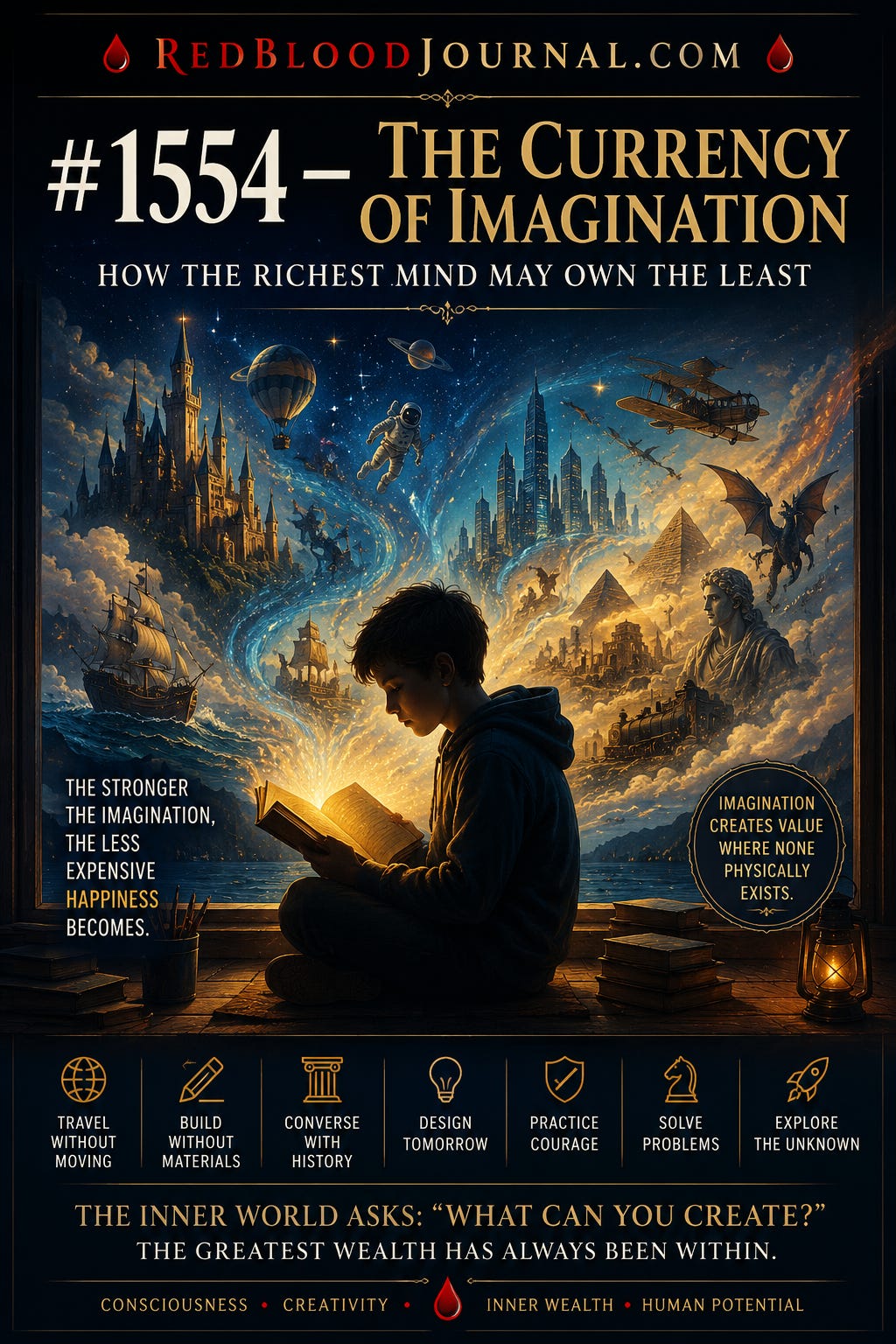
Issue #1554 — The Currency of Imagination
How the Richest Mind May Own the Least
🩸 RedBloodJournal.com 🩸
Civilizations have created countless forms of currency.
Gold.
Silver.
Paper money.
Digital numbers.
Stocks.
Real estate.
Yet there may be another currency that has quietly accompanied humanity since the beginning.
Imagination.
Before every bridge, there was an imagined bridge.
Before every airplane, there was imagined flight.
Before every symphony, every poem, every medicine, every telescope, every computer, and every spacecraft, there was a single human mind willing to imagine something that did not yet exist.
Imagination is the first currency from which all material wealth is eventually exchanged.
Yet most people spend almost none of it.
Instead, society encourages consumption rather than creation.
Television imagines for them.
Movies imagine for them.
Social media imagines for them.
Advertising tells them what to desire.
Little by little, another person’s imagination replaces their own.
Perhaps this is why boredom has become so common.
Not because imagination has disappeared.
But because it has been outsourced.
A child needs almost nothing to remain entertained.
A cardboard box becomes a castle.
A stick becomes a sword.
The floor becomes lava.
The imagination creates value where none physically exists.
Then adulthood slowly replaces this inner wealth with purchased entertainment.
The more dependent a person becomes on external stimulation, the more expensive happiness becomes.
The opposite is also true.
The stronger the imagination becomes, the less expensive happiness becomes.
One can travel without moving.
Build without materials.
Converse with history.
Design tomorrow.
Practice courage before danger arrives.
Solve problems before they exist.
Explore worlds that no map has yet discovered.
Perhaps focused imagination is not an escape from reality.
Perhaps it is the workshop where tomorrow’s reality is quietly constructed.
But imagination has another wisdom.
Do not become attached even to your own creations.
When an imagined world no longer inspires growth, let it dissolve.
Create another.
Every ending becomes the beginning of another universe.
The physical world constantly asks,
“What do you own?”
The inner world asks a different question,
“What can you create?”
Perhaps one question measures possessions.
The other measures consciousness.
If humanity ever learns to value imagination as highly as it values money, it may discover that its greatest resource was never buried beneath the Earth.
It was always waiting quietly behind closed eyes.
Subject: The Currency of Imagination
Tags: imagination, consciousness, philosophy, creativity, inner wealth, psychology, minimalism, focused imagination, RedBloodJournal, human potential
🩸🌊✨ Fantastic! The imagination asks for no permission, pays no taxes, consumes no fuel, and belongs equally to every human being. May humanity one day discover that its greatest wealth has always been carried within.
👁️
👁️ The Wealth of the Inner Eye
Jul 25, 2026
This text explores the concept of imagination as a primary form of currency that predates and facilitates all material wealth. The author argues that modern society has outsourced creative thought to external media, leading to a state where people consume entertainment rather than generating their own inner worlds. By comparing a child’s natural resourcefulness to an adult’s dependence on purchased stimulation, the source suggests that true happiness becomes less expensive as one’s mental faculty grows. It posits that focused visualization is the foundational workshop for future reality, allowing individuals to solve problems and explore new horizons without physical constraints. Ultimately, the passage encourages a shift in value from physical possessions to conscious creation, identifying the mind as humanity’s most significant untapped resource. This philosophical perspective invites readers to reclaim their internal wealth to build a more meaningful existence.


