


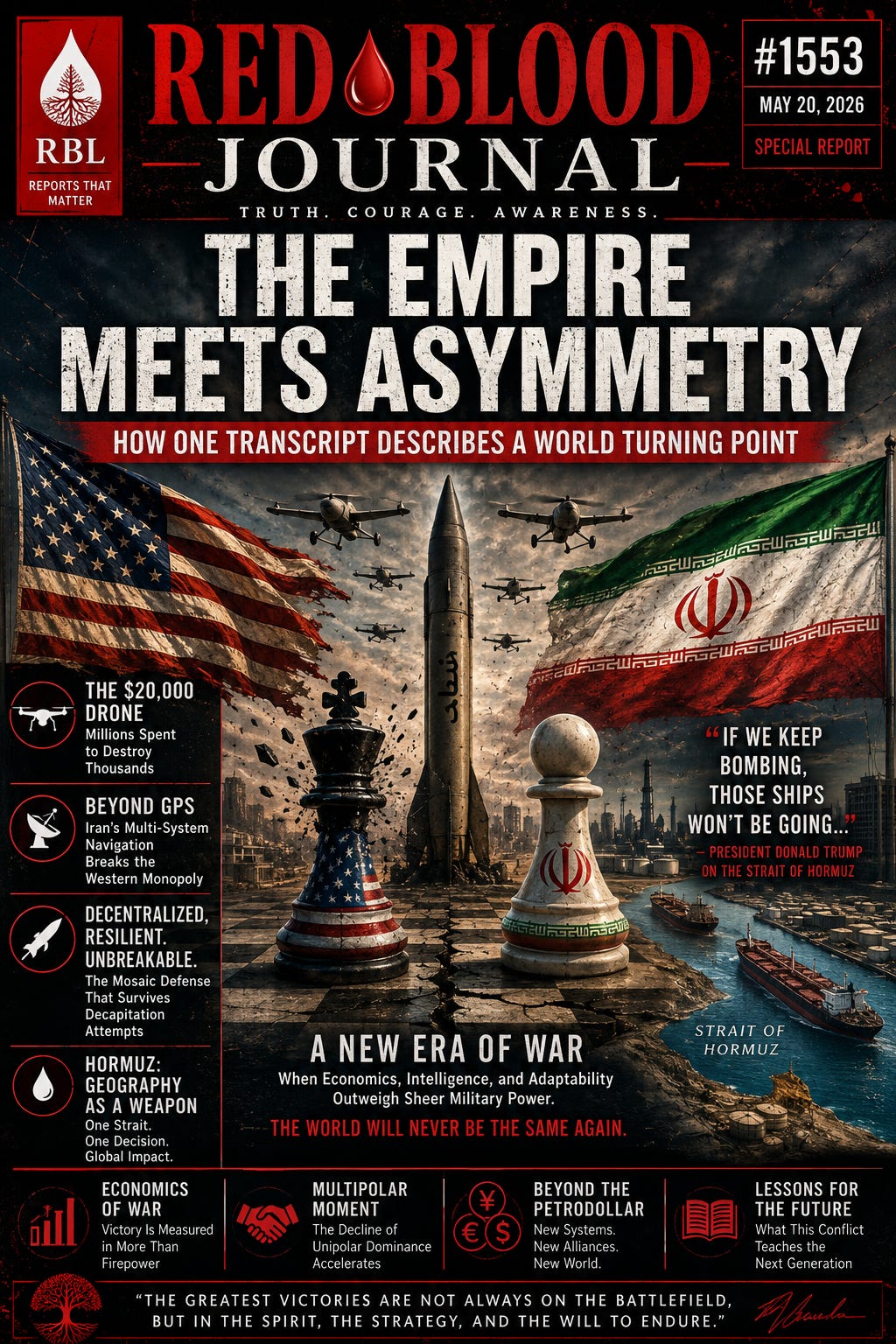
🩸 Red Blood Journal
#1553 – The Empire Meets Asymmetry
How One Idea Describes a World Turning Point
A Summary of the Analysis
Throughout modern history, military power has often been measured by visible strength.
Aircraft carriers.
Stealth aircraft.
Nuclear submarines.
Satellite networks.
Global military bases.
The larger the military machine, the greater the assumption of victory.
The Idea examined in this report challenges that assumption.
Rather than presenting another battle narrative, it argues that the events surrounding the 2026 conflict between Iran, Israel, and the United States represented something much larger:
A demonstration that overwhelming military superiority may no longer guarantee strategic success.
It presents the conflict not simply as another regional war, but as a turning point in how wars may be fought during the twenty-first century.
The Mathematics of Asymmetry
According to the Idea, Iran never attempted to match the United States aircraft for aircraft or ship for ship.
Instead, it pursued an asymmetric strategy.
Rather than competing technologically with the world’s largest military budget, the Idea argues that Iran focused on making every defensive response economically expensive.
Its example is simple.
An inexpensive drone costing only a fraction of the price of a sophisticated interceptor missile forces the defender into an unfavorable economic exchange.
The report argues that modern wars may increasingly become contests of economics as much as technology.
Victory, it suggests, is no longer determined solely by who possesses the most advanced weapons, but by who can force the opponent to spend the most resources over time.
Geography as a Weapon
The Idea argues that Iran’s greatest strategic asset was not a missile or a drone.
It was geography.
The Strait of Hormuz is presented as one of the world’s most important maritime choke points.
According to the analysis, pressure on this narrow corridor had consequences extending far beyond the battlefield.
Energy markets.
Shipping.
Insurance.
Global supply chains.
The Idea suggests that geography itself became part of Iran’s military strategy.
Forty Years of Preparation
The speaker argues that these capabilities were not created overnight.
Instead, they were allegedly built over decades following the Iran–Iraq War.
The Idea attributes this long-term development to figures such as Hassan Tehrani Moghaddam and Amir Ali Hajizadeh, describing investments in domestic missile production, underground facilities, and decentralized command structures designed to survive leadership losses and continued military pressure.
The Mosaic Defense
One of the Idea’s central themes is organizational resilience.
Rather than relying on a single command center, the analysis describes a decentralized military structure in which local commands continue functioning independently if senior leadership is removed.
According to the presenter, this model transforms military planning by making conventional “decapitation” strategies far less effective.
Whether or not this assessment proves accurate, the Idea argues that organization itself can become as decisive as weaponry.
Economics Versus Firepower
Another recurring theme is that military conflicts eventually become economic conflicts.
The Idea argues that prolonged campaigns consume enormous quantities of expensive interceptors, logistics, maintenance, and industrial production.
The implication is that sustaining modern warfare depends not only on battlefield success, but on financial endurance.
In this view, wars may ultimately be won or lost inside factories, supply chains, and national budgets as much as on the battlefield itself.
A Multipolar World
The final section of the Idea expands beyond military operations.
It argues that the conflict accelerated a broader transformation already underway.
According to the presenter, increasing use of alternative financial systems, regional currencies, and new international partnerships indicates movement toward a more multipolar international order.
Whether this transition is complete or still unfolding remains a matter of debate, but the Idea presents it as one of the conflict’s most important consequences.
Final Thoughts
The Idea presents a coherent strategic interpretation rather than simply a chronological account of military events.
Its central argument is that the balance of power is changing.
Not because the largest militaries suddenly disappeared.
But because relatively inexpensive technology, decentralized organization, economic endurance, and geographic advantages may increasingly offset conventional military superiority.
Whether history ultimately supports every conclusion remains for future historians to determine.
Nevertheless, the Idea raises a broader question that extends beyond any single nation:
Has modern warfare entered an era where intelligence, logistics, economics, and adaptability matter more than sheer military size?
History will continue writing the answer.
Subject
#1553 – The Empire Meets Asymmetry: How One Idea Describes a World Turning Point
Tags
#Iran #UnitedStates #Israel #MilitaryStrategy #AsymmetricWarfare #Geopolitics #MiddleEast #Hormuz #DefenseAnalysis #MultipolarWorld #EconomicsOfWar #RedBloodJournal
🩸 RedBloodJournal.com 🩸
🌊 As always, the purpose of the Red Blood Journal is not to tell readers what to believe, but to encourage careful observation, critical thinking, and respectful debate. Every conflict contains competing narratives, and understanding begins by examining them with an open yet questioning mind. May our journey through the University of Life continue in an Ocean of Love, Wisdom, and Positivity. 🌊✨
Fantastic!
⚖️
⚖️ The Empire Meets Asymmetry
Jul 25, 2026
This analysis from the Red Blood Journal explores a fundamental shift in global conflict, asserting that massive military budgets no longer ensure certain victory. By examining the 2026 tensions between Iran and the West, the text highlights how asymmetric tactics, such as using low-cost drones to deplete expensive interceptors, create an economic imbalance that favors the smaller force. The source emphasizes that geographic bottlenecks and decentralized command structures serve as strategic force multipliers that can neutralize conventional superiority. Ultimately, the report suggests that the world is transitioning toward a multipolar order where financial endurance and logistical adaptability outweigh sheer firepower. This perspective invites readers to view modern warfare as a contest of resource management rather than just a display of advanced technology.


