


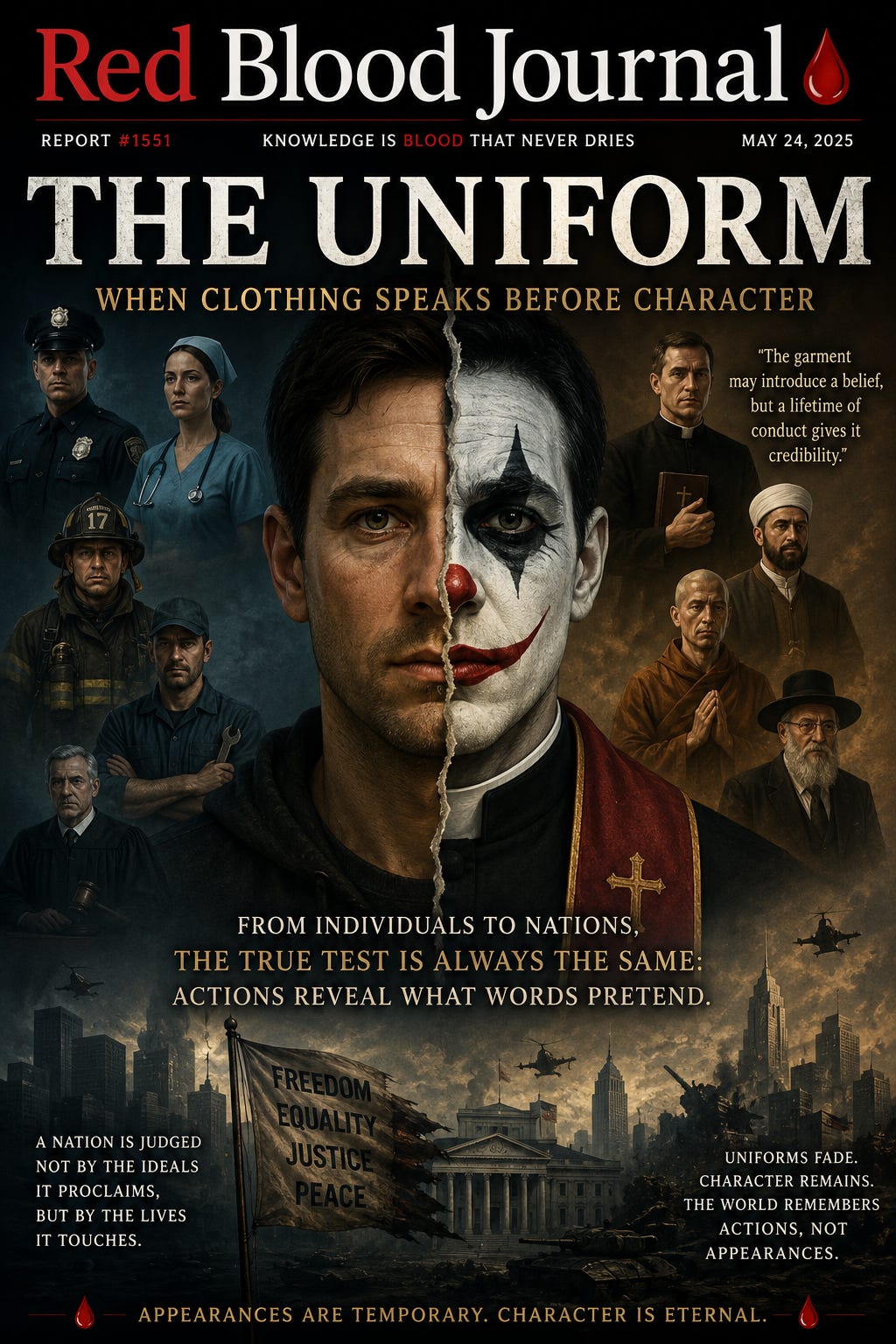
Issue #1551
— The Uniform
When Clothing Speaks Before Character
🩸 RedBloodJournal.com 🩸
Every profession has its uniform.
A police officer wears one.
A nurse wears one.
A firefighter, a mechanic, a judge, and a soldier all wear one.
The uniform exists for a practical purpose. It tells society what role a person performs before a single word is spoken.
No one expects the uniform itself to guarantee honesty, wisdom, or kindness.
It simply identifies a job.
But there is another kind of uniform.
One that attempts to communicate something much deeper.
Morality.
Throughout history, many people have chosen to wear symbols of their inner beliefs. A cross around the neck. Religious robes. A turban. A habit. A yarmulke. A cassock. Distinctive clothing encouraged by faith or tradition.
These garments often represent sincere devotion.
But they also create a burden.
The moment morality becomes visible, every action of the individual becomes connected to what that clothing represents.
A clown illustrates this perfectly.
The audience sees bright colors, oversized shoes, and painted smiles.
Everyone expects laughter.
Yet behind the makeup may stand a person carrying loneliness, grief, or despair.
The costume announces a role.
It does not reveal the soul.
Perhaps every moral uniform presents the same question.
Does it reveal the person?
Or only the part they are expected to play?
History reminds us that people wearing the garments of virtue have sometimes acted in ways that betrayed the very principles they appeared to represent.
Likewise, history is filled with ordinary men and women wearing no recognizable symbols of faith who quietly lived lives of remarkable honesty, compassion, courage, and humility.
Perhaps morality was never intended to be worn before it was lived.
Because once belief becomes part of one’s public appearance, every selfish act, every lie, every abuse of power, every pursuit of wealth over conscience becomes more than a personal failure.
It becomes a reflection—fairly or unfairly—upon the belief itself.
The public rarely separates the individual from the symbol.
The garment becomes the evidence.
Perhaps this is why true morality has little need to advertise itself.
Character introduces itself through actions long before words or clothing become necessary.
A truly honest person does not require a uniform to convince others of honesty.
A compassionate person does not need a title to demonstrate compassion.
The soul quietly reveals itself through everyday choices.
Perhaps the greatest uniform is the invisible one.
Character.
It cannot be purchased.
It cannot be tailored.
It cannot be inherited.
It cannot be worn for a ceremony and removed afterward.
It accompanies every decision.
But perhaps this lesson does not stop with individuals.
Perhaps nations also wear uniforms.
Flags.
Constitutions.
National mottos.
Declarations of liberty.
Promises of equality.
Proclamations of justice.
These become the garments through which a nation introduces itself to the world.
Yet a flag cannot prove freedom.
A constitution cannot guarantee justice.
A speech cannot create honesty.
Just as a religious robe cannot prove virtue, national ideals cannot prove moral conduct by themselves.
Every nation is ultimately judged not only by the principles it proclaims, but by how faithfully it lives them.
How it treats its own people.
How it treats strangers.
How it uses power.
How it responds when no one is watching.
History repeatedly shows that societies, regardless of culture or political system, sometimes proclaim ideals that their actions fail to uphold.
The distance between words and deeds is often where trust is either built or lost.
Perhaps this is the hidden danger of every uniform.
The louder the symbol speaks, the more carefully the actions beneath it are examined.
When appearance becomes more important than character, the uniform slowly becomes a disguise.
Whether worn by an individual, a religious institution, a corporation, or a government, the same principle remains.
The world eventually remembers actions more clearly than appearances.
Perhaps the highest form of morality is one that requires no costume.
No public announcement.
No visible badge.
No special clothing.
Only a life that quietly reflects what it claims to believe.
Because uniforms eventually wear out.
Titles eventually disappear.
Flags fade.
Buildings crumble.
The body itself returns to dust.
Only character continues its journey.
Subject: #1551 — The Uniform: When Symbols Speak Louder Than Character
Tags: philosophy, morality, character, religion, government, ethics, symbolism, institutions, authenticity, Red Blood Journal
🩸🌊✨ Fantastic!
Perhaps the Creator never intended humanity to judge one another by uniforms, titles, flags, or garments, but by the quiet consequences of our actions. Clothes can be copied. Titles can be granted. Symbols can be displayed. But character cannot be manufactured. In the end, every uniform is left behind, while every deed continues its journey across generations before returning to the same infinite ocean from which all life began. There, appearances no longer exist—only truth.
👤
👤 The Invisible Uniform of Character
Jul 25, 2026
This text explores the dichotomy between outward symbols and inner character, arguing that visual markers like uniforms, religious attire, and national flags often mask true identity. While professional garments identify a specific role, moral and national symbols carry the heavy burden of representing deep-seated virtues that the wearer may or may not actually possess. The author warns that public displays of morality can become a disguise, as society eventually judges individuals and nations by their consistent actions rather than their proclamations. Ultimately, the piece suggests that authentic integrity is an invisible quality that requires no advertisement or costume to be recognized. True value lies in a life where deeds align with beliefs, outlasting temporary titles and fading garments to leave a permanent legacy of truth.


