


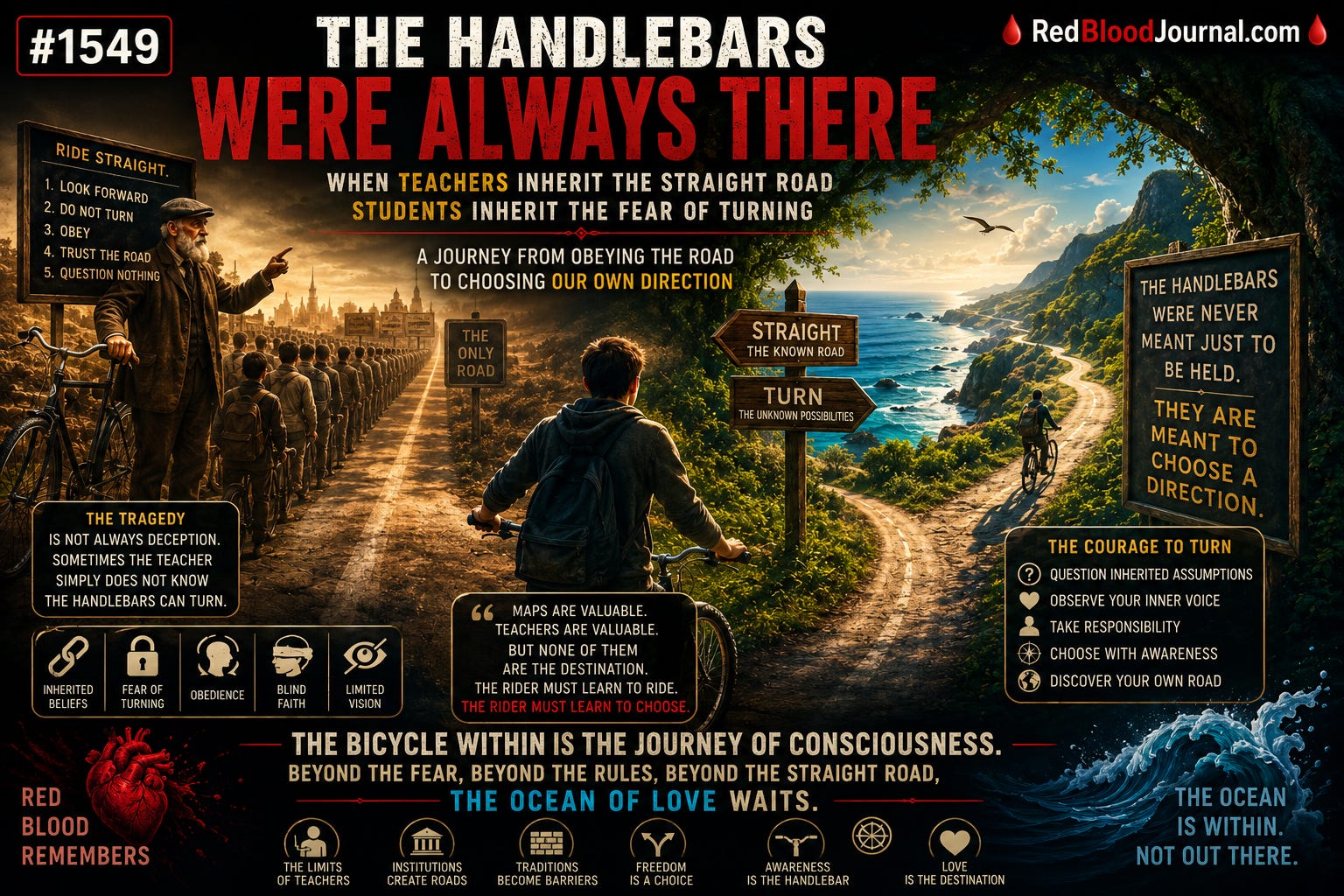
Issue #1549
🩸 #1549 The Handlebars Were Always There
When Teachers Inherit the Straight Road and Students Inherit the Fear of Turning
🩸 RedBloodJournal.com 🩸
A student can only be taught what the teacher has discovered.
But the student may also inherit everything the teacher failed to discover.
Imagine a bicycle instructor who has spent his entire life riding forward in a perfectly straight line.
He knows how to mount the bicycle.
He knows how to balance.
He knows how to pedal.
He knows how to accelerate.
He knows how to stop.
He has traveled an impressive distance, and because he has survived the journey, he is regarded as an authority.
Students gather around him.
They observe his movements.
They memorize his instructions.
They repeat his language.
They are told:
Keep the wheel straight.
Look forward.
Do not lean.
Do not turn.
The teacher may be sincere.
He may even believe he has taught them everything there is to know about riding.
But he has never understood the handlebars.
He believes their purpose is merely to give the rider something to hold.
He does not know that they are connected to the front wheel.
He does not know that the bicycle was designed not merely to travel, but to choose a direction.
The teacher knows movement.
He does not know freedom.
And because the students trust him, they inherit the same limitation.
The Straight Road Becomes Sacred
At first, riding straight is only a technique.
Later, it becomes a tradition.
Eventually, it becomes a commandment.
The first generation says:
“This is how our teacher rode.”
The second generation says:
“This is the correct way to ride.”
The third generation says:
“Anyone who turns is dangerous.”
The fourth generation no longer remembers that turning was ever possible.
By then, the straight road is no longer seen as one direction among many.
It is called the only road.
The teacher’s limitation becomes the institution’s doctrine.
The institution’s doctrine becomes the student’s fear.
And the student’s fear becomes the prison of the next generation.
The First Student Who Turns
One day, a student notices something.
When he moves the handlebars slightly, the front wheel responds.
At first, he thinks he has damaged the bicycle.
He has been taught that the wheel must always remain straight.
He tries again.
The bicycle turns.
Nothing breaks.
The sky does not fall.
The road does not disappear.
For the first time, he sees something that was always beside him but remained invisible from the straight path.
Another road.
A river.
A forest.
A village.
An entire world concealed by the command never to turn.
He returns to the instructor and says:
“The handlebars are not merely something to hold. They allow the rider to choose direction.”
The teacher faces a difficult moment.
He can become curious.
Or he can become threatened.
He can say:
“Show me.”
Or he can say:
“You have betrayed the bicycle.”
This may be one of the most important crossroads in human history.
Not the moment when someone discovers something new—
but the moment when an authority decides whether the discovery will be explored or punished.
The Fear of the Turn
Why would students refuse to turn even after being shown that turning is possible?
Because turning is not merely a physical movement.
It is a psychological separation from certainty.
The straight road is familiar.
It has rules.
It has signs.
It has instructors stationed along the way.
It offers the comfort of knowing that millions of others are moving in the same direction.
Turning creates uncertainty.
The student must look.
Judge.
Balance.
Choose.
Take responsibility.
Once the handlebars are used, the rider can no longer claim that direction was entirely imposed upon him.
He becomes responsible for where he travels.
That is why freedom can be more frightening than obedience.
Obedience allows the rider to say:
“I followed the road I was given.”
Freedom asks:
“Why did I choose this road?”
The Teacher Who Never Turned
The deepest tragedy is not always deception.
Sometimes the teacher is not hiding anything.
Sometimes he simply does not know.
He was trained by another instructor who also traveled only in a straight line.
That instructor inherited the same lesson from someone before him.
The chain may continue backward for centuries.
Each teacher believes he is preserving truth.
Each student believes obedience is wisdom.
No secret committee is required.
No conscious conspiracy is necessary.
A limitation can reproduce itself simply because no one examines it.
Human beings do not inherit only knowledge.
They inherit assumptions.
They inherit fears.
They inherit forbidden questions.
They inherit invisible borders drawn by people who may never have crossed the territory themselves.
The strongest prison is not the one guarded from outside.
It is the one the prisoner has been trained to defend from within.
The History of the Straight Road
Civilizations repeatedly build straight roads.
Religions construct them.
Governments construct them.
Universities construct them.
Corporations construct them.
Families construct them.
Political parties construct them.
Scientific institutions construct them.
Even rebellion can construct its own straight road.
Every system begins with some useful discovery.
A method works.
A lesson helps.
A principle protects.
A structure creates order.
But over time, the method can become sacred.
The lesson becomes unquestionable.
The protective wall becomes a prison.
The system begins defending its original direction even after the landscape has changed.
What began as guidance becomes limitation.
What began as wisdom becomes repetition.
What began as a path becomes a rail.
The bicycle is still moving.
The riders may even be traveling faster than ever.
But speed cannot correct a mistaken direction.
In fact, the faster a civilization travels without examining its course, the farther it may move from where it intended to go.
Technology Improved the Bicycle
Humanity has spent extraordinary energy improving the bicycle.
We have made it lighter.
Faster.
More comfortable.
More efficient.
We added gears.
Suspension.
Navigation.
Electric assistance.
Digital displays.
Satellite tracking.
We can measure the rider’s heartbeat, speed, distance, and calories.
But none of these advancements answer the deeper question:
Who selected the direction?
A technologically advanced bicycle can still travel down a road chosen thousands of years ago by someone who never knew the handlebars could turn.
This may explain one of civilization’s greatest contradictions.
Humanity possesses tools that earlier generations would have considered miraculous.
Yet fear, tribalism, greed, war, domination, and spiritual confusion remain familiar.
The bicycle has advanced.
The rider’s understanding of direction has not advanced at the same speed.
We learned how to travel farther.
We did not necessarily learn where to go.
The Outside Instructor
The straight-road system teaches the student to search outward for direction.
Ask the teacher.
Consult the authority.
Study the official map.
Wait for permission.
Follow the signs.
Trust the procession.
The student becomes skilled at receiving direction but inexperienced at discovering it.
This is not always harmful.
A beginner needs instruction.
A child needs protection.
A traveler benefits from a map.
But guidance becomes dangerous when it prevents the development of inner navigation.
A good teacher holds the bicycle while the student learns balance.
A controlling teacher never lets go.
A true teacher wants the student eventually to ride without him.
A dependent institution needs the student to remain convinced that falling is inevitable without its hand.
The difference is enormous.
One creates riders.
The other creates followers.
The Religion of the Instructor
Eventually, students may stop studying the bicycle entirely.
They study the instructor.
They preserve his clothing.
They repeat his sentences.
They debate the exact position of his hands.
They construct buildings in his honor.
They argue over which account of his journey is correct.
They condemn students trained by another instructor.
They may even fight over which teacher owned the true bicycle.
But still, few turn the handlebars.
This does not necessarily mean the original teacher failed.
Perhaps he intended his students to ride.
Perhaps he demonstrated balance so they could discover movement for themselves.
Perhaps he pointed toward the open road.
But generations transformed the pointer into the destination.
The instructor became more important than the lesson.
Belief replaced practice.
Membership replaced discovery.
Repetition replaced experience.
The students learned everything about the teacher except what the teacher may have wanted them to learn about themselves.
The Danger of the Inner Compass
Institutions often warn that turning inward is dangerous.
And there is some truth in that warning.
The inner voice is not automatically wise.
Fear speaks from within.
Desire speaks from within.
Pride speaks from within.
Trauma speaks from within.
Instinct speaks from within.
Self-deception can disguise itself as revelation.
Therefore, inner guidance should not mean blindly obeying every feeling.
The rider must learn the difference between impulse and conscience.
Between desire and understanding.
Between fear and warning.
Between ego and awareness.
The solution to dependence is not reckless certainty.
It is disciplined observation.
The student must learn not only that the handlebars turn, but how to steer without crashing.
That requires attention.
Humility.
Practice.
Correction.
And the willingness to admit when a chosen road leads nowhere.
Freedom without awareness becomes chaos.
Authority without freedom becomes imprisonment.
The mature rider requires both balance and direction.
The University of the Inner Rider
Imagine an education system that taught children how to use the full bicycle.
Not only how to obey instructions.
Not only how to memorize approved roads.
But how to examine direction.
How to recognize fear.
How to question inherited assumptions without becoming arrogant.
How to listen to guidance without surrendering judgment.
How to observe thought before acting upon it.
How to distinguish the voice of the frightened animal from the quiet awareness beneath it.
How to change direction without hatred for those still traveling straight.
Such an education would not destroy religion, science, tradition, or authority.
It would place them in their proper role.
They would become maps rather than prisons.
Teachers rather than masters.
Tools rather than identities.
Starting points rather than final destinations.
A university worthy of the human spirit would not merely prepare students to earn, consume, compete, and survive.
It would teach them how to become conscious riders of their own lives.
The Red Blood Question
The history of Red Blood has repeatedly returned to the same wound beneath different subjects.
The subject may be war.
Medicine.
Religion.
Government.
Technology.
Money.
Media.
Artificial intelligence.
Corporate power.
National identity.
Food.
Ownership.
Fear.
But beneath them is one recurring question:
Who is steering?
Is the individual choosing?
Or merely continuing?
Is society moving toward a destination consciously selected?
Or accelerating along an inherited road?
Is the teacher opening possibilities?
Or protecting the limits of his own training?
Is the institution serving the human being?
Or has the human being become fuel for the institution?
Is technology expanding consciousness?
Or merely making the cage more comfortable?
The Red Blood perspective is not that every authority is evil or every tradition is false.
It is that no authority should be allowed to replace awareness.
No teacher should become more sacred than truth.
No map should become more important than the territory.
No road should be called eternal simply because generations were afraid to turn.
The Courage to Test the Handlebars
The first act of freedom may be very small.
A slight movement of the hands.
A quiet question.
A private doubt.
A willingness to look toward a road others ignore.
The student does not need to destroy the bicycle.
He does not need to insult the teacher.
He does not need to declare every previous lesson worthless.
Balance still matters.
Pedaling still matters.
Experience still matters.
The teacher may have offered valuable knowledge.
But gratitude does not require permanent limitation.
Respect does not require intellectual surrender.
The student can honor the teacher and still travel beyond the teacher’s experience.
In fact, the greatest honor may be to continue the journey the teacher could not complete.
When the Student Becomes the Teacher
Every student who discovers turning eventually faces the same danger.
He may teach others that his chosen turn is the only correct turn.
A liberator can become a new jailer.
A revolutionary can build another straight road.
A student who escapes one doctrine can create another.
The lesson is not merely to turn left instead of continuing forward.
The lesson is to remain conscious of the handlebars.
To remember that direction must remain examinable.
To understand that no single road reveals the entire landscape.
The mature teacher does not say:
“Follow my turn forever.”
He says:
“Learn balance. Study the road. Use the handlebars. Remain awake.”
The goal is not to replace one obedience with another.
It is to awaken the rider.
The Road to the Inner Ocean
Perhaps the bicycle was never meant only to move the body across the land.
Perhaps it is a symbol of consciousness traveling through physical existence.
The body provides the frame.
Instinct provides the momentum.
Teachers provide early guidance.
Tradition provides maps.
Experience provides balance.
But awareness must eventually hold the handlebars.
Without awareness, the rider becomes a passenger on his own bicycle.
He moves, but does not choose.
He travels, but does not explore.
He obeys the road while believing the road is reality.
The inner ocean begins where automatic movement ends.
It begins when the rider becomes quiet enough to ask:
Who taught me this direction?
Did that teacher know the whole bicycle?
Am I afraid to turn because the road is dangerous—or because turning was forbidden?
Is this my destination, or merely the destination I inherited?
The answers may not arrive immediately.
But the questions themselves move the handlebars.
Conclusion: The Wheel Was Waiting
The bicycle was never defective.
The handlebars were never hidden.
The ability to turn was present from the beginning.
What was missing was permission.
Permission to test.
Permission to question.
Permission to discover.
Permission to move without condemning those who remain on the straight road.
Perhaps humanity does not need another instructor demanding a new direction.
Perhaps it needs teachers courageous enough to admit:
“I learned to balance, but I may not know every road.”
And students courageous enough to respond:
“Thank you for teaching me to ride. Now I must learn where the bicycle can go.”
The straight road was not necessarily a lie.
It was simply incomplete.
The teacher knew movement.
The student must discover direction.
The bicycle belongs neither to the instructor nor to the institution.
It belongs to the consciousness learning how to ride it.
And beyond the familiar road, beyond the signs, beyond the fear of turning, the Ocean of Love waits without demanding obedience.
It does not command the rider from the clouds.
It quietly reflects the sky from within.
Subjects
The Limits of Teachers
Inherited Beliefs
Authority and Inner Awareness
Freedom of Thought
Religion and Institutional Dependence
Technology Without Direction
The Psychology of Obedience
Consciousness and Choice
The Bicycle Within
The History of Red Blood
The Inner Compass
The Ocean of Love
Tags
#TheHandlebarsWereAlwaysThere #BicycleWithin #Consciousness #InnerAwareness #InheritedBeliefs #Authority #FreedomOfThought #Religion #Philosophy #HumanNature #SelfKnowledge #InnerCompass #OceanOfLove #RedBloodJournal
🌊 May every teacher have the humility to acknowledge the roads they never traveled. May every student have the courage to test the handlebars without hatred, arrogance, or fear. And may humanity discover that true guidance does not imprison the rider on one road—it prepares the rider to meet every turn with awareness, balance, compassion, and love.
🩸🌊✨ Fantastic!
🚲
🚲 The Handlebars of Awareness: Choosing the Human Direction
Jul 24, 2026
Using the metaphor of a bicycle, this text examines how educational and social institutions often prioritize rigid obedience over personal agency. It describes a cycle where instructors pass down limitations as sacred truths, teaching students to move forward while ignoring their inherent power to steer. This inherited fear of turning transforms helpful guidance into a psychological prison that discourages individual exploration and accountability. The source argues that while technology and tools have advanced, human consciousness remains stagnant because people struggle to claim their inner navigation. True maturity requires the courage to test the handlebars, moving beyond blind tradition toward a life of conscious, self-directed choice. Ultimately, the narrative calls for a shift from creating followers to empowering individuals who can balance external wisdom with their own awareness.


