


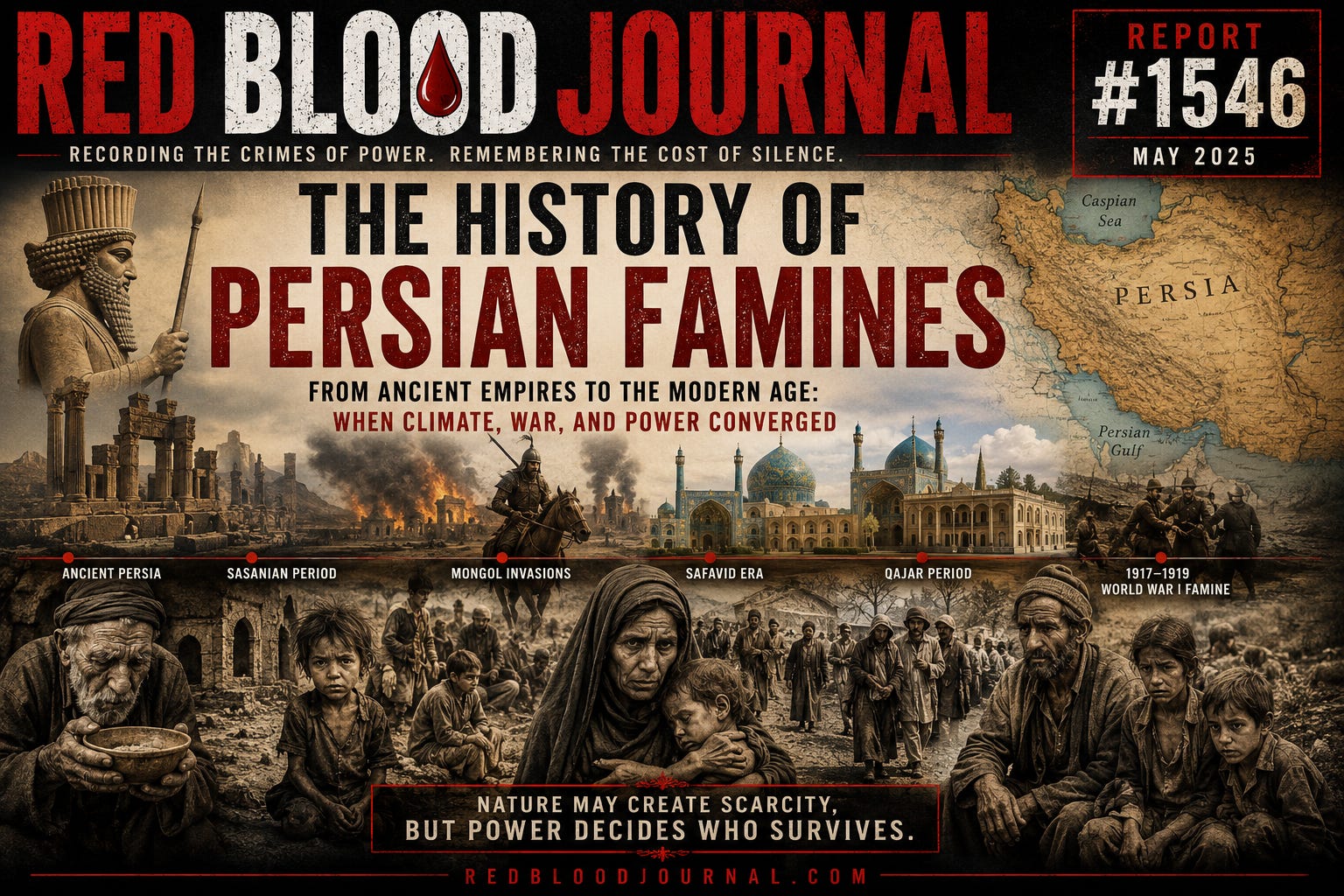
🩸 #1546 The History of Persian Famines
🩸 Red Blood Journal 🩸
Report #1546
The History of Persian Famines
From Ancient Empires to the Modern Age: When Climate, War, and Power Converged
Subject: Persian History, Iran, Famine, Food Security, War, Political Economy
RedBloodJournal.com
Throughout its long history, Persia—modern-day Iran—has endured repeated periods of famine. Some were brought on primarily by nature, others by invasion, and still others by the interaction of drought, war, political weakness, economic disruption, and disease.
Persia occupies one of the world’s oldest continuously inhabited civilizations. Situated between East and West, it has long served as a crossroads for commerce, culture, and conquest. That same geography also exposed it to invading armies, interrupted trade routes, and recurring environmental challenges.
The history of Persian famines is therefore not the story of one disaster, but of a recurring pattern in which natural hardship and human decisions repeatedly intersected.
Ancient Persia
Under the Achaemenid Empire (approximately 550–330 BCE), agriculture depended heavily upon seasonal rainfall and sophisticated irrigation systems.
When drought struck, local shortages could develop rapidly.
The empire attempted to reduce risk by maintaining grain reserves, encouraging regional trade, and constructing the Royal Road, allowing food to move between provinces.
Although localized famines occurred, the centralized administrative system often prevented shortages from becoming empire-wide catastrophes.
The Parthian and Sasanian Periods
Between the third century BCE and the seventh century CE, Persia experienced repeated wars against Rome and later the Byzantine Empire.
Agricultural regions were frequently devastated by military campaigns.
Irrigation canals were damaged.
Harvests failed.
Trade routes became unsafe.
Disease spread alongside displaced populations.
Several historical chronicles describe years in which entire provinces struggled with severe food shortages.
The Arab Conquest
The Arab conquest of Persia in the seventh century brought major political and economic transformation.
Years of warfare disrupted farming and irrigation.
Changing systems of taxation and administration created additional hardship during periods of poor harvest.
Although Persian agriculture gradually recovered under later Islamic dynasties, localized famines continued to appear throughout medieval history.
The Mongol Catastrophe
The Mongol invasions of the thirteenth century produced one of the greatest demographic disasters in Iranian history.
Cities were destroyed.
Canals were abandoned.
Villages disappeared.
Farmland was left uncultivated.
The collapse of irrigation systems proved especially devastating because much of Persia depended upon carefully maintained water infrastructure.
Even after the armies departed, famine continued as agricultural production collapsed across wide regions.
Safavid Persia
During the Safavid Empire (1501–1736), Persia experienced periods of prosperity as well as repeated food crises.
Several famines followed combinations of:
drought
war with the Ottoman Empire
internal rebellion
locust infestations
disease
Cities such as Isfahan occasionally suffered severe shortages despite the empire’s wealth.
The Great Persian Famine (1870–1872)
The famine of 1870–1872 is generally regarded as the deadliest documented famine of the Qajar period.
Its causes were multiple.
Severe drought reduced agricultural production.
Livestock disease damaged rural economies.
Transportation remained primitive, making it difficult to move grain between regions.
Merchants and landowners reportedly hoarded grain while prices rose dramatically.
The Qajar government lacked both the administrative capacity and transportation infrastructure to organize effective nationwide relief.
Modern historical estimates generally suggest that between 1.5 and 2 million people may have died, although some earlier writers proposed substantially higher figures that remain disputed.
Regardless of the precise number, the famine profoundly affected Persian society and exposed the weakness of the state.
The World War I Famine (1917–1919)
Although Persia declared neutrality during the First World War, its territory became a battleground for competing armies.
British, Russian, Ottoman, and local forces operated in different regions.
The consequences were devastating.
Military requisitions removed food and livestock.
Transportation systems broke down.
Trade was interrupted.
Inflation soared.
Disease spread among weakened populations.
Several years of drought further reduced harvests.
Unlike earlier famines caused primarily by weather, the crisis of 1917–1919 emerged from a combination of environmental stress and wartime disruption.
Responsibility remains debated.
Some historians argue that British wartime policies significantly worsened conditions in areas under their influence.
Others emphasize the combined effects of drought, disease, the collapse of commerce, actions by multiple occupying forces, domestic grain speculation, and the weakness of the Qajar government.
Because census records were incomplete, mortality estimates vary widely, ranging from approximately two million to much higher figures proposed by some authors.
The Allied Occupation During World War II
In 1941, Britain and the Soviet Union occupied Iran to secure oil resources and establish supply routes to the Soviet Union.
The occupation produced inflation, transportation disruptions, and shortages in several regions.
Although hardship was widespread, this period generally did not reach the scale of the nineteenth-century famine or the crisis of 1917–1919.
Why Persia Was Especially Vulnerable
Several long-term characteristics increased Persia’s vulnerability to famine:
Semi-arid climate with frequent drought cycles.
Dependence on seasonal rainfall.
Irrigation systems requiring constant maintenance.
Mountainous terrain that isolated many communities.
Strategic location exposed to repeated invasions.
Limited transportation before the twentieth century.
Political fragmentation during periods of weak central authority.
Grain speculation and local market failures during shortages.
Nature often created the initial shortage.
Human institutions determined whether that shortage became a humanitarian catastrophe.
Lessons from Persian History
Persian famines demonstrate that food security depends upon far more than rainfall.
A nation requires functioning transportation, trusted institutions, resilient agriculture, effective emergency planning, and the ability to move supplies rapidly to affected populations.
When war interrupts commerce, when governments weaken, when markets fail, or when information is suppressed, famine can emerge even where food still exists elsewhere.
The Persian experience reminds us that geography alone does not determine survival.
The quality of governance, infrastructure, and social cooperation often determines whether a poor harvest becomes temporary hardship or national tragedy.
Conclusion
The history of Persian famines is ultimately a history of resilience.
Empires rose and fell.
Invaders crossed the Iranian plateau.
Dynasties changed.
Trade routes shifted.
Yet generation after generation rebuilt villages, restored irrigation, replanted fields, and preserved one of humanity’s oldest civilizations.
History records the suffering.
It also records the endurance.
Perhaps the greatest lesson is that while drought may test the land, it is wisdom, cooperation, and accountable leadership that determine whether a people emerge stronger or are consumed by the crisis.
Like rivers that disappear beneath the desert only to emerge again, civilizations endure when they continue to nourish one another.
Beyond every hardship lies the possibility of renewal, reminding us that humanity ultimately shares the same horizon—and the same ocean.
🩸🌊✨ Fantastic!
Tags: Persia, Iran, Persian History, Qajar Dynasty, World War I, Great Persian Famine, Food Security, Middle East History, Drought, Political Economy, Red Blood Journal
🇮🇷
🇮🇷 Persistence and Scarcity:
The History of Persian Famines
Jul 24, 2026
This text provides a comprehensive historical survey of food scarcity in Persia, tracing the recurring patterns of famine from ancient empires to the modern era. The narrative highlights how environmental stressors like drought and locusts frequently combined with human factors, including war, invasion, and political instability, to trigger humanitarian disasters. Key events such as the Mongol invasions, the devastating Great Famine of 1870, and the resource disruptions of the World Wars are examined to show their impact on Iranian society. The source emphasizes that while geography and climate created initial vulnerabilities, the quality of governance and infrastructure often determined the severity of these crises. Ultimately, the history of these famines serves as a testament to the resilience of Persian civilization in the face of repeated demographic catastrophes. Through this overview, the text illustrates that food security is deeply dependent on social cooperation and accountable leadership.


