


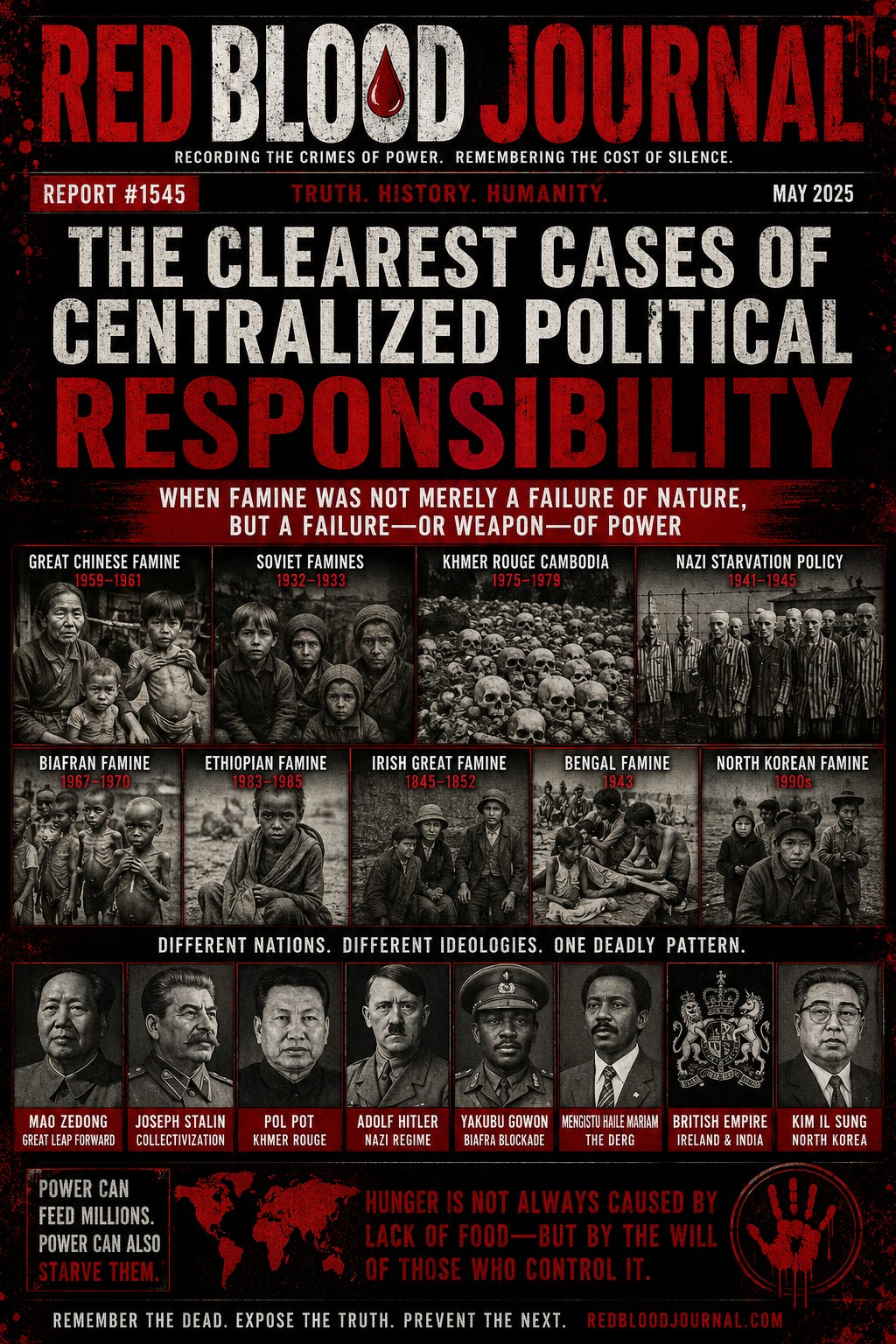
#1545 The Clearest Cases of Centralized Political Responsibility
🩸 Red Blood Journal 🩸
Report #1545
The Clearest Cases of Centralized Political Responsibility
When Famine Was Not Merely a Failure of Nature, but a Failure—or Weapon—of Power
Subject: Political Famine, Centralized Power, State Responsibility, Mass Starvation
RedBloodJournal.com
Famine is often described as though it were simply the result of drought, crop disease, flood, or bad luck.
But history repeatedly shows something darker.
A drought may reduce the harvest.
A crop disease may destroy one source of food.
A war may damage roads and farms.
Yet these conditions do not always become mass famine.
The decisive factor is often political power.
Who controls the grain?
Who controls transportation?
Who controls movement?
Who decides which population receives food and which population is abandoned?
Who punishes those who report the truth?
Who continues taking food from starving villages?
Who prevents people from leaving?
Who blocks foreign assistance?
Who insists that the political program must continue even while human bodies disappear?
The clearest political famines are those in which authority was concentrated strongly enough that the decisions of one government, one party, or one ruling structure shaped the survival of millions.
These are not merely stories of administrative mistakes.
They are warnings about what happens when centralized authority becomes more important than human life.
Mao Zedong and the Great Chinese Famine
The Great Chinese Famine of approximately 1959–1961 stands among the most devastating famines in recorded history.
The famine developed during the Great Leap Forward, Mao Zedong’s campaign to rapidly transform China from an agricultural society into a collectivized industrial power.
Villages were reorganized into enormous communes.
Private farming was restricted.
Rural labor was redirected from food production into industrial projects, including the infamous backyard furnaces intended to produce steel.
Officials competed to report impossible harvest figures.
Once those false numbers traveled upward, the state demanded grain based on harvests that had never existed.
Food was removed from communities whose real production was already collapsing.
Local officials feared telling the truth.
Farmers could not freely leave.
Criticism of the program could be treated as political disobedience.
The state did not merely misunderstand the famine.
Its political structure made honesty dangerous.
That meant fabricated success continued while starvation expanded.
Mao did not personally administer every village, but he controlled the political program, defended it, and created the climate in which officials learned that loyalty was safer than reality.
The famine was therefore not simply caused by weather.
It was caused by the collision between centralized ideology and censored truth.
The state preferred the success of the plan on paper to the survival of the population in reality.
Joseph Stalin and the Soviet Famines
The Soviet famine of 1932–1933 affected Ukraine, Kazakhstan, southern Russia, and other Soviet regions.
Its roots were deeply political.
Joseph Stalin’s government imposed forced collectivization on agriculture.
Independent farms were absorbed into collective systems.
Livestock and grain were confiscated.
Peasants who resisted could be branded enemies, kulaks, saboteurs, or traitors.
In Ukraine, grain procurement continued despite widespread starvation.
Food searches, seizures, blacklisting of villages, and restrictions on travel prevented hungry people from escaping or obtaining supplies elsewhere.
In Kazakhstan, forced settlement destroyed traditional nomadic life and devastated the pastoral economy.
The political structure was unmistakable:
The state controlled land.
The state controlled grain.
The state controlled transportation.
The state controlled information.
The state controlled whether starving citizens could cross a regional border.
The debate over whether the Ukrainian famine legally qualifies as genocide continues in some academic and political settings.
But the central responsibility of Stalin’s government is not seriously erased by that debate.
The famine did not develop outside the reach of the state.
It developed through the state’s own machinery.
The same centralized power that claimed to create abundance created conditions in which food could be removed from the hungry and the hungry could be prevented from escaping.
Pol Pot and the Khmer Rouge
Cambodia under Pol Pot and the Khmer Rouge represents another extreme example of famine emerging directly from political design.
When the Khmer Rouge seized power in 1975, cities were emptied.
Families were separated.
Money and normal markets were abolished.
Millions of people were forced into rural labor camps and agricultural collectives.
Food production was controlled through ideological commands rather than practical knowledge.
Workers were given inadequate rations while expected to meet impossible quotas.
Movement was restricted.
Individual food gathering could be punished.
People were executed for alleged disobedience, former social position, education, ethnicity, or suspected disloyalty.
The regime attempted to rebuild society from the ground up.
But it treated human beings as raw material for a political experiment.
Famine, disease, overwork, execution, and social destruction became inseparable.
The Khmer Rouge did not merely fail to feed Cambodia.
It destroyed the economic and social systems through which people had previously survived.
When private exchange, family support, local knowledge, movement, and independent food access were eliminated, survival depended entirely on the regime.
The regime then failed catastrophically—and often deliberately punished those who could not survive its system.
Nazi Germany and Deliberate Starvation
Under Adolf Hitler, starvation was not always an unintended wartime consequence.
In several contexts, it became an instrument of occupation and racial policy.
Nazi planning for Eastern Europe envisioned the diversion of food away from occupied populations and toward Germany and its armed forces.
Millions of Soviet prisoners of war were deliberately underfed.
Jewish populations confined in ghettos were subjected to rations incapable of sustaining life.
Occupied territories were stripped of agricultural output.
The Nazi state categorized populations by perceived racial and political value.
Food distribution reflected that hierarchy.
Those considered valuable to the Reich received priority.
Those considered expendable were permitted—or intended—to die.
This is one of the clearest examples in history of centralized political responsibility because the starvation was not hidden inside an accidental policy failure.
It was tied directly to military, racial, and imperial objectives.
Food became a weapon.
Hunger became a method of population control.
Starvation became part of the machinery of occupation and extermination.
The Nigerian Federal Blockade of Biafra
During the Nigerian Civil War from 1967 to 1970, the breakaway region of Biafra was subjected to a federal blockade.
The Nigerian government sought to defeat the secession through military isolation.
Food, fuel, medicine, and commercial access were severely restricted.
The result was mass starvation, especially among children.
Images of emaciated Biafran children became some of the most recognizable humanitarian photographs of the twentieth century.
The federal government did not invent the civil war alone.
The Biafran leadership also made decisions that prolonged the conflict and rejected some political settlements.
But the immediate mechanism of starvation was the blockade imposed by the stronger surrounding power.
The famine was not caused by lack of food on the planet.
It was caused by the political decision to prevent food from reaching a trapped population.
This is the essential nature of blockade famine:
Food exists.
The starving exist.
The authority between them decides whether they meet.
Mengistu Haile Mariam and the Ethiopian Famine
The Ethiopian famine of 1983–1985 is often remembered through images of drought and international charity campaigns.
But drought alone does not explain the scale of the disaster.
Ethiopia was ruled by the Marxist Derg government under Mengistu Haile Mariam.
The country was also experiencing civil war and counterinsurgency.
Military operations disrupted agriculture.
Trade and movement were restricted.
Some communities were displaced.
Aid became entangled with political and military objectives.
The government pursued forced resettlement and villagization programs, moving populations in the name of national planning and security.
Rebel-controlled areas faced particular difficulties accessing assistance.
The famine became internationally visible, but its political structure was often simplified into a story of dry land and hungry Africans.
The deeper reality was that drought struck a population already trapped inside war, forced policy, restricted movement, and authoritarian control.
Nature created scarcity.
Politics determined who could escape it.
British Imperial Responsibility in Ireland and India
British imperial famines differ from the Maoist, Stalinist, Khmer Rouge, and Nazi examples because there was not always one openly declared plan to starve a population.
The responsibility was often expressed through doctrine, indifference, economic priorities, racial hierarchy, taxation, property systems, and refusal to intervene effectively.
Ireland
During the Irish Great Famine, potato blight destroyed the staple crop relied upon by much of the poor population.
But Ireland remained politically governed from Britain.
Food continued to move through commercial channels while the poor starved.
Relief was limited, inconsistent, and shaped by economic ideology.
Evictions continued.
The government feared that extensive intervention would create dependency or disrupt the market.
The result was that a natural crop disease became a political catastrophe.
The blight killed potatoes.
Policy determined how many people died afterward.
British India
In several nineteenth-century Indian famines, drought reduced harvests while colonial authorities continued to prioritize taxation, market discipline, limited relief, and imperial economic policy.
During the Bengal famine of 1943, war, inflation, military priorities, supply disruption, administrative failure, and inadequate relief combined into catastrophe.
Historians continue to debate the personal responsibility of individual British leaders, including Winston Churchill.
But the larger imperial responsibility is harder to avoid.
The colonial state controlled military priorities, transportation, trade policy, emergency relief, and the governing structure.
When such a state possesses power but fails to protect the governed, that failure is political.
It is especially political when the suffering population has little power to change the rulers who control the response.
North Korea and the Political Distribution of Hunger
North Korea’s famine of the 1990s followed floods, economic crisis, agricultural weakness, and the collapse of Soviet support.
But the state’s highly centralized structure shaped the outcome.
The government controlled food distribution.
Political loyalty influenced access.
The military and favored groups received priority.
Movement and private trade were restricted.
Information was concealed.
External assistance arrived slowly and operated under severe limitations.
In a centralized system, famine does not always mean that absolutely no food exists.
It may mean the state controls food so completely that certain groups are left outside the protected circle.
The population’s survival becomes dependent on political classification.
That is not merely food shortage.
It is political hunger.
What These Famines Had in Common
Despite differences in ideology, culture, geography, and historical period, these famines shared several patterns.
1. The state controlled food
Grain, livestock, transport, markets, or relief systems were placed under centralized authority.
2. Officials were punished for truth
Local leaders learned that reporting failure threatened their careers, freedom, or lives.
3. Ideology overruled evidence
The plan had to succeed, even while reality showed that it had failed.
4. Movement was restricted
People could not freely travel in search of food.
5. Food was removed from starving regions
Procurement, confiscation, requisition, or export continued despite visible hunger.
6. Aid was delayed or obstructed
Relief was treated as a political threat, military disadvantage, or admission of failure.
7. Certain groups were treated as expendable
Class, ethnicity, region, political loyalty, or military status affected the right to eat.
8. Information was controlled
Famine worsened behind censorship, denial, propaganda, or statistical fabrication.
The Central Question
The central question in a political famine is not merely:
Was there enough food?
The more important questions are:
Who controlled the food?
Who controlled access?
Who controlled the roads?
Who controlled the truth?
Who had the power to stop the catastrophe and chose not to?
Centralized authority can organize extraordinary relief when it values human life.
But the same authority can also organize confiscation, blockade, silence, forced movement, false reporting, and death.
Power itself does not create famine.
Power without accountability makes famine easier to create, easier to hide, and harder to escape.
Conclusion: Hunger as a Mirror of Power
The clearest political famines reveal something larger than the history of food.
They reveal the moral structure of government.
When a government possesses the means to feed, transport, inform, and rescue—but instead confiscates, blocks, denies, or conceals—the famine becomes a political document written in human bodies.
The dead cannot testify.
The empty villages cannot file complaints.
The censored farmer cannot correct the national statistics.
The child inside the blockade cannot debate economic theory.
That is why these histories must not be reduced to drought, bad weather, or unfortunate policy.
Nature may create the first shortage.
But centralized power often decides whether that shortage becomes a tragedy, a catastrophe, or a weapon.
And perhaps the final lesson is that any political system—left, right, imperial, revolutionary, nationalist, communist, colonial, military, or racial—can become dangerous when its leaders love the continuation of power more than the continuation of life.
The future does not become safer merely by changing the flag above the grain warehouse.
It becomes safer when no ruler is allowed to control food, truth, movement, and survival without accountability.
Beyond every border, ideology, empire, and party, humanity remains one fragile tide in the same ocean.
When food is withheld from one shore, the entire ocean is wounded.
When truth is allowed to flow, compassion may still reach the hungry before power closes the gates.
🩸🌊✨ Fantastic!
Tags: Political Famine, Mao Zedong, Joseph Stalin, Holodomor, Great Chinese Famine, Khmer Rouge, Pol Pot, Nazi Starvation Policy, Biafra, Ethiopian Famine, British Empire, Irish Famine, Bengal Famine, North Korea, State Power, Food Control, Blockade, Centralized Authority, Red Blood Journal
⚖️
⚖️ The Architecture of Political Famine
Jul 24, 2026
The provided text examines historical instances where centralized political power transformed natural food shortages into man-made catastrophes. Across diverse ideologies—from the Soviet Union and Maoist China to colonial empires and the Khmer Rouge—the author argues that mass starvation is often a weapon of state policy rather than a mere environmental failure. These regimes frequently utilized censorship, restricted movement, and forced grain requisitions to prioritize political goals over human survival. By controlling the distribution of food and truth, authorities either ignored or intentionally facilitated the deaths of millions to maintain control. Ultimately, the source serves as a warning that unchecked authority without accountability inevitably treats human life as an expendable resource in the pursuit of power.


