


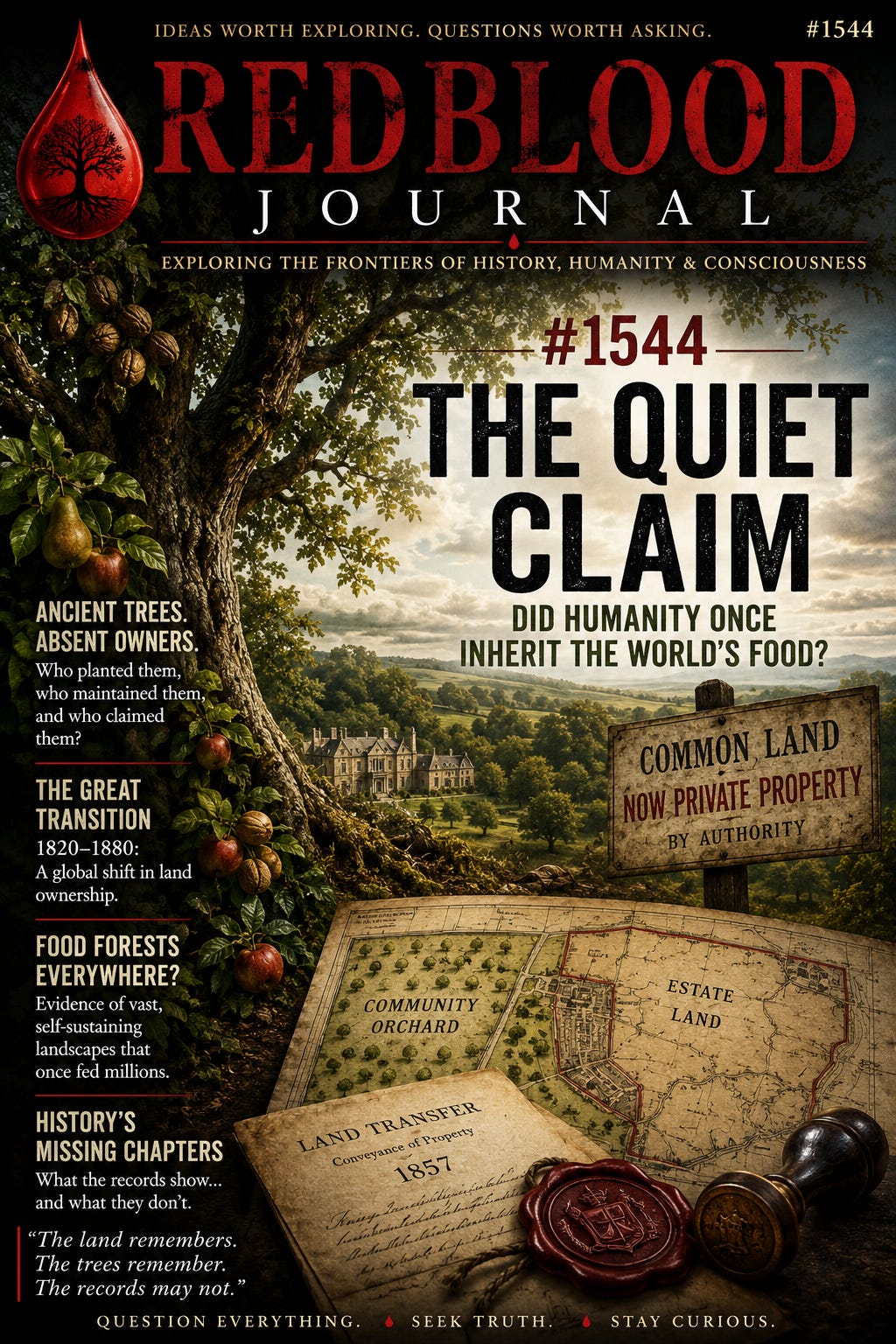
#1544 — The Quiet Claim
🩸 Red Blood Journal
Did Humanity Once Inherit the World’s Food?
Every civilization inherits stories.
Some stories are supported by overwhelming historical evidence.
Others remain mysteries.
And some exist only as ideas that invite investigation.
This report explores one such idea.
Not as established history.
Not as proven fact.
But as a question that deserves careful thought.
The Idea
Imagine a world where food was not primarily produced by annual farming, industrial agriculture, or private corporations.
Instead, imagine landscapes naturally filled with mature fruit trees, nut trees, medicinal plants, and perennial ecosystems capable of feeding entire populations with relatively little maintenance.
These landscapes are often referred to today as food forests.
The idea behind Report #1544 suggests that such systems may once have existed on a far larger scale than modern history acknowledges.
A Curious Historical Window
According to the idea, a remarkable transition appears to occur during the nineteenth century.
Across many regions of the world, communal lands became:
Private estates
Royal parks
State forests
Colonial holdings
Protected properties
The timing appears surprisingly similar across numerous countries.
Supporters of the idea ask whether this was merely administrative modernization—or whether something larger was taking place.
The Ancient Trees
One observation repeatedly raised involves very old trees.
Throughout Europe and elsewhere, some of the oldest surviving trees are not ornamental species.
They are:
Walnut
Chestnut
Apple
Pear
Mulberry
Quince
Many appear to predate the estates and parks that now surround them.
The question naturally follows:
Who planted them?
And perhaps more importantly,
Who benefited from them before modern ownership records began?
Commons Become Property
History unquestionably records numerous enclosure movements throughout Europe and later throughout colonial territories.
Land that had once been available for communal use gradually became legally owned.
This much is historically documented.
Idea #1544 asks readers to consider whether these legal transitions may have involved more than simple changes in administration.
Could productive communal landscapes have gradually become restricted private assets?
The Missing Chapters
The proposal points toward an unusual pattern.
Many historical records begin with ownership already established.
What appears less common is detailed documentation explaining what existed immediately before the first formal registration.
The report asks whether this absence represents:
Lost records
Ordinary historical gaps
Administrative simplification
—or whether important parts of earlier land history have simply faded from collective memory.
The answer remains unknown.
Parks That Once Fed People?
Another fascinating observation concerns historic parks.
Many famous estates and royal gardens contain centuries-old food-producing trees that appear older than the parks themselves.
Rather than concluding anything definite, Idea #1544 asks an intriguing question:
Were some modern ornamental parks originally productive landscapes that later changed purpose?
The evidence required to answer that question remains incomplete.
Ownership and Food
Regardless of whether every aspect of the idea proves correct, it raises a broader philosophical question.
What happens when something that once belonged to everyone gradually belongs to someone?
Ownership changes more than legal documents.
It changes access.
It changes dependence.
It changes economics.
And eventually it changes how future generations imagine the world has always been.
Reading Between the Lines
History is often remembered through governments, kings, wars, and treaties.
But history can also be read through landscapes.
Old roads.
Ancient orchards.
Forgotten maps.
Tree rings.
Property records.
And the quiet questions nobody thought to ask.
Sometimes history is not hidden by what is written.
Sometimes it is hidden by what is never written at all.
The Lesson
Whether Idea #1544 ultimately proves accurate, partially accurate, or entirely mistaken, it reminds us of something valuable.
Civilizations should never stop asking questions.
Curiosity is not the enemy of history.
It is one of the tools that allows history to continually refine itself.
The strongest ideas are those willing to face both supporting evidence and contradictory evidence with equal honesty.
Perhaps the greatest lesson is not about who owned the trees.
Perhaps it is about remembering to ask how ownership begins in the first place.
Final Thought
Every generation inherits both knowledge and assumptions.
The challenge is learning which is which.
Some forests feed the body.
Others feed the imagination.
The wisest explorers learn to walk through both with open eyes, careful judgment, and respect for evidence wherever it may lead.
🩸 RedBloodJournal.com 🩸
Subject: The Quiet Claim — Did Humanity Once Inherit the World’s Food?
Tags: #1544 #FoodForests #History #LandOwnership #Commons #Property #AncientTrees #HistoricalInquiry #AlternativeHistory #RedBloodJournal
🩸🌊✨ Fantastic! May every question lead not to division, but to greater understanding. In the vast Ocean of Love and Positivity, truth has nothing to fear from honest inquiry.
🌳
🌳The Quiet Claim: A Legacy of Forgotten Food Forests
Jul 24, 2026
This text explores the alternative historical theory that the world was once covered in vast, communal food forests rather than the industrial farms we see today. The author suggests that these productive landscapes were systematically converted into private estates and royal parks during the nineteenth century, effectively hiding their original purpose. By examining ancient fruit and nut trees that appear older than the properties surrounding them, the report questions whether modern land ownership erased a legacy of universal food access. The narrative highlights the global enclosure movements that transformed common resources into restricted assets, potentially altering human independence. Ultimately, the source encourages readers to investigate historical gaps and reconsider how our ancestors might have sustained themselves before the advent of private property records. It serves as a philosophical inquiry into how collective memory can be reshaped by changing social and legal structures over time.


