


🩸 Red Blood Journal
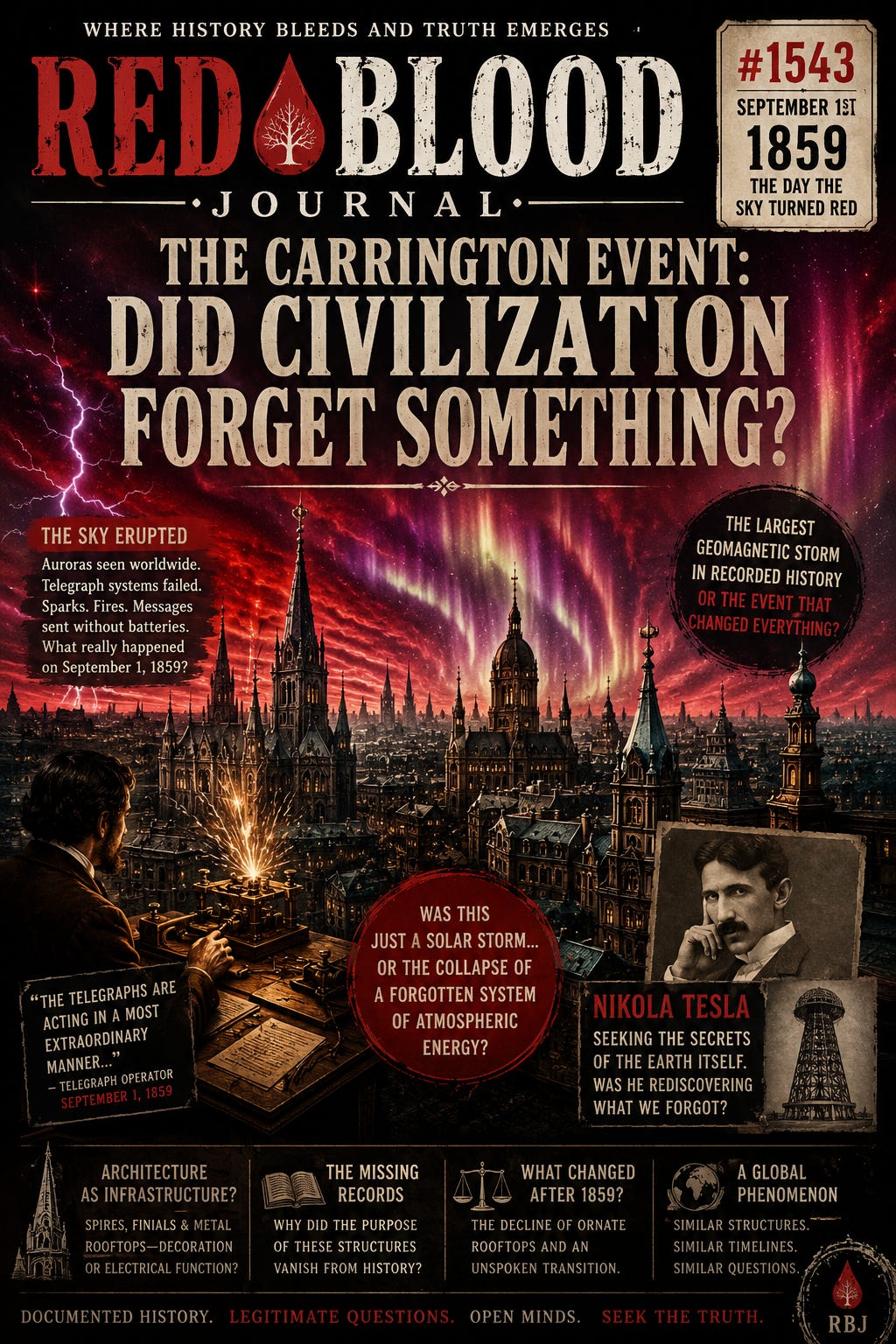
#1543 – The Carrington Event: Did Civilization Forget Something?
When the Sky Turned Red
On September 1, 1859, the world witnessed one of the most extraordinary natural events ever recorded.
The sky glowed red across continents.
Auroras appeared far beyond the polar regions.
Telegraph systems across Europe and North America malfunctioned. Operators reported sparks, electrical shocks, and in some cases messages continued to transmit even after batteries had been disconnected.
History remembers this event as The Carrington Event, named after British astronomer Richard Carrington, who observed an enormous solar flare shortly before the geomagnetic storm reached Earth.
Modern science considers it the most powerful geomagnetic storm in recorded history.
Few scientists dispute that conclusion.
But beyond the accepted science lies another question.
The Question That Refuses to Disappear
The official explanation successfully describes what happened in the sky.
It explains charged particles.
It explains Earth’s magnetic field.
It explains disrupted telegraph lines.
Yet some researchers and independent investigators have asked whether there may be parts of the historical record that remain incomplete.
Not necessarily wrong.
Simply incomplete.
The Architecture Mystery
Walk through photographs of cities built before the late nineteenth century.
Large civic buildings.
Cathedrals.
Universities.
Government buildings.
Railway stations.
Many display remarkably similar features:
Tall spires
Copper finials
Metal rooftop structures
Internal metal frameworks
Elaborate conductive ornamentation
The conventional explanation is straightforward.
Decoration.
Religious symbolism.
Lightning protection.
But some observers ask another question:
Why did so many civilizations repeatedly construct similar metal structures at the highest points of their most important buildings?
Coincidence?
Tradition?
Or function?
A Forgotten Technology?
One speculative theory proposes that these architectural elements may once have interacted with atmospheric electricity.
According to this hypothesis:
Buildings were designed to collect or manage electrical charge.
Large structures formed parts of distributed energy systems.
Atmospheric electricity may have been better understood than history presently acknowledges.
There is presently no accepted archaeological or engineering evidence proving such a worldwide energy network existed.
Nevertheless, the idea continues to attract curiosity because of the remarkable similarities found in monumental architecture across different cultures.
Tesla’s Shadow
Nikola Tesla devoted much of his later career to studying Earth’s electrical environment.
His Wardenclyffe Tower sought to transmit electrical energy without conventional wires.
Tesla frequently described nature itself as an electrical system.
Some interpret his work as an attempt to discover something entirely new.
Others wonder whether he believed he was rediscovering knowledge that earlier civilizations may have understood differently.
History offers no definitive answer.
After 1859
Another observation raised by proponents of the hypothesis is that architecture appears to change during the decades following the Carrington Event.
Older buildings were renovated.
Many ornate rooftop structures disappeared.
Architectural styles became simpler.
Copper ornamentation became less common.
Mainstream historians generally attribute these changes to industrialization, changing construction methods, economics, urban redevelopment, and evolving architectural styles.
Others ask whether something else may also have contributed.
The Missing Records
Perhaps the most intriguing question is not what disappeared.
It is whether anyone knew what had disappeared.
If a forgotten technology once existed, would later generations even know what questions to ask?
History preserves many buildings.
It preserves photographs.
But documentation describing the exact purpose of many architectural details is often sparse.
Whether this represents ordinary historical loss or something more remains open to interpretation.
Two Ways to View the Story
View One
The Carrington Event was exactly what science describes:
An exceptionally powerful solar storm that temporarily disrupted the electrical technology of its day.
View Two
The Carrington Event may have exposed or disrupted a relationship between civilization and atmospheric electricity that humanity later abandoned, forgot, or replaced.
At present, this remains speculation rather than established historical fact.
Final Thoughts
Sometimes history advances by proving new ideas.
Sometimes it advances by asking better questions.
The Carrington Event is unquestionably real.
The red skies were real.
The geomagnetic storm was real.
The telegraph disruptions were real.
Whether there was anything more hidden within that remarkable day remains unknown.
Perhaps future discoveries will reinforce the conventional explanation.
Perhaps they will reveal details not yet understood.
Until then, the Carrington Event serves as a reminder that every generation inherits not only knowledge—but also unanswered questions.
Subject: The Carrington Event: Science, Speculation, and the Architecture of a Forgotten World
Tags: #CarringtonEvent #1859 #SolarStorm #History #Architecture #Tesla #AtmosphericElectricity #GeomagneticStorm #HistoricalMysteries #RedBloodJournal
🩸 RedBloodJournal.com 🩸
May every unanswered question inspire deeper investigation rather than certainty, and may every search for truth lead us closer to wisdom in the vast ocean of knowledge, humility, and love that connects us all.
🩸🌊✨ Fantastic!
☀️
The Carrington Event and the Mystery of Atmospheric Architecture
Jul 24, 2026
The Carrington Event of 1859 is primarily recognized by science as a massive geomagnetic storm that caused vivid red auroras and disrupted global telegraph systems. However, this text explores an alternative hypothesis suggesting that the ornate architecture of the pre-industrial era may have been designed to harness atmospheric electricity. Proponents of this theory point to the common use of metal spires and copper finials on historical buildings, suggesting these were functional components of an ancient energy network rather than mere decoration. The narrative posits that the solar storm might have compromised this forgotten technology, leading to the simpler architectural styles observed in the late nineteenth century. While mainstream historians attribute these changes to industrialization and economics, the text highlights the work of Nikola Tesla as a possible attempt to rediscover this lost understanding of nature’s electrical systems. Ultimately, the source presents a dual perspective, weighing established scientific facts against speculative theories regarding the mysteries of our technological past.


