



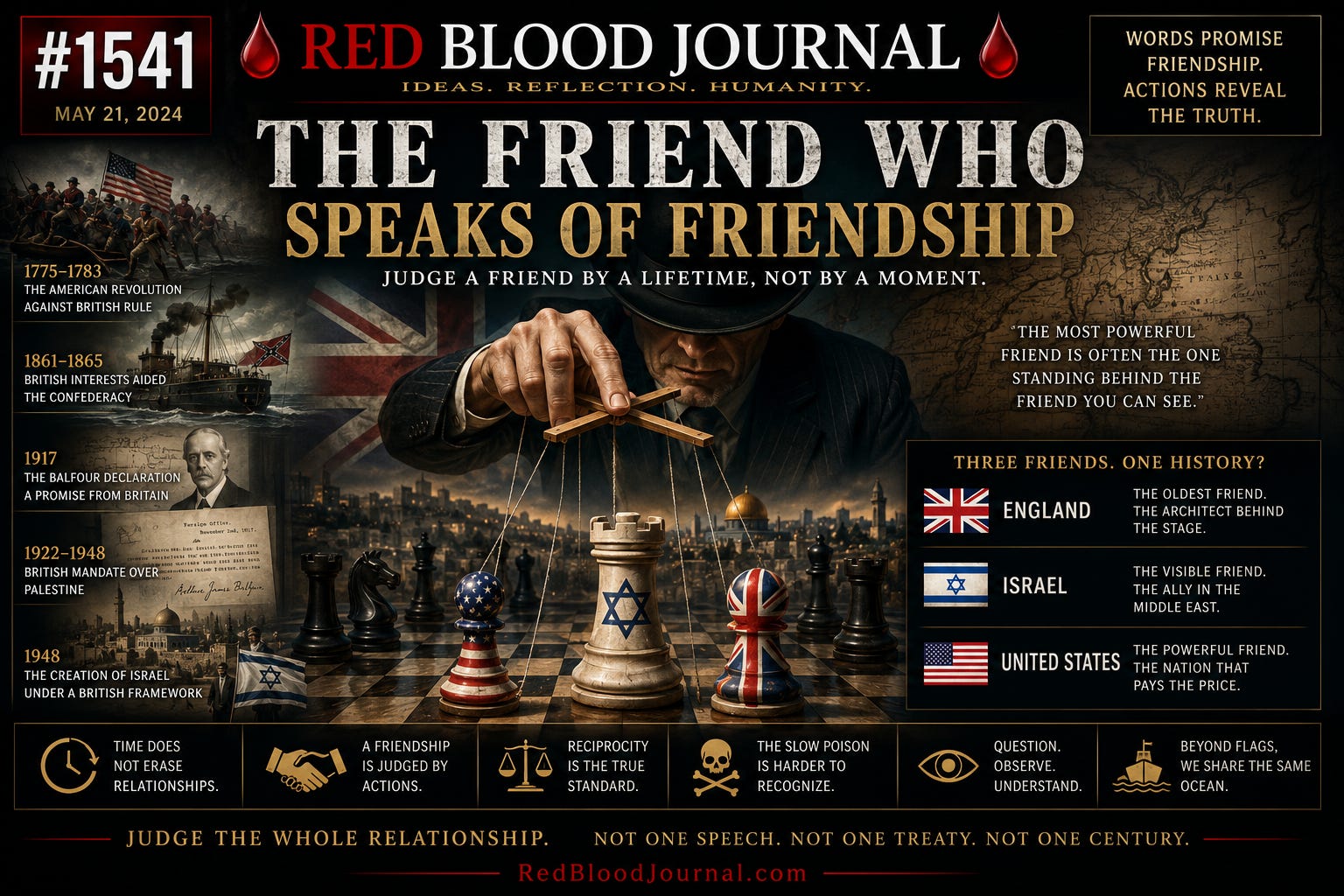
🩸 #1541 The Friend Who Speaks of Friendship
🩸 RedBloodJournal.com
#1541 – The Friend Who Speaks of Friendship
When Words Promise Friendship but Actions Tell Another Story
There is an old observation that words reveal intentions, but actions reveal priorities.
An individual may repeatedly hear,
“I value our friendship.”
Yet over time, reality begins to tell a different story.
The friendship slowly becomes one-sided.
The requests continue.
The sacrifices continue.
The giving continues.
But the receiving slowly disappears.
Nothing dramatic happens in a single day.
Instead, life becomes a gradual exchange where one side continually invests while the other continually benefits.
Eventually a simple question emerges:
If friendship is measured by actions rather than words, what kind of friendship is this?
The same question can be asked not only between individuals but also between nations.
Throughout history, governments have described one another as partners, allies, strategic friends, brothers, and indispensable allies.
Diplomatic language is often filled with promises of cooperation, mutual security, shared prosperity, common values, and lasting friendship.
Yet every generation eventually judges those relationships not by speeches but by results.
Does the relationship strengthen both societies?
Does it leave both populations more prosperous?
More independent?
More secure?
Or does one side become increasingly dependent while the other accumulates greater influence?
Sometimes the greatest danger is not open hostility.
An obvious enemy can be recognized.
People prepare for enemies.
People defend themselves against enemies.
The more difficult challenge is distinguishing between genuine partnership and a relationship that gradually weakens one side while continuously strengthening the other.
History contains examples where alliances produced extraordinary prosperity.
History also contains examples where unequal partnerships eventually generated resentment because many citizens believed the balance of benefits had shifted too far in one direction.
The deeper question therefore is not simply:
Who calls himself a friend?
The deeper question is:
Who consistently behaves like one?
Friendship Is Judged Across Time
Friendship is never judged by one afternoon.
It is judged across an entire relationship.
No one excuses years of harmful actions simply because today’s conversation sounds pleasant.
Every promise...
Every sacrifice...
Every betrayal...
Every act of support...
becomes part of the evidence.
Time does not erase friendship.
Time reveals it.
The same principle applies to nations.
When examining the relationship between countries, history cannot be divided into isolated chapters simply because governments have changed.
Institutions survive.
Financial systems survive.
Intelligence relationships survive.
Strategic interests survive.
Empires disappear in name while many of their institutions continue under different forms.
A nation therefore has every right—even every responsibility—to judge its friendships across centuries rather than election cycles.
The Friend Behind the Friend
Modern political discussion often focuses upon the visible relationship between the United States and Israel.
It dominates headlines.
Military cooperation.
Intelligence sharing.
Diplomatic disputes.
Congressional debates.
Foreign aid.
Regional conflict.
Yet another historical perspective asks a different question.
Is the most visible friend necessarily the oldest or most influential friend?
History shows that Britain occupied a unique position long before the modern alliance between Washington and Jerusalem developed.
The American colonies fought Great Britain to gain independence.
During the American Civil War, Britain officially remained neutral, yet important British commercial and shipbuilding interests materially assisted the Confederacy through financing, commerce, and the construction of Confederate naval vessels.
Decades later, Britain became the imperial authority responsible for governing Palestine.
The British government issued the Balfour Declaration.
The British Mandate incorporated that declaration into international administration.
Britain therefore became one of the principal governmental architects of the political framework from which the State of Israel eventually emerged.
Private financial support for early Jewish settlements came from several sources, including members of the Rothschild family.
The political framework, however, was established through British imperial policy.
These are historical events.
From these events, different people draw different conclusions.
Some conclude that Britain simply played its historical role before passing leadership to the United States.
Others believe Britain’s influence continues through diplomacy, finance, intelligence cooperation, legal institutions, and long-standing strategic relationships.
This report does not ask the reader to accept one conclusion without examination.
It simply asks whether history should be considered as one continuous relationship rather than disconnected episodes.
The Visible Friend and the Older Friend
Israel may today appear as America’s closest Middle Eastern ally.
Britain may appear to play a quieter role.
But friendships are not measured only by today’s headlines.
They are measured by the entire history that produced today’s circumstances.
The officials change.
Governments change.
Flags change.
Political parties change.
Methods evolve.
Open empire becomes diplomacy.
Direct administration becomes partnership.
Military occupation becomes strategic influence.
Power rarely disappears.
It usually changes its form.
Whether one ultimately concludes that Britain, the United States, Israel, the European Union, or another actor exercises the greatest influence is a matter for historical and political debate.
The important principle remains unchanged.
Do not judge friendship by appearances alone.
Judge it by its entire history.
The Slow Poison
Perhaps the greatest danger is not open hostility.
An enemy can be recognized.
An enemy prepares you to defend yourself.
A smiling friend who gradually weakens your independence is much more difficult to recognize.
The most dangerous poison is often administered in very small doses.
Not enough to kill.
Only enough to slowly redirect.
One concession.
One dependency.
One agreement.
One obligation.
One generation at a time.
Eventually the direction has completely changed while few remember where the journey began.
The same principle exists between individuals.
The same principle may exist between nations.
A friendship that continually requires sacrifice from only one side slowly ceases to resemble friendship.
It begins to resemble dependence.
The Standard of Every Friendship
Every nation should periodically ask the same questions every individual asks.
Does this friendship strengthen both sides?
Does it preserve independence?
Does it increase prosperity?
Does it encourage sovereignty?
Does it respect mutual benefit?
Or has one partner become accustomed to giving while the other becomes accustomed to receiving?
These questions are not accusations.
They are responsibilities.
Because friendship without honest evaluation eventually becomes habit.
Habit eventually becomes dependency.
Dependency eventually becomes accepted reality.
The Whole Relationship
The greatest mistake may be judging nations only through today’s events.
History is one continuous conversation.
The Revolutionary War...
The Civil War...
The British Empire...
The Mandate for Palestine...
The creation of Israel...
Modern alliances...
Intelligence cooperation...
Financial systems...
Military agreements...
They are often discussed separately.
Yet history itself is continuous.
The relationship cannot be fully understood by separating each chapter from the book.
Whether one believes Britain remains the principal long-term influence behind the Western alliance, or believes leadership has genuinely shifted elsewhere, every reader should examine the evidence across the full historical timeline rather than only the latest headline.
Friendship deserves that same standard.
Judge the whole relationship.
Not one administration.
Not one treaty.
Not one speech.
Not one century.
The whole relationship.
🩸 Subject: #1541 – The Friend Who Speaks of Friendship: Judging Nations by the Whole Relationship
In the end, every individual and every nation eventually discovers that friendship is measured not by promises spoken in moments of convenience, but by the accumulated weight of actions across generations. History cannot be divided into isolated pieces simply because time has passed. Each generation inherits the consequences of those relationships and also inherits the responsibility to examine them with honesty, humility, and an independent conscience. Beyond governments, empires, and alliances lies the same ocean that surrounds every shore, reminding humanity that truth is best pursued through careful observation, thoughtful reflection, and a willingness to judge actions more heavily than words.
🩸🌊✨ Fantastic!
⚖️
The Whole Relationship:
Judging Alliances Beyond Words
Jul 23, 2026
This text examines the distinction between professed friendship and genuine partnership, emphasizing that the true nature of a relationship is revealed through consistent actions rather than diplomatic rhetoric. The author argues that both personal and international bonds must be evaluated by whether they foster mutual independence or create one-sided dependency. By looking at the historical roles of Britain, the United States, and Israel, the source suggests that modern alliances are often the result of long-term institutional and imperial legacies. Readers are encouraged to judge these connections across entire centuries rather than focusing on current headlines or specific political administrations. Ultimately, the piece warns that a relationship requiring continuous sacrifice from only one side is not a friendship, but a form of gradual subjugation. True understanding requires an honest analysis of the cumulative weight of history and the long-term priorities revealed by results.


