


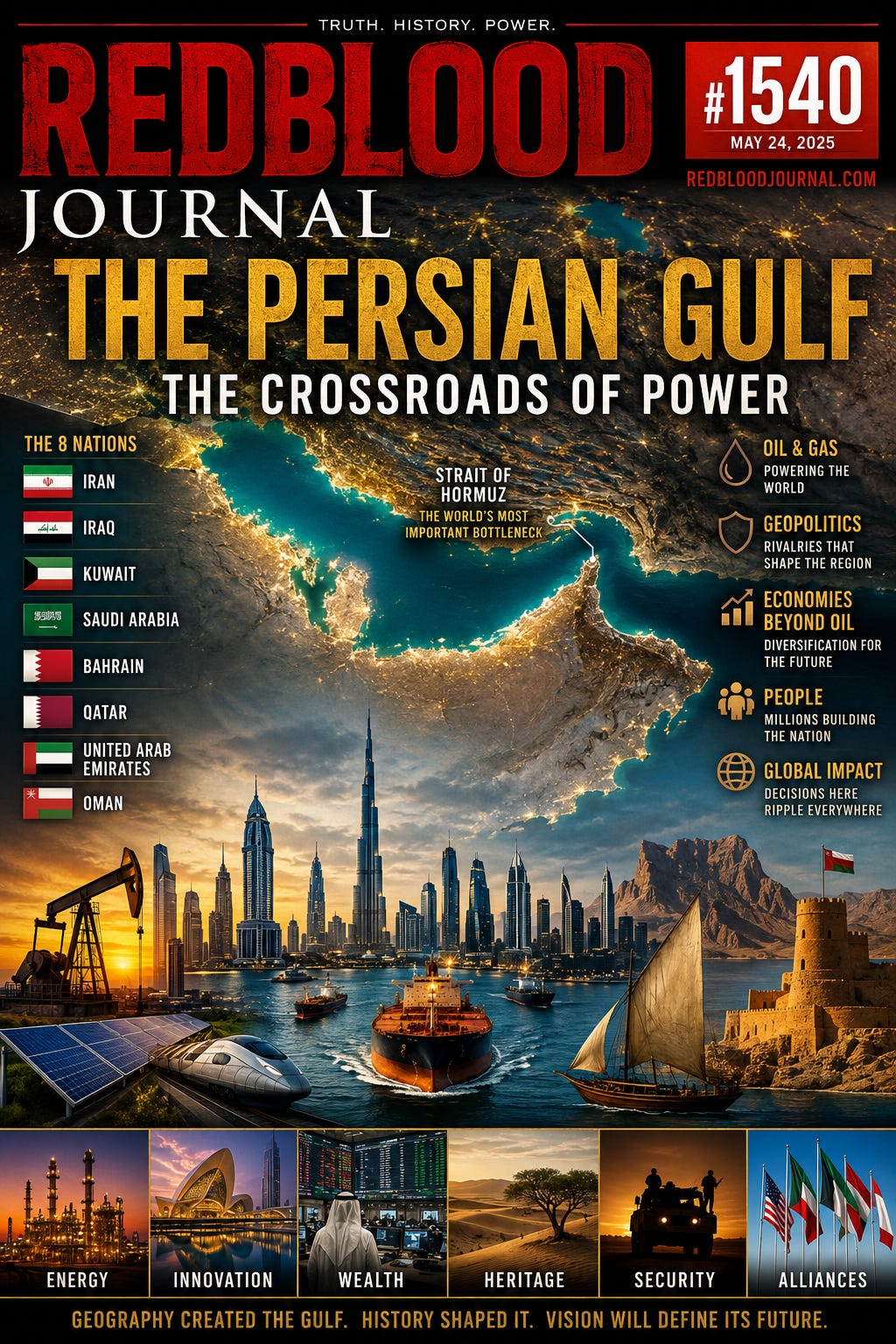
🩸 #1540 — The Persian Gulf: The Crossroads of Power
🩸 Red Blood Journal
1540 — The Persian Gulf: The Crossroads of Power
Why the World’s Eyes Never Leave These Waters
For thousands of years, the Persian Gulf has been far more than a body of water.
It has been a highway of civilizations.
A battlefield of empires.
A source of unimaginable wealth.
And one of the few places on Earth where geography alone can influence the entire global economy.
To understand today’s Middle East, one must first understand the Persian Gulf.
The Seven Arab Gulf States and Iran
The Persian Gulf is bordered by eight nations.
Iran
The largest country on the Gulf, with a civilization stretching back thousands of years. Persia once ruled one of history’s greatest empires, and today Iran remains one of the region’s dominant military and political powers.
Iraq
Although Iraq possesses only a short coastline on the Gulf, it has enormous oil reserves and has played a central role in nearly every major Gulf conflict of the last century.
Kuwait
A small nation whose vast oil reserves transformed it into one of the wealthiest countries per capita. Its 1990 invasion by Iraq changed Middle Eastern history and led to the Gulf War.
Saudi Arabia
The largest Arab country bordering the Gulf.
Home to Islam’s holiest cities and some of the world’s largest proven oil reserves, Saudi Arabia has become one of the region’s most influential political and economic powers.
Bahrain
A small island kingdom that became a major financial center.
It also hosts the United States Fifth Fleet, making it strategically important far beyond its size.
Qatar
Once known primarily for pearl diving, Qatar now possesses one of the world’s largest natural gas reserves and has become a global diplomatic and media player.
United Arab Emirates
A federation formed in 1971 from seven emirates.
The UAE transformed itself from small fishing communities into one of the world’s most modern economies through oil revenues, investment, trade, tourism, aviation, and finance.
Oman
Located at the entrance to the Gulf, Oman controls part of the Strait of Hormuz and has traditionally maintained a neutral foreign policy, often serving as a quiet mediator in regional disputes.
Geography Created Strategy
The Persian Gulf itself is relatively small.
Yet nearly one-third of the world’s seaborne oil exports travel through its narrow entrance:
The Strait of Hormuz.
At its narrowest point, only a few dozen miles separate Iran from Oman.
Every tanker carrying oil toward Europe, Asia, or North America must pass through this bottleneck.
If Hormuz closes, energy markets around the world immediately react.
Oil Changed Everything
Before oil, much of the Gulf economy depended upon:
Fishing
Pearl diving
Camel caravans
Maritime trade
Everything changed after the discovery of oil during the twentieth century.
Oil revenues financed:
Modern cities
Airports
Universities
Hospitals
Highways
Ports
Sovereign wealth funds
Military modernization
Entire skylines rose from what had once been desert villages.
Beyond Oil
Many Gulf nations recognize that oil will not last forever.
Today they invest heavily in:
Artificial Intelligence
Renewable energy
Nuclear power
Finance
Tourism
Aviation
Logistics
Technology
Space exploration
Their goal is to transform natural resource wealth into long-term economic resilience.
The Region’s Great Rivalry
Much of Gulf politics revolves around one central competition:
Iran and Saudi Arabia.
Their differences include:
Security interests
Regional influence
Different political systems
Religious leadership
Military alliances
This rivalry has shaped conflicts throughout the Middle East for decades.
Why Outside Powers Care
Throughout history, outside powers have sought influence over the Gulf.
Among them:
Portuguese Empire
Ottoman Empire
British Empire
United States
Soviet Union
Russia
China
The reason remains remarkably consistent:
Energy.
Trade.
Military access.
Global stability.
The Gulf Cooperation Council (GCC)
The GCC includes:
Saudi Arabia
United Arab Emirates
Qatar
Kuwait
Bahrain
Oman
It promotes economic cooperation, security coordination, and regional integration among its members.
Iran and Iraq are not members.
Wealth Beyond Oil
Several Gulf countries now manage some of the world’s largest sovereign wealth funds.
Rather than spending all oil income immediately, they invest globally in:
Companies
Infrastructure
Real estate
Technology
Financial markets
These investments are intended to generate income long after oil production declines.
The Human Side
One of the Gulf’s most remarkable characteristics is its demographics.
In several Gulf states, expatriate workers significantly outnumber native citizens.
Millions have arrived from:
India
Pakistan
Bangladesh
Philippines
Egypt
Jordan
Europe
North America
Their labor has helped build many of the modern cities seen today.
The Challenges Ahead
The Gulf now faces a new generation of questions.
Can economies diversify successfully?
Can regional rivalries be managed peacefully?
Can water shortages be solved?
Can prosperity continue after oil?
Can technological innovation replace natural resources as the engine of growth?
These questions will shape the next century.
Final Thoughts
The Persian Gulf is not merely a collection of wealthy states connected by oil.
It is one of the world’s great strategic crossroads—where geography, commerce, history, religion, diplomacy, and energy converge.
Empires have competed for these waters for centuries.
Modern nations continue to invest, negotiate, and prepare for the future because what happens in the Persian Gulf rarely remains confined to the Gulf itself.
Whether through energy markets, global trade, financial investment, or international security, the decisions made along these shores often ripple across the entire world.
Perhaps that is the greatest lesson the Persian Gulf offers: geography may shape opportunity, but leadership, cooperation, and long-term vision determine whether a region merely survives—or truly prospers.
🩸 RedBloodJournal.com
🌊✨ Fantastic!
🌍 The Persian Gulf:
Global Crossroads of Power and Energy
Jul 23, 2026
The provided text explores the Persian Gulf’s critical role as a global geopolitical and economic hub, highlighting how its unique geography influences international stability. It details the eight bordering nations, noting their transition from traditional pearl diving and trade to becoming massive energy powerhouses fueled by oil and natural gas. Central to the narrative is the Strait of Hormuz, a vital maritime chokepoint through which a significant portion of the world’s petroleum flows. The source also examines the regional rivalries and internal demographics that define the area, specifically the competition between Iran and Saudi Arabia. Ultimately, the text illustrates how these desert kingdoms are now diversifying their wealth into technology and infrastructure to ensure a future beyond fossil fuels. Therefore, the Gulf remains a strategic crossroads where energy markets, military interests, and global trade intersect.


