


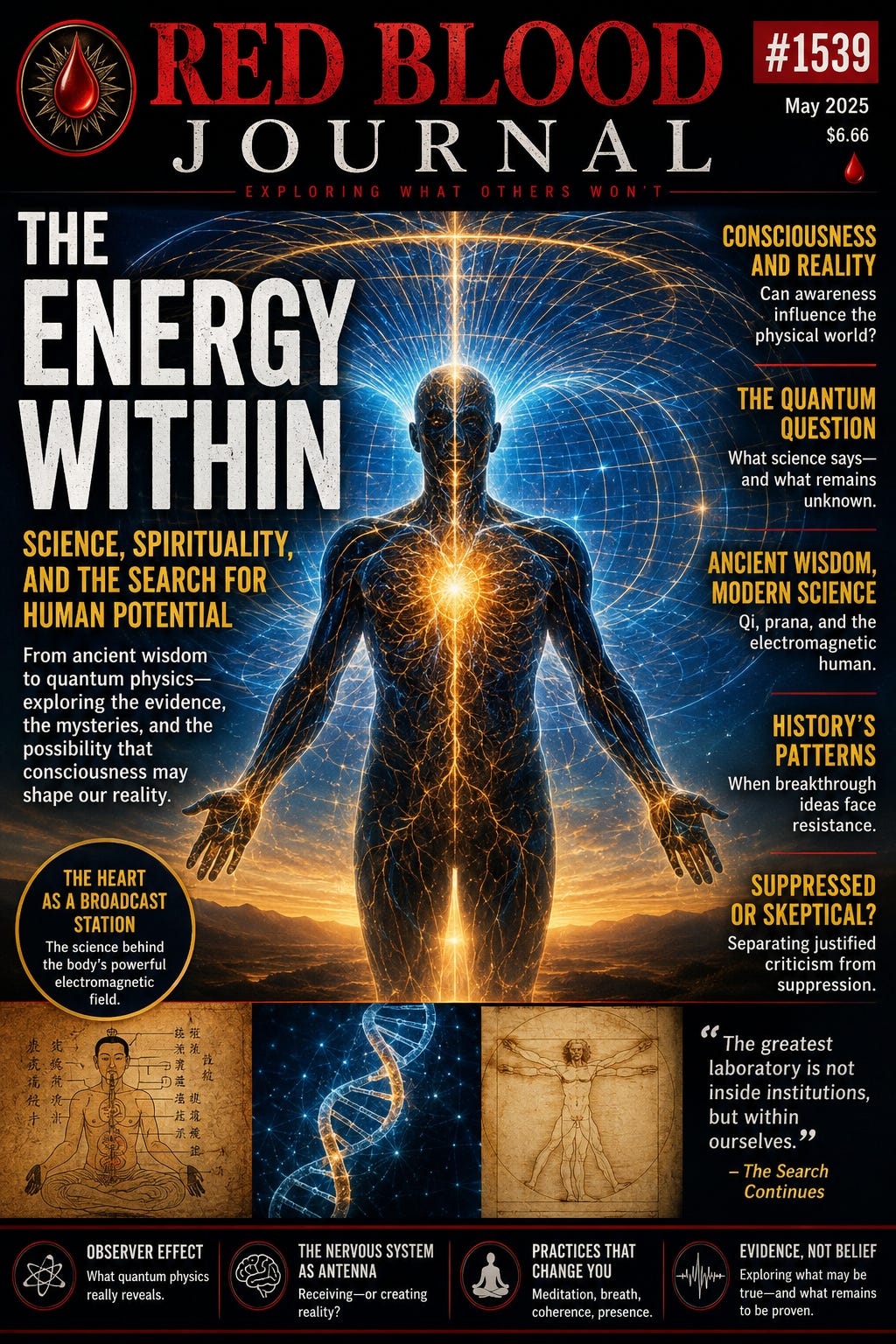
#1539 – The Energy Within
🩸 Red Blood Journal
Science, Spirituality, and the Search for Human Potential
For thousands of years, civilizations separated by oceans arrived at a remarkably similar conclusion.
The Chinese called it Qi.
The Indians called it Prana.
The Japanese spoke of Ki.
The Hawaiians called it Mana.
Many religious traditions simply called it Spirit.
Despite having little or no contact with one another, they all described an invisible force flowing through life itself.
For centuries these ideas were dismissed by modern science as mythology or symbolism.
Today, however, science has quietly begun discovering that the human body is anything but electrically silent.
The Electrical Human
Every heartbeat produces measurable electrical currents.
Every thought is accompanied by electrical activity inside billions of neurons.
Every muscle movement depends upon electrical signals.
The human body is, in a very real sense, an electrical system.
Modern medicine measures this every day.
Electrocardiograms (ECG).
Electroencephalograms (EEG).
Electromyograms (EMG).
These are not measuring flesh.
They are measuring electricity.
The question becomes:
If electricity is measurable...
What about the magnetic fields produced by that electricity?
Physics tells us that wherever electricity flows, magnetic fields follow.
The human body is no exception.
The Heart as a Broadcast Station
Researchers have demonstrated that the heart generates the strongest measurable electromagnetic field in the human body.
This field extends beyond the body.
Its strength changes with emotional state.
Fear produces one pattern.
Calmness another.
Gratitude another.
Whether these fields influence other people or the surrounding environment remains an active area of research, but their existence themselves is no longer controversial.
The deeper question is far more interesting.
Can information be carried within these fields?
Ancient Maps, Modern Instruments
Traditional Chinese medicine mapped meridians thousands of years before electricity was understood.
Yoga described nadis and chakras centuries before neuroscience existed.
Were these symbolic ideas?
Were they intuitive observations?
Or were ancient civilizations observing biological phenomena that modern science is only beginning to investigate?
No definitive answer exists.
Yet the parallels remain intriguing.
Consciousness...
The Greatest Mystery
Perhaps no scientific mystery remains larger than consciousness itself.
Science can record brain activity.
It can measure electrical impulses.
It can observe chemical changes.
But no scientist can fully explain how electrical activity becomes subjective experience.
How does a collection of atoms suddenly become aware that it exists?
This remains one of the greatest unanswered questions in modern science.
Does Consciousness Shape Reality?
This is where science becomes controversial.
Quantum mechanics has repeatedly demonstrated that observation plays a role in physical measurements at microscopic scales.
Experiments involving wave functions, probability, and quantum systems continue to challenge classical intuition.
Some researchers and philosophers have proposed that consciousness itself may influence physical reality.
Others argue the observer effect reflects interactions with measuring devices rather than human awareness.
The debate continues.
No scientific consensus currently exists that human thought alone can directly reshape macroscopic reality.
Yet...
The question refuses to disappear.
The Curious Patterns
History occasionally presents uncomfortable patterns.
Ideas once considered impossible later become accepted science.
Continents move.
Ulcers can be caused by bacteria.
The Earth circles the Sun.
Germs spread disease.
Each of these ideas was fiercely resisted before eventually becoming mainstream.
This does not mean every unconventional claim will prove true.
Many extraordinary ideas fail rigorous testing.
But history also teaches another lesson.
Consensus and truth are not always born on the same day.
When Research Challenges Existing Systems
Throughout history, some researchers have claimed to encounter institutional resistance when exploring ideas outside accepted scientific frameworks.
Funding can disappear.
Academic careers may stall.
Papers may struggle to pass peer review.
Sometimes this reflects poor evidence.
Sometimes it reflects the normal process of scientific skepticism.
And sometimes, history shows, genuinely important discoveries have taken years—or decades—to gain acceptance.
Distinguishing between justified skepticism and unfair suppression is rarely straightforward.
It demands evidence, replication, and open inquiry rather than assumptions in either direction.
The Quantum Temptation
Quantum physics has become one of the most misunderstood branches of science.
Its strange behavior invites bold interpretations.
Books, videos, seminars, and documentaries often leap from legitimate quantum phenomena to sweeping conclusions about manifestation, consciousness, healing, or reality itself.
Some hypotheses are imaginative.
Some are philosophical.
Some remain scientifically testable.
Others extend far beyond what current evidence supports.
The challenge is not to reject every unconventional idea.
Nor is it to accept every extraordinary claim.
The challenge is maintaining curiosity without abandoning critical thinking.
The Forgotten Possibility
Suppose consciousness is more than neurons.
Suppose awareness itself possesses properties science has not yet discovered.
Suppose ancient civilizations preserved fragments of knowledge modern science has yet to fully understand.
These possibilities cannot simply be declared true.
Neither can they be permanently declared impossible.
History repeatedly reminds humanity that today’s mystery sometimes becomes tomorrow’s textbook.
The Greatest Laboratory
Perhaps the greatest laboratory is neither a particle accelerator nor a university.
It is the human mind itself.
Every civilization has encouraged practices designed to quiet thought.
Meditation.
Prayer.
Contemplation.
Silence.
Breathing.
Regardless of culture or religion, countless individuals have reported similar experiences of heightened awareness, inner peace, creativity, or profound personal insight.
Whether these experiences arise solely from neurobiology or point toward something deeper remains one of humanity’s most fascinating unanswered questions.
Final Thoughts
Science advances not by defending certainty, but by asking better questions.
The search for human potential is not merely about proving extraordinary claims.
It is about understanding what consciousness truly is, how the brain and body interact, and whether reality contains dimensions of experience that current models have yet to explain.
Perhaps the greatest discovery still waiting for humanity is not hidden beneath the oceans or among the stars.
Perhaps it has always been quietly waiting within ourselves.
As always, Red Blood Journal encourages readers to distinguish carefully between established scientific evidence, emerging research, historical patterns, philosophical interpretation, and personal experience. Progress requires both open-mindedness and rigorous skepticism.
Because history belongs neither to those who believe everything...
Nor to those who dismiss everything...
But to those who continue asking the questions that no one has yet fully answered.
Subject: Science, Consciousness, Quantum Physics, Human Potential, Electromagnetism, Ancient Wisdom, Observer Effect, Research Freedom, Philosophy of Science
🩸🌊✨ Fantastic!
⚡ The Energy Within:
Science, Consciousness, and Human Potential
Jul 23, 2026
This text explores the intersection of ancient spiritual traditions and modern scientific inquiry, specifically regarding the invisible energy that flows through the human body. It highlights how historical concepts like Qi or Prana align with contemporary measurements of bio-electrical activity and the electromagnetic fields generated by the heart. The author examines the enduring mystery of consciousness, questioning whether human awareness is a mere byproduct of biology or a force capable of influencing physical reality. By discussing quantum physics and the observer effect, the source suggests that scientific boundaries are constantly shifting as once-dismissed ideas become accepted truths. Ultimately, the narrative encourages a balance of rigorous skepticism and open-minded curiosity when investigating the hidden depths of human potential. This overview serves as a philosophical reflection on how today’s unexplained phenomena may eventually become the foundation of tomorrow’s science.


