


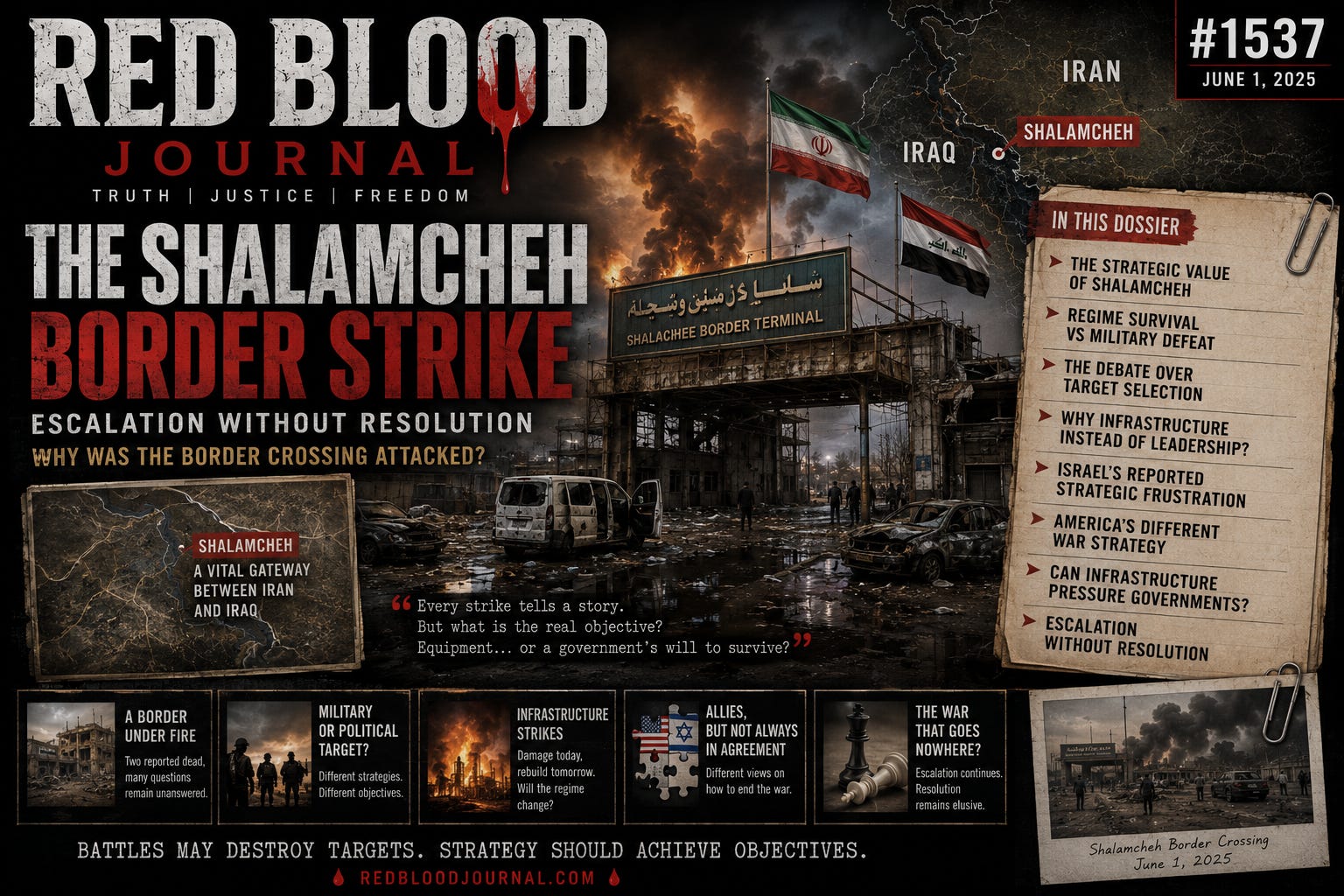
#1537 – The Shalamcheh Border Strike
🩸 Red Blood Journal
Military & Geopolitical
Escalation Without Resolution
Every war eventually reaches a point where observers begin asking a simple question:
What is the actual objective?
Not the official objective.
Not the political speeches.
Not the daily headlines.
The real objective.
The recent strike near the Shalamcheh border crossing, one of the principal gateways between Iran and Iraq, has revived exactly that question. Reports and commentary surrounding the attack immediately generated competing explanations. Some focused on its military value. Others pointed to speculation about the presence of senior security officials. Still others viewed the strike as part of a broader campaign to pressure Iran back toward negotiations.
The differing interpretations illustrate how difficult it can be to determine strategic intent during an ongoing conflict.
Why Shalamcheh Matters
Shalamcheh is far more than an ordinary border crossing.
It is historically one of the most important gateways between Iran and Iraq.
For decades it has served civilian travel, religious pilgrimages, commerce, and logistical movement.
Because of that strategic geography, almost any military activity around Shalamcheh immediately attracts attention.
A strike against such an area naturally raises questions:
Was the objective military?
Logistical?
Political?
Psychological?
Or simply symbolic?
Without official confirmation, multiple interpretations remain possible.
The Debate Over Target Selection
Military analysts have increasingly debated a broader question.
If the objective is merely reducing military capability, then attacks against missile depots, command centers, factories, bridges, railways, ports and infrastructure follow traditional military doctrine.
If, however, the objective were to weaken a government’s ability to maintain internal control, then a different set of targets might be considered strategically more significant.
This distinction has appeared repeatedly in public commentary regarding the conflict.
Some analysts argue that military infrastructure and political infrastructure are not always the same thing.
Destroying equipment is one objective.
Disrupting governing capacity is another.
Those are very different strategies.
Infrastructure or Leadership?
This question lies at the center of current geopolitical debate.
Why attack infrastructure instead of leadership?
Infrastructure can often be repaired.
Bridges can be rebuilt.
Power stations restored.
Railroads repaired.
Factories reconstructed.
Leadership structures, command networks, and decision-making institutions operate differently.
Whether governments choose one approach or another depends on legal, military, political, diplomatic, and humanitarian considerations that are rarely visible to the public.
From the outside, observers see only the visible effects—not necessarily the strategic calculations behind them.
Military Defeat vs. Regime Survival
History demonstrates that destroying military assets does not automatically produce political change.
Many governments have continued functioning despite severe damage to infrastructure.
Others have collapsed with relatively little physical destruction.
Military capability and political survival are related—but they are not identical.
A government may lose equipment while maintaining control.
Conversely, political legitimacy can erode even when military resources remain substantial.
This distinction explains why analysts often separate:
Military defeat
Political defeat
Economic exhaustion
Internal instability
These are different conditions that do not always occur together.
Escalation Without Resolution
Another pattern has become increasingly noticeable.
One side announces retaliation.
The other promises a response.
Infrastructure is damaged.
Counter-strikes follow.
Markets react.
Diplomatic statements multiply.
Yet after each cycle, the broader strategic picture often appears remarkably similar.
The conflict escalates.
But resolution remains elusive.
Each round creates new costs without necessarily bringing the parties closer to a durable outcome.
America’s Different Strategy
Public reporting and commentary suggest that the United States has generally emphasized degrading military capabilities, strategic infrastructure, and coercive pressure while also seeking to influence negotiations.
At the same time, some Israeli commentators have publicly questioned whether concentrating primarily on infrastructure can achieve broader political objectives, arguing that it may not significantly alter the governing structure itself. These represent strategic viewpoints rather than established outcomes.
The difference illustrates that even close partners may debate the most effective military strategy.
Can Infrastructure Pressure Governments?
Modern history offers examples supporting different conclusions.
In some conflicts, sustained pressure on infrastructure contributed to political concessions.
In others, damaged infrastructure primarily increased hardship for civilians while governments remained in power.
The effectiveness of such strategies depends on many factors, including political institutions, public resilience, international support, economic conditions, and the willingness of leaders to absorb costs.
There is no universal formula.
Reading Between the Lines
One lesson repeatedly emerges from modern conflicts.
Military operations may reveal as much through what is not targeted as through what is.
Target selection reflects priorities, constraints, legal considerations, intelligence assessments, alliance politics, and desired end states.
Without access to classified planning, outside observers can only evaluate visible actions and compare them with historical experience.
The Shalamcheh strike therefore becomes more than an isolated battlefield event.
It becomes another piece of a much larger geopolitical puzzle—one in which military force, diplomacy, deterrence, and negotiation continue to intersect without producing a clear resolution.
Perhaps history will ultimately judge not only which side possessed greater military power, but whether the chosen strategy matched the political objective it sought to achieve.
Subjects
The Shalamcheh Border Strike
Strategic Border Crossings
Infrastructure vs Leadership
Military Strategy
Regime Survival
Political Objectives in War
Air Power
Escalation Dynamics
Geopolitics of Iran
Modern Warfare
Every conflict eventually ends, but the lessons it leaves behind can shape generations. Understanding strategy requires looking beyond explosions and headlines toward the deeper relationship between military action, political objectives, and human consequences. May greater understanding contribute, however modestly, to a future where conflicts are resolved with fewer lives lost and where wisdom prevails over destruction.
🩸🌊✨ Fantastic!
🌍
The Shalamcheh Puzzle:
Strategic Infrastructure and Political Objectives
Jul 23, 2026
This report examines the geopolitical implications of a military strike near the Shalamcheh border crossing, a vital link between Iran and Iraq. The text explores the ongoing strategic debate regarding whether infrastructure destruction or targeting leadership is more effective for achieving long-term political goals. Analysts observe a pattern of escalation without resolution, noting that damaging physical assets does not always translate into political defeat or regime change. The source highlights a potential tactical divergence between the United States and Israel, specifically concerning how to best exert pressure on a government’s governing capacity. Ultimately, the document suggests that target selection reveals the hidden priorities and constraints of military powers during an ongoing conflict. Through this lens, the border strike serves as a case study for the complex relationship between military force and strategic objectives.


