


🩸 Red Blood Journal
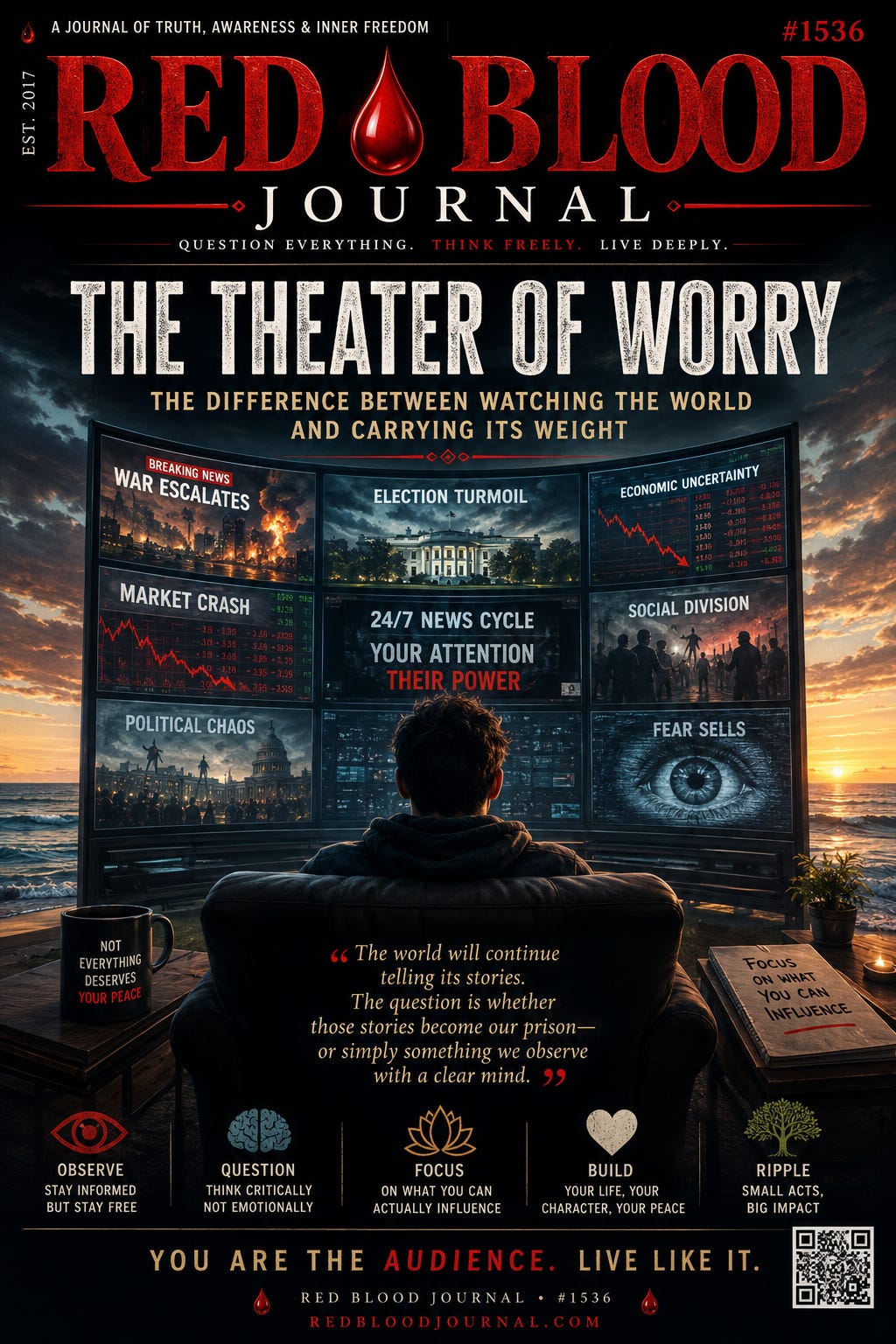
#1536 — The Theater of Worry
The Difference Between Watching the World and Carrying Its Weight
Every generation has believed it was living through the most important events in history.
Wars.
Political battles.
Economic crises.
Natural disasters.
Scandals.
Predictions of collapse.
The headlines change.
The emotions remain remarkably similar.
But perhaps there is a question very few people ask themselves:
What effect can I actually make—right here, right now?
Not in theory.
Not through endless online arguments.
Not by worrying.
But in reality.
How many people personally know someone who changed the direction of a government?
How many ordinary citizens have directly influenced national policy?
For most people, the honest answer is probably none.
Governments continue making decisions.
Corporations continue pursuing their interests.
Markets continue moving.
History continues unfolding.
Whether one spends the day worrying or laughing with family, many of those events will proceed exactly as they would have anyway.
That observation is not an argument against voting, participating in communities, or standing up for principles. Throughout history, collective action has sometimes led to meaningful social and political change.
Instead, it raises a different question:
If worrying alone changes nothing, what does it actually change?
Usually, only the person doing the worrying.
Peace becomes anxiety.
Energy becomes exhaustion.
Attention becomes captivity.
The modern news cycle rarely asks for five minutes.
It asks for every hour.
Twenty-four hours a day.
Seven days a week.
Every notification competes for one thing:
Your attention.
Attention has quietly become one of the world’s most valuable commodities.
The longer it can be held...
The more valuable it becomes.
Perhaps that is why every headline is presented as urgent.
Every disagreement becomes a crisis.
Every event becomes historic.
Every story demands emotional participation.
But what if participation through worry is not participation at all?
What if it is simply emotional investment in events over which we possess little or no direct control?
Imagine sitting in a movie theater.
On the screen, civilizations rise and fall.
Heroes triumph.
Villains betray.
Entire worlds collapse.
The audience laughs.
The audience cries.
But when the lights come on, everyone understands something important:
The movie was real as a story, but the audience was never inside it.
Perhaps there is wisdom in treating the constant stream of headlines with the same perspective.
Observe.
Learn.
Question.
Verify.
Stay informed.
But refuse to surrender your inner peace to every plot twist.
The greatest influence most people will ever have is not over presidents, kings, billionaires, or international conflicts.
It is over their own character.
Their own family.
Their own neighborhood.
Their own work.
Their own kindness.
Those ripples often travel farther than they appear.
History remembers famous names.
Life is transformed far more often by ordinary people quietly doing extraordinary things within their own reach.
Perhaps genuine freedom begins when we recognize the difference between concern and control.
The world will continue telling its stories.
The question is whether those stories become our prison—or simply something we observe with a clear mind.
In the end, each of us must decide where to invest the limited hours of a lifetime.
Some will spend them chasing every headline.
Others will build a life that no headline can easily disturb.
The screen will always keep playing.
The wiser question may simply be:
Do we have to become one of the actors, or is it enough to remain an attentive audience?
Subjects
Attention and the Modern News Cycle
Worry Versus Control
The Economics of Attention
Emotional Investment in Current Events
Collective Action and Individual Agency
The Psychology of Headlines
Inner Peace in an Age of Information
Choosing Where to Invest Attention
The Theater of Modern Media
Living Beyond the News Cycle
May every wave remind us that while storms can fill the horizon, the ocean itself remains deeper, calmer, and larger than any single storm. We cannot always choose the waves we witness, but we can choose whether they disturb the depths within us.
🩸 RedBloodJournal.com 🩸
🩸🌊✨ Fantastic!
🧘♀️ The Theater of Worry
Jul 23, 2026
This text explores the psychological impact of the modern news cycle, suggesting that constant exposure to global crises often results in fruitless anxiety rather than meaningful change. The author argues that the attention economy thrives by framing every headline as an urgent catastrophe to capture and monetize human focus. By comparing current events to a theatrical performance, the source encourages readers to maintain a healthy distance between their inner peace and external events they cannot control. Instead of succumbing to emotional exhaustion over national headlines, the writing advocates for investing energy into one’s local community, family, and personal character. Ultimately, the piece distinguishes between staying informed and becoming a prisoner to a narrative, urging a shift toward intentional living.


