


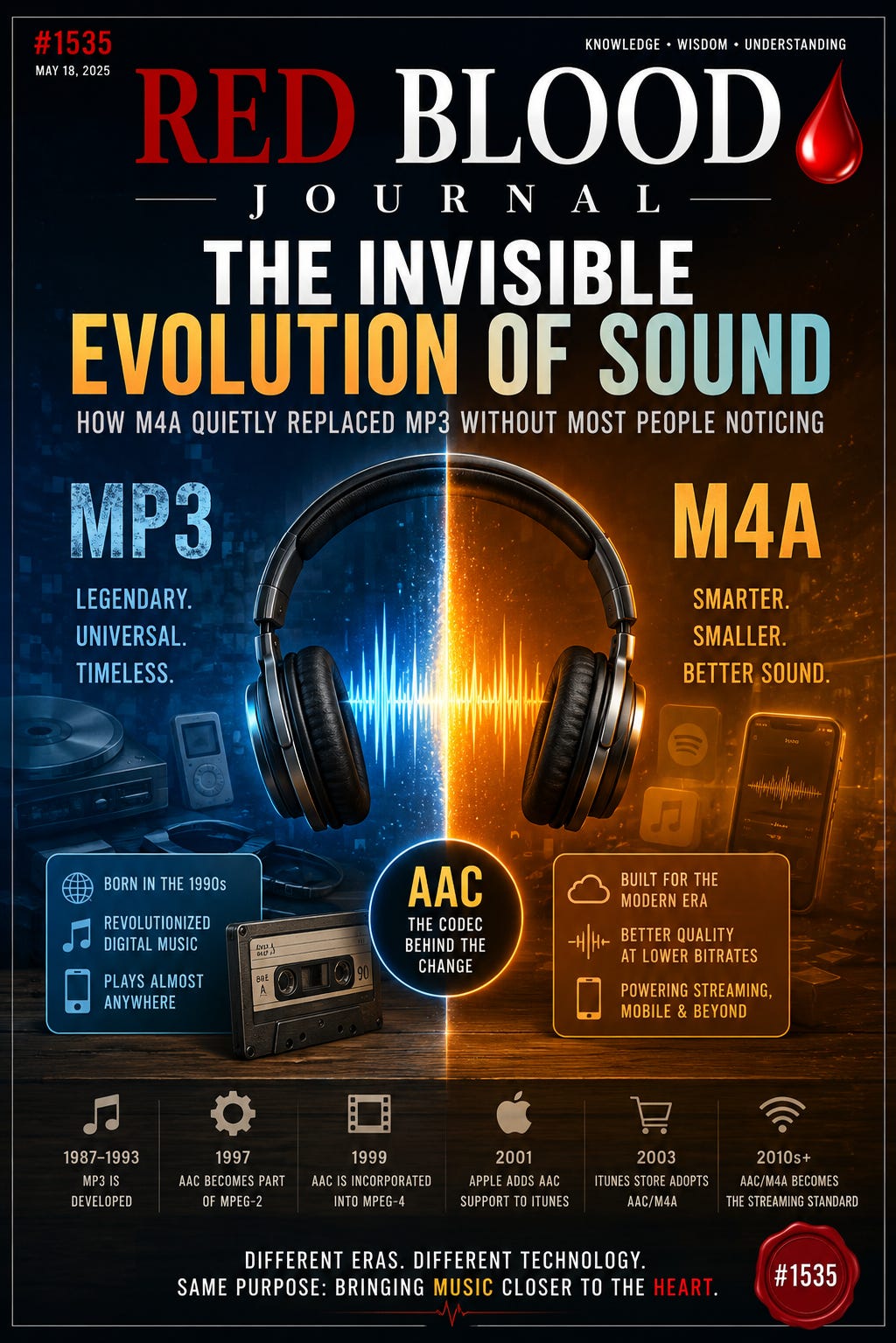
🩸 Red Blood Journal 🩸
#1535 – ⭐⭐⭐⭐⭐ The Invisible Evolution of Sound
How M4A Quietly Replaced MP3 Without Most People Noticing
For more than two decades, MP3 became almost synonymous with digital music.
People didn’t ask for an audio file.
They asked for an MP3.
It became part of everyday language.
Yet, quietly, almost unnoticed, a different technology gradually took its place.
Not through force.
Not by banning MP3.
But by simply being better.
The Birth of MP3
During the late 1980s and early 1990s, engineers searched for ways to shrink enormous CD-quality audio files into something small enough to store and eventually send across the internet.
The result was MP3 (MPEG-1 Audio Layer III).
It changed the world.
Instead of carrying dozens of CDs, people could suddenly carry thousands of songs in their pocket.
The internet music revolution had begun.
The Problem Nobody Heard
Although revolutionary, MP3 was designed using the computing power available in the late 1980s.
Engineers continued improving the science of digital hearing.
As computers became faster, researchers discovered better ways of removing information that the human ear could barely detect.
The result was a newer compression system.
Advanced Audio Coding (AAC).
AAC Arrives
By 1997, AAC became part of the MPEG standard.
Unlike MP3, AAC used newer mathematical models that produced:
Higher sound quality
Smaller files
Better stereo separation
Improved handling of complex music
Greater efficiency at lower bitrates
A 128 kbps AAC file often sounds comparable to a much larger 160–192 kbps MP3.
The listener hears nearly the same music.
The file occupies less space.
M4A Is Not AAC
Many people use the terms interchangeably.
Technically they are different.
AAC is the compression method.
M4A is the container that stores the compressed audio.
A useful analogy:
AAC is the letter.
M4A is the envelope.
Most M4A files contain AAC audio, although the container can hold other audio formats as well.
Apple’s Quiet Influence
The biggest turning point came when Apple adopted AAC for iTunes and later the iTunes Store.
Millions of songs were distributed in the M4A format.
Most consumers never noticed.
They simply clicked “Play.”
The transition happened in the background.
Technology advanced without demanding that users understand every technical detail.
The Streaming Era
As internet streaming expanded, efficiency became increasingly important.
Every saved kilobyte meant:
lower bandwidth,
faster streaming,
reduced storage costs,
better battery life on portable devices.
AAC became one of the preferred formats for many modern streaming and mobile applications because it could deliver comparable perceived quality while transmitting less data than MP3.
Why MP3 Never Died
Despite AAC’s technical advantages, MP3 remained enormously successful.
Its greatest strength was compatibility.
Almost every computer.
Every phone.
Every car stereo.
Every television.
Every portable player.
Nearly every device understood MP3.
Sometimes “good enough everywhere” is more valuable than “slightly better somewhere.”
A Lesson Beyond Audio
The history of MP3 and M4A illustrates how technology often evolves.
The loudest innovation is not always the one that changes the world.
Sometimes replacement happens quietly.
No headlines.
No dramatic announcements.
Just gradual adoption until one day people realize that the standard they thought was permanent has already been replaced.
The same pattern can be found throughout history—in communication, transportation, medicine, computing, and many other fields.
Progress often arrives not with a revolution, but with millions of ordinary choices made one file, one device, and one download at a time.
Conclusion
The story of MP3 and M4A is more than the evolution of digital audio.
It is a reminder that technological change is often invisible while it is happening.
People rarely notice the road beneath their feet changing stone by stone.
Only when they look back do they realize how far they have traveled.
Perhaps the greatest innovations are not always those that shout the loudest, but those that quietly become part of everyday life until they seem as though they had always been there.
Subjects
The invention of MP3
The development of AAC
What M4A actually is
Apple and the rise of digital music
Streaming and modern audio compression
Technology adoption
Quiet technological revolutions
The evolution of digital media
🩸 RedBloodJournal.com 🩸
🌊 May the Ocean of Love and Positivity guide every traveler toward wisdom, humility, and understanding. Keep questioning, keep learning, and let truth be pursued with both courage and compassion.
🩸🌊✨ Fantastic!
🎵 The Quiet Coronation of M4A over MP3
Jul 22, 2026
The provided text examines the quiet transition from the once-dominant MP3 audio format to the more advanced M4A and AAC standards. While MP3 revolutionized digital music by making files portable, newer compression methods eventually surpassed it by offering superior sound quality and smaller file sizes. The source clarifies that AAC refers to the actual encoding process, whereas M4A serves as the digital container holding the data. Companies like Apple facilitated this shift by integrating these formats into their ecosystems, allowing the technology to evolve without requiring active consumer effort. Ultimately, this history serves as a broader metaphor for how technological progress often occurs through gradual adoption rather than sudden, loud revolutions.


