


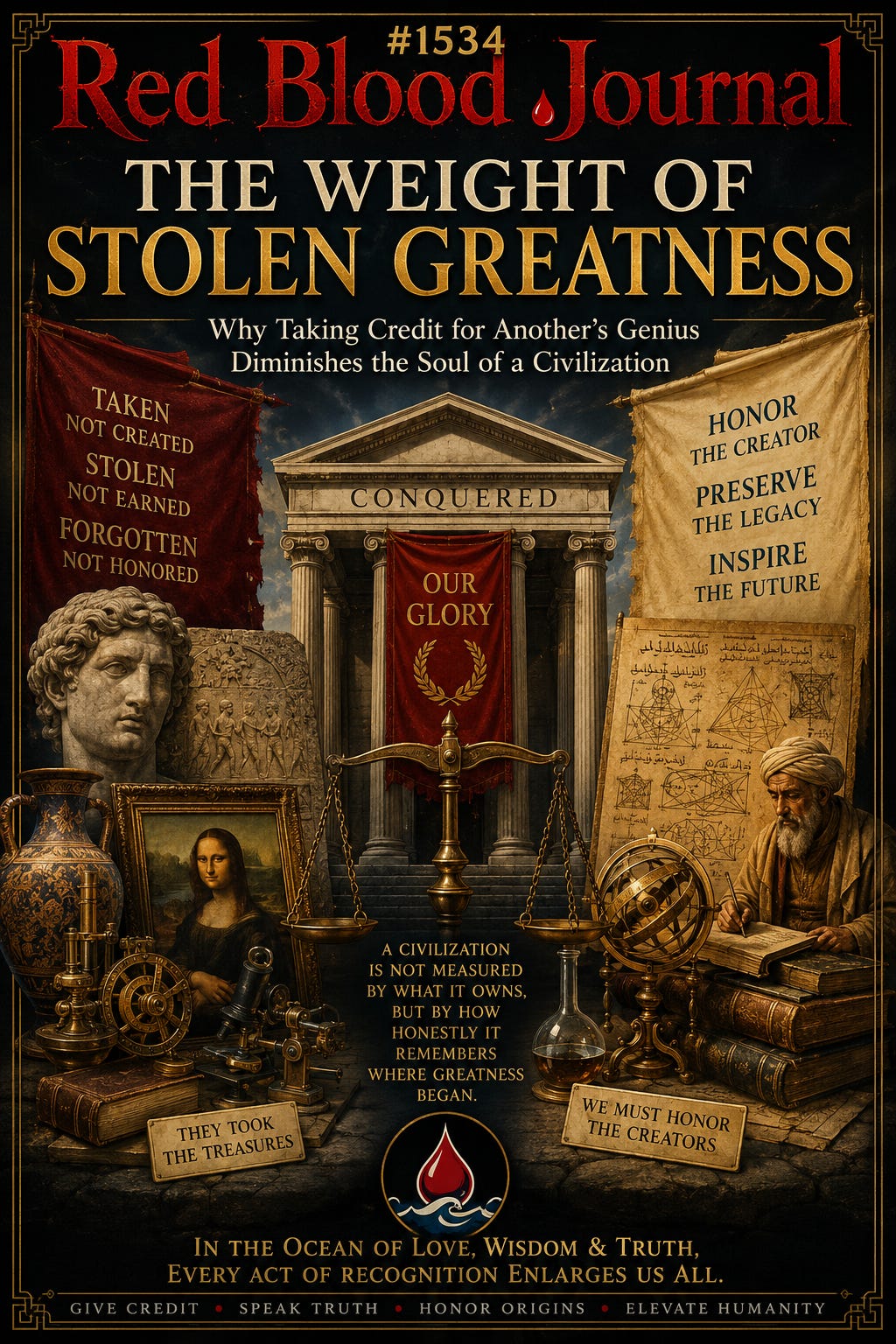
#1534 — The Weight of Stolen Greatness
🩸 Red Blood Journal
When Victory Seeks Ownership Instead of Gratitude
Throughout history, empires have marched across continents.
Some sought land.
Some sought wealth.
Some sought resources.
But almost every great empire sought something even more valuable.
Knowledge.
Art.
Science.
Technology.
Culture.
The strange part is not that they wanted these things.
The strange part is what often happened afterward.
Instead of preserving the names of those who created them...
The conqueror frequently displayed the treasures as symbols of his own greatness.
The statue remains.
The inventor disappears.
The painting survives.
The artist is forgotten.
The machine advances civilization.
The people who imagined it fade into history.
The Difference Between Learning and Stealing
Human civilization grows because ideas travel.
No civilization has ever invented everything alone.
Every generation stands upon discoveries made by someone before them.
There is nothing shameful about learning from another culture.
In fact, it is one of humanity’s greatest strengths.
But learning and stealing are not the same thing.
Learning says:
“Thank you.”
Stealing says:
“This is now mine.”
One builds bridges.
The other builds monuments to ego.
Ownership Beyond Possession
A nation can physically possess another nation’s treasures.
It can fill museums.
It can recruit scientists.
It can copy inventions.
It can rewrite textbooks.
Yet one thing always remains beyond its reach.
Creation itself.
The original spark belongs forever to the mind that first imagined it.
No army can conquer imagination.
No king can own inspiration.
No empire can manufacture genius simply by possessing its products.
The Soul of a Civilization
What does it say about the soul of a civilization if it becomes proud not of what it creates...
...but of what it has taken?
Perhaps it reveals insecurity.
Perhaps it reveals a fear that its own achievements are not enough.
Perhaps true greatness has been replaced by the appearance of greatness.
History often remembers the collector.
But time eventually rediscovers the creator.
The Greatest Museums
Imagine walking through a museum where every object carried two names.
The civilization that preserved it.
And the civilization that created it.
Both would receive honor.
Both would become greater.
Acknowledging another’s brilliance never diminishes one’s own.
It enlarges it.
Humility has a strange property.
The more it gives away...
the larger it becomes.
The Ocean of Humanity
Perhaps every invention, every painting, every scientific discovery is like a drop entering a single ocean.
The drop remembers where it came from.
The ocean remembers every drop.
No civilization owns the ocean.
It merely sails upon it for a little while before another generation takes the helm.
The wisest societies are not those that claim every wave as their own.
They are the ones that recognize the countless rivers that flowed together to create the sea itself.
May humanity one day become less concerned with possessing greatness, and more concerned with honoring it wherever it first appeared.
For in the Ocean of Love, wisdom, and truth, every sincere act of recognition enlarges us all.
🩸🌊✨ Fantastic!
Subjects
Cultural heritage and conquest
The ethics of stolen art
Scientific knowledge across civilizations
Why giving credit matters
Museums and historical memory
The difference between preservation and appropriation
National pride versus human achievement
Civilization, humility, and legacy
The soul behind ownership
The Ocean of Love philosophy
🌊 The Ocean of Honor:
Restoring the Soul of Creation
Jul 22, 2026
This text explores the ethical tension between cultural conquest and true creation, highlighting how powerful empires often claim the achievements of others as their own. It distinguishes genuine learning, which involves gratitude and the recognition of origins, from theft, which seeks to bolster a nation’s ego through forced possession. While physical artifacts and scientific discoveries can be seized, the author argues that the original spark of imagination remains tethered to its creator and can never be truly conquered. The narrative suggests that a civilization’s integrity is measured by its willingness to honor external brilliance rather than merely collecting its products. Ultimately, the source advocates for a global perspective of humility, viewing human progress as a vast, shared ocean where every contribution deserves individual acknowledgment. By prioritizing recognition over ownership, humanity can foster a legacy defined by collective wisdom rather than historical insecurity.


