


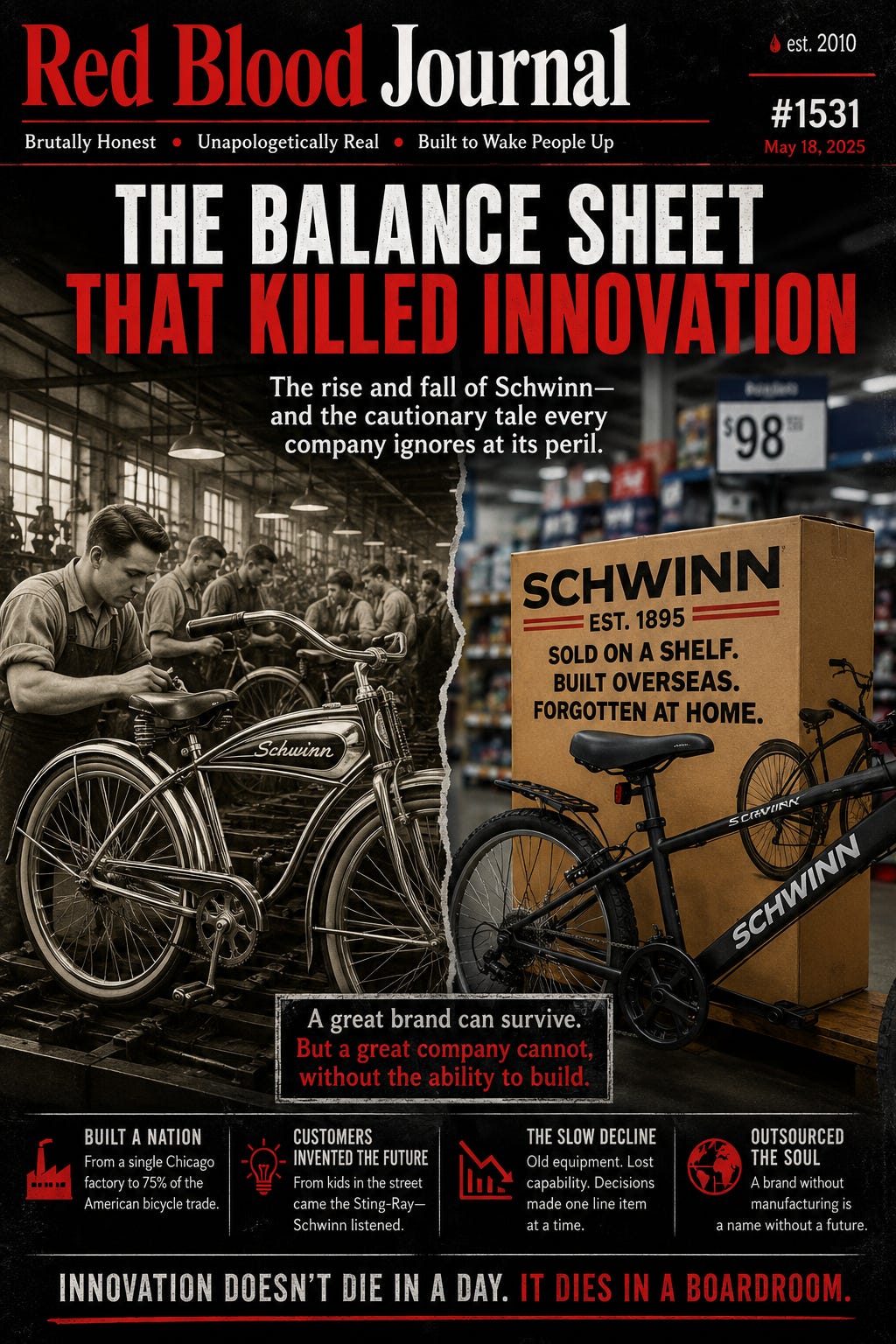
#1531 – ⭐⭐⭐⭐⭐ The Balance Sheet That Killed Innovation
🩸 RedBloodJournal.com 🩸
Throughout history, great companies rarely disappear overnight.
Most decline one decision at a time.
The story of Schwinn, once considered the Cadillac of American bicycles, is one example.
Beginning as a small Chicago company founded by German immigrant Ignatz Schwinn, the business survived economic crashes, the Great Depression, and two World Wars. It became one of America’s most respected manufacturers by producing quality products, constantly improving them, and paying attention to what customers actually wanted.
When competitors failed, Schwinn invested.
When others hesitated, Schwinn built.
When customers desired something new, Schwinn often listened.
One of the company’s greatest successes came from observing children modifying their own bicycles. Instead of dismissing the idea, engineers developed the famous Sting-Ray bicycle, which became one of the most successful products in the company’s history.
The lesson seemed obvious.
Innovation rarely begins inside conference rooms.
It usually begins where people actually use the product.
Yet success can quietly become its own obstacle.
As decades passed, manufacturing equipment aged while competitors invested in newer production methods. Foreign manufacturers adopted lighter materials, modern welding techniques, and more efficient factories.
Schwinn still understood the market.
It even recognized emerging trends such as BMX and mountain bikes.
The problem was no longer imagination.
The problem was execution.
The company gradually lost the ability to manufacture the products it knew customers wanted.
Production increasingly moved to outside suppliers.
Over time, the company became more dependent upon others to build what once had been its greatest strength.
The Schwinn name remained valuable.
Its manufacturing capability did not.
Eventually leadership became increasingly focused on reducing costs, solving labor disputes, relocating production, and improving financial statements.
Each decision could appear reasonable when viewed individually.
Together they slowly weakened the foundation that had made the company successful.
By the time bankruptcy arrived, it was less a sudden collapse than the final chapter of a process that had been unfolding for years.
The Schwinn story illustrates a broader principle.
A brand can survive for years after the capability that created the brand has disappeared.
Reputation can outlive craftsmanship.
Marketing can outlive manufacturing.
A famous name can continue generating sales long after the original culture that built trust has faded away.
Perhaps the greatest lesson is that innovation cannot simply be purchased.
It must be continually renewed.
Factories, skills, engineers, and experienced workers represent knowledge accumulated over decades.
Once that knowledge leaves, rebuilding it is neither quick nor inexpensive.
The future often appears first in unexpected places:
A neighborhood shop.
A garage.
A small startup.
A child experimenting with an old product.
Those willing to observe may discover tomorrow before everyone else.
Those focused only on today’s balance sheet may never notice until tomorrow belongs to someone else.
History repeatedly demonstrates that organizations rarely fail because they cannot see the future.
More often, they fail because they stop looking out the window.
Subjects
Schwinn
American manufacturing
Innovation
Leadership
Outsourcing
Industrial decline
Customer-driven innovation
Corporate strategy
Manufacturing capability
Business history
🩸🌊✨ Fantastic!
🚲 The Balance Sheet That Killed Innovation
Jul 22, 2026
This text examines the industrial decline of Schwinn, once a premier American bicycle manufacturer, to illustrate how corporate stagnation occurs. The company initially flourished by prioritizing quality and observing how customers modified their products, leading to iconic designs like the Sting-Ray. However, leadership eventually prioritized short-term financial metrics and outsourcing over maintaining their own innovative manufacturing capabilities. As production shifted to foreign competitors with superior technology, the brand’s reputation outlived its craftsmanship, leading to an eventual collapse. The source argues that true innovation requires a continuous investment in physical skills and ground-level observation rather than a narrow focus on balance sheets. Ultimately, the narrative serves as a warning that businesses fail when they stop looking at evolving consumer needs and lose the expertise that built their initial success.


