


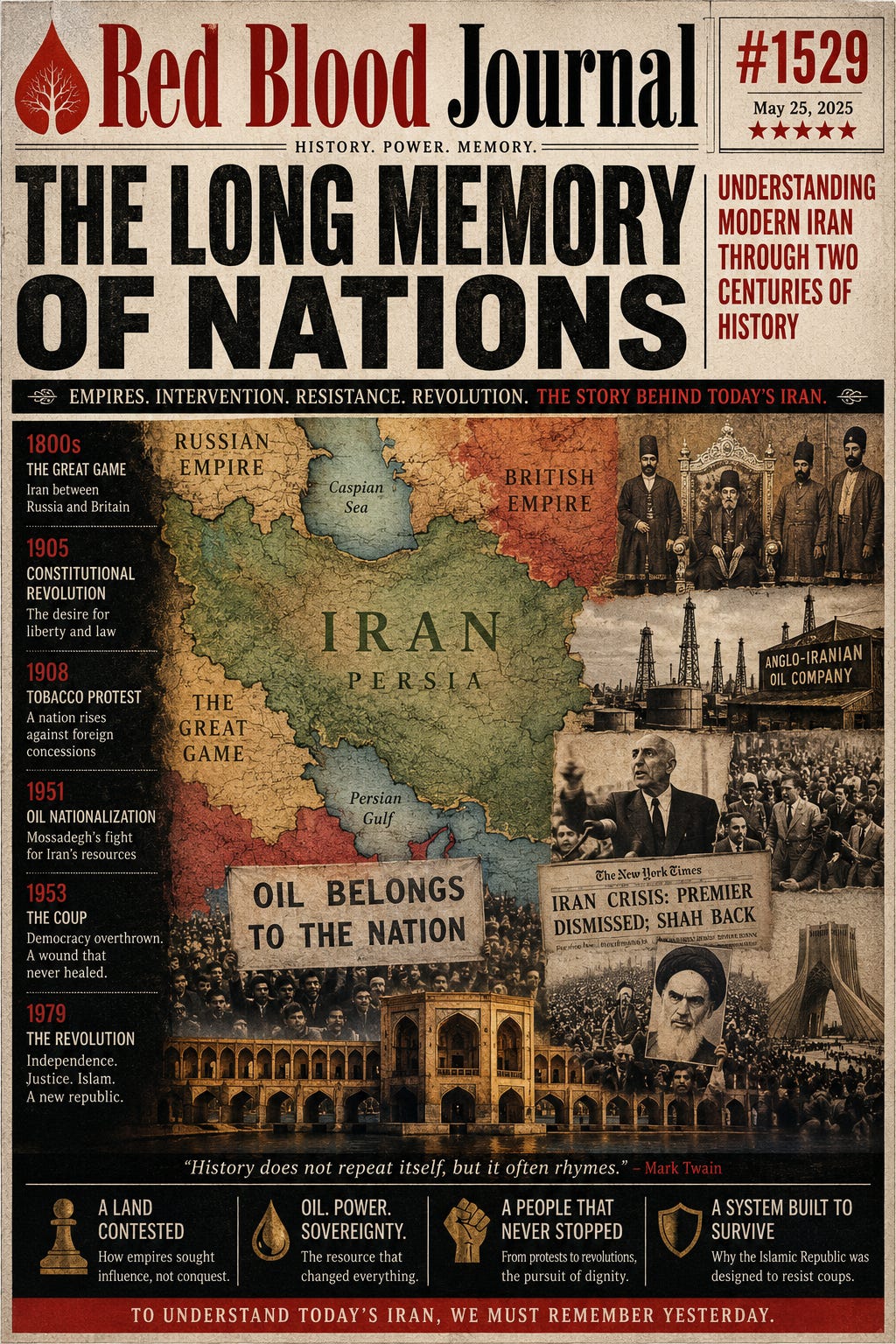
🩸 Red Blood Journal
#1529 — ⭐⭐⭐⭐⭐ The Long Memory of Nations
Understanding Modern Iran Through Two Centuries of History
History often explains what today’s headlines cannot.
When people think of Iran, images of war, sanctions, nuclear negotiations, protests, religious leadership, or regional conflict usually come to mind.
But these events did not emerge in isolation.
The uploaded historical presentation argues that modern Iran is the product of more than two centuries of repeated foreign intervention, competition between great powers, economic exploitation, revolution, and national efforts to regain sovereignty.
Whether one agrees with every conclusion or not, understanding this historical perspective helps explain why many decisions made by Iran’s government are viewed inside the country through a very different lens than they often are in the West.
A Civilization Before the Headlines
Long before the Islamic Republic existed, Persia was one of history’s great civilizations.
For centuries it stood among the dominant powers of the ancient world.
The presentation argues that Iran’s collective memory is shaped not only by recent decades but by thousands of years of civilization followed by a long period of decline and outside interference.
The Great Game
Beginning in the early nineteenth century, Iran found itself trapped between two expanding empires.
Russia pushed south.
Britain sought to protect India.
Iran became less a nation left alone than a strategic buffer separating competing powers.
Rather than conquiring the country outright, foreign governments increasingly sought influence through diplomacy, economic concessions, military agreements, and political leverage.
This pattern would repeat itself for generations.
Selling Pieces of a Nation
Successive rulers granted foreign powers control over industries, customs, railroads, banking, communications, and trade in exchange for desperately needed money.
Some modernization occurred.
Infrastructure expanded.
But many Iranians increasingly believed that the wealth created inside their country benefited outsiders far more than their own people.
The resulting resentment became one of the recurring themes throughout modern Iranian history.
Oil Changes Everything
The discovery of oil transformed Iran forever.
What had once been an important strategic location suddenly became one of the world’s most valuable energy producers.
The presentation argues that from this point forward, control over Iranian oil became inseparable from international politics.
Oil was no longer simply an economic resource.
It became a strategic asset tied directly to global military power and geopolitical competition.
Democracy Interrupted
The Constitutional Revolution, the Tobacco Protest, and later the movement led by Prime Minister Mohammad Mossadegh represented attempts by Iranians to exercise greater national independence.
Mossadegh’s effort to nationalize Iran’s oil industry became one of the defining political moments of the twentieth century.
The transcript presents the 1953 coup, carried out with British and American involvement, as one of the most influential events shaping modern Iranian distrust toward foreign governments.
The Shah’s Modernization
Following the coup, Iran experienced rapid modernization.
Roads, universities, hospitals, military expansion, women’s voting rights, and economic development transformed much of the country.
At the same time, political opposition was suppressed, censorship increased, and the secret police expanded their influence.
The presentation argues that many Iranians increasingly viewed modernization and authoritarianism as advancing together.
Revolution
Ayatollah Ruhollah Khomeini successfully combined religious leadership with widespread nationalist frustration.
His message was not presented solely as a religious movement.
It was also framed as ending centuries of foreign domination and restoring Iranian independence.
In 1979 the monarchy collapsed.
The Islamic Republic replaced it with an entirely new political system.
Building a Coup-Resistant State
According to the presentation, the Islamic Republic’s institutions were deliberately designed to prevent another externally supported overthrow.
Multiple layers of military organizations, religious oversight, intelligence services, elected institutions, and constitutional mechanisms were created so that no single political event could easily remove the system.
Whether viewed positively or negatively, the presentation argues that this institutional design helps explain why the government has survived numerous internal and external crises for decades.
Looking Through History Instead of Headlines
One of the strongest themes throughout the presentation is that governments often remember history differently than outside observers.
Where others may see present-day geopolitical decisions, Iran’s leadership may see memories of repeated intervention, occupation, sanctions, foreign influence, and struggles over national sovereignty.
History does not determine every decision.
But it often explains why different nations interpret the same events through entirely different historical experiences.
Understanding those experiences does not require agreement.
It simply requires understanding.
Final Thoughts
Perhaps the most important lesson is that no nation exists only in the present.
Every country carries memories.
Some remember victories.
Others remember occupations.
Some remember prosperity.
Others remember betrayal.
Whether one agrees with the presentation’s interpretations or challenges them, it reminds us that today’s conflicts are often rooted in stories that began generations earlier.
To understand the present, we must first understand the past.
Only then can headlines become history rather than mystery.
Subjects
Persia
The Great Game
British Empire
Russian Empire
Foreign Intervention
Constitutional Revolution
Tobacco Protest
Oil Nationalization
Mohammad Mossadegh
1953 Coup
Reza Shah
Mohammad Reza Shah
Islamic Revolution
Ayatollah Khomeini
Islamic Republic
Iranian History
Sovereignty
Geopolitics
Middle East
Historical Memory
🩸 History rarely disappears.
It simply waits beneath the surface until another generation is forced to remember it.
🩸🌊✨ Fantastic!
📜 The Long Memory of Nations:
Understanding Modern Iran
Jul 21, 2026
The provided text explores modern Iran by examining how over two centuries of foreign interference and geopolitical competition have shaped its current identity. It highlights how the strategic struggle between global powers like Britain and Russia transformed the nation into a buffer zone, leading to the exploitation of its oil and resources. Significant historical turning points, specifically the 1953 coup and the 1979 Revolution, are presented as catalysts for a deep-seated national distrust of outside influence. Consequently, the current Islamic Republic is described as a system specifically engineered to be resistant to foreign-backed overthrows and external pressure. Ultimately, the source argues that understanding Iran’s collective historical memory is essential to interpreting its contemporary political decisions and international relations.


