


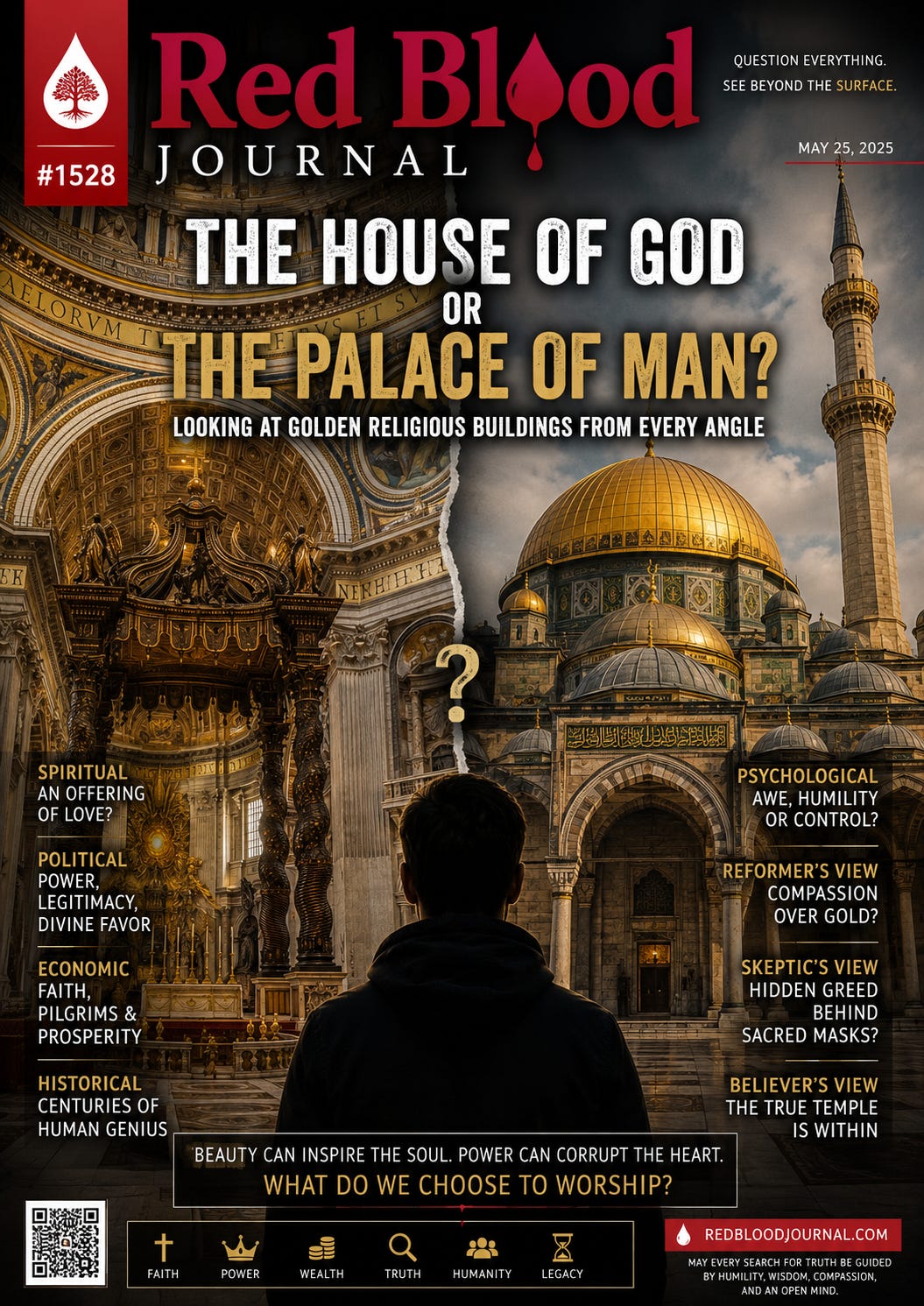
🩸 Red Blood Journal
#1528 — ⭐⭐⭐⭐⭐ The House of God or the Palace of Man?
Looking at Golden Religious Buildings from Every Angle
Throughout history, humanity has built structures unlike anything else on Earth.
Cathedrals that reach toward the heavens.
Mosques crowned with golden domes.
Temples covered in precious metals.
Walls decorated with marble, mosaics, gemstones, and gold leaf.
The explanation often given is simple:
“They were built for God.”
But is that the entire story?
Or does reality become more interesting when viewed from every angle?
The Spiritual View
Perhaps these magnificent buildings represent humanity’s highest expression of love toward the Creator.
Gold does not rust.
It reflects light.
It symbolizes purity, eternity, and perfection.
If people build palaces for kings, perhaps offering the finest craftsmanship to God is an act of gratitude rather than extravagance.
From this perspective, beauty itself becomes a form of worship.
The Psychological View
Architecture influences emotion.
Large spaces make people feel small.
High ceilings naturally draw the eyes upward.
Gold catches light in ways few materials can.
Silence echoes differently beneath a giant dome.
Whether intentional or not, these designs create awe.
Some would argue awe opens the heart to God.
Others would argue awe strengthens the authority of the institution.
Perhaps both can be true simultaneously.
The Political View
History repeatedly shows governments and religion becoming intertwined.
A ruler who builds a magnificent religious monument also demonstrates:
Power.
Stability.
Prosperity.
Divine favor.
The building becomes more than a place of worship.
It becomes a national symbol.
The Economic View
Great religious centers often became centers of commerce.
Pilgrims traveled.
Markets formed.
Hotels, merchants, artisans, and entire communities developed around them.
Donations increased.
Land ownership expanded.
Religious institutions sometimes became among the largest landowners in their regions.
Faith and economics often grew together.
The Historical View
Many of the world’s most famous religious buildings required decades—or centuries—to complete.
Entire generations contributed.
Stone cutters.
Engineers.
Artists.
Metal workers.
Glass makers.
Calligraphers.
Architects.
Regardless of one’s beliefs, these structures represent extraordinary human achievement.
The Philosophical View
A question has echoed through history:
If God is beyond material possessions...
Why does humanity offer Him gold?
Perhaps because people naturally give their finest gifts to what they value most.
Or perhaps because humans themselves admire wealth and unconsciously project those values onto religion.
The Reformer’s View
Many religious reformers challenged institutional wealth.
They asked:
Should resources build larger buildings...
Or feed the hungry?
Should faith be recognized by golden ceilings...
Or by acts of compassion?
These questions have appeared in many religious traditions over many centuries.
The Skeptic’s View
A skeptic may see another possibility.
What if magnificent buildings also serve human ambitions?
What if wealth wrapped in sacred language becomes difficult to question?
What if visible splendor creates an image of unquestionable authority?
In this interpretation, gold is not merely decoration.
It becomes reputation.
Influence.
Trust.
Power.
This perspective does not prove hidden motives, but it asks whether institutions can sometimes benefit materially from symbols that inspire reverence.
The Believer’s View
A believer may answer differently.
The building itself is not the destination.
It is merely a place where people gather.
Gold does not create faith.
People do.
The true temple is found within the human heart.
Without sincere faith, even the grandest cathedral or mosque is only stone and metal.
Reading Between the Lines
Perhaps the deeper lesson is not about churches.
Or mosques.
Or temples.
Perhaps it is about humanity itself.
Every institution reflects the people who build it.
Where there is genuine devotion, beauty may emerge.
Where there is ambition, power may accumulate.
Where there is greed, even sacred symbols can be used for worldly purposes.
Reality rarely fits into a single explanation.
The same building can simultaneously be:
A masterpiece.
A sanctuary.
A national monument.
A political statement.
An economic engine.
A work of love.
Or, in some cases, a symbol of excess.
Final Reflection
The question may not be whether gold belongs in places of worship.
The deeper question is whether the hearts of those who build, maintain, and visit those places remain focused on what the gold was intended to represent.
If the gold points beyond itself toward humility, compassion, and the Creator, it serves one purpose.
If it points toward prestige, control, or accumulation of wealth, it serves another.
History offers examples that supporters and critics alike can point to.
Perhaps the responsibility belongs not to the stone, the dome, or the gold—but to every generation that decides what those symbols will ultimately mean.
The reader is invited to examine the evidence, reflect on history, and reach their own conclusions.
Subjects
Religious Architecture
Gold in Churches and Mosques
Faith and Power
Sacred Symbols
Institutional Wealth
History of Religion
Political Authority
Economics of Pilgrimage
Psychology of Architecture
Reading Between the Lines
🩸 RedBloodJournal.com
🌊 May every search for truth be guided by humility, wisdom, compassion, and an open mind. The strongest ideas are those that can withstand honest questioning.
🩸🌊✨ Fantastic!
🕌 Gold and Grace: The Architecture of Devotion and Power
Jul 21, 2026
The provided text explores the multifaceted motivations behind the construction of opulent religious monuments adorned with gold and precious materials. By examining these structures through diverse lenses, the author evaluates whether such grandeur represents genuine spiritual devotion or serves more worldly goals like political dominance and economic growth. The narrative highlights how architecture can influence human psychology by evoking a sense of awe that may reinforce either faith or institutional authority. Furthermore, it addresses the philosophical tension between material wealth and the humble core values of many religious traditions. Ultimately, the source suggests that these buildings are complex reflections of humanity, functioning simultaneously as artistic triumphs and symbols of power. Through this analysis, readers are encouraged to consider how the intentions of the builders and visitors define the true meaning of these golden landmarks.


