


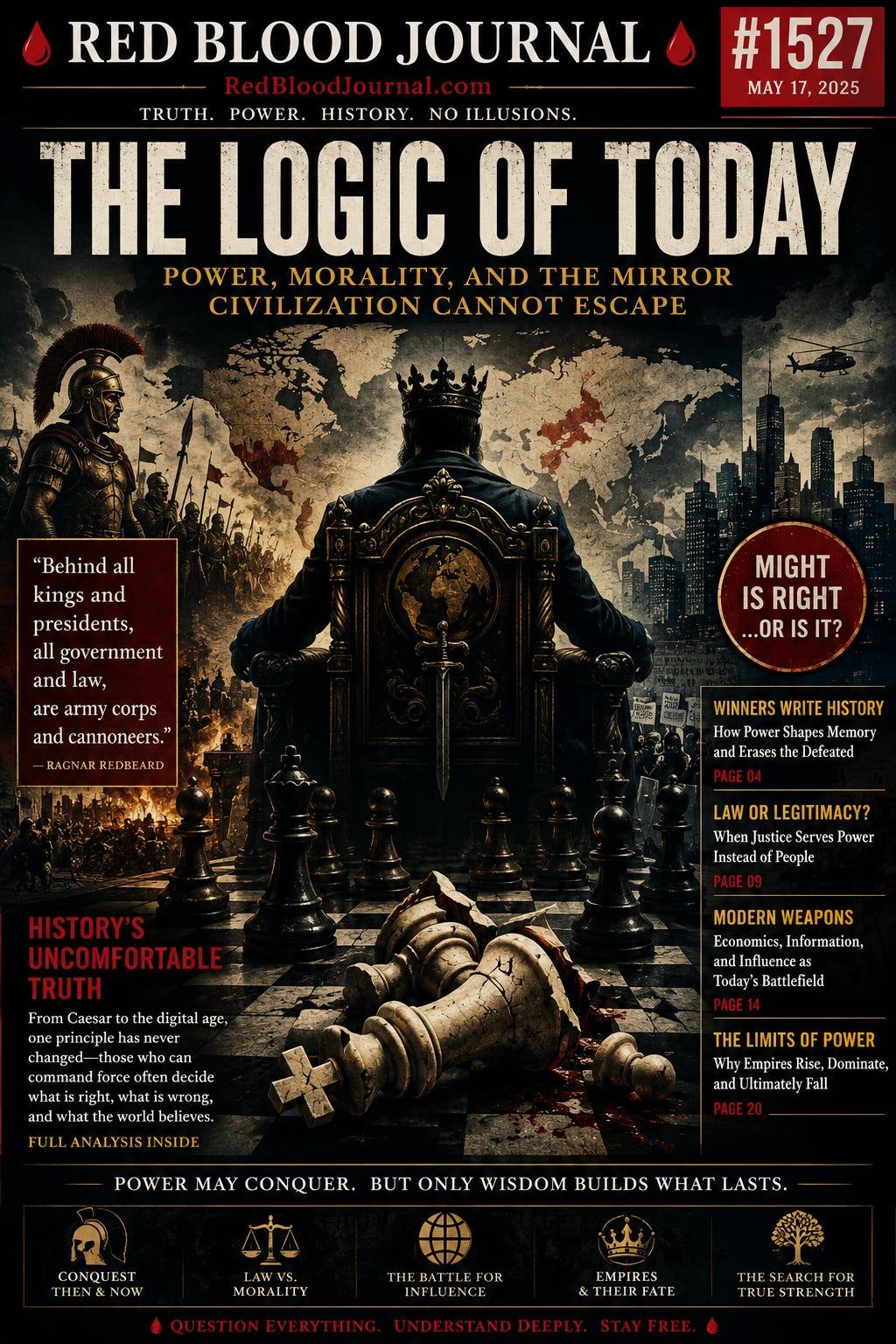
🩸 Red Blood Journal 🩸
RedBloodJournal.com
#1527 — ⭐⭐⭐⭐⭐ The Logic of Today
Power, Morality, and the Mirror Civilization Cannot Escape
Throughout history, one uncomfortable observation has repeatedly surfaced.
Those who possess the greatest ability to organize force often become those who write the rules.
Not because they are necessarily wiser.
Not because they are morally superior.
But because history is usually written by those who remain standing.
This disturbing idea lies at the center of The Logic of Today by Arthur Desmond (writing as Ragnar Redbeard), a book that rejects nearly every moral principle embraced by modern civilization and instead argues that power—not justice—is the true engine of history.
Whether one agrees with it or not, its central challenge remains difficult to ignore.
The Question Nobody Likes Asking
Nearly every nation teaches its children that governments exist because people agreed to create them.
The book asks a different question.
If every citizen stopped obeying tomorrow...
What would remain?
Would laws continue because they are morally correct?
Or because someone possesses the power to enforce them?
The uncomfortable answer is that every functioning government ultimately possesses some capacity to compel obedience through institutions such as police, courts, or armed forces.
That observation alone does not determine whether a government is just or unjust, but it highlights that ideals and enforcement have historically coexisted.
Civilization or Organized Power?
Modern society often presents itself as governed by:
Justice
Equality
Human Rights
Democracy
Constitutions
Yet history repeatedly shows another layer.
Empires rarely expanded through debate.
Revolutions rarely succeeded through petitions alone.
Borders seldom changed because both sides politely agreed.
Wars.
Economic pressure.
Political leverage.
Military victories.
The book argues that these realities are not exceptions.
They are the hidden foundation beneath political language.
The Winners Write Memory
One of the oldest sayings states:
History is written by the victors.
Whether entirely true or not, there is an important observation behind it.
The side that survives often controls:
education
monuments
museums
archives
official narratives
national heroes
national villains
Future generations inherit these interpretations.
The defeated rarely receive equal opportunity to explain themselves.
Laws Can Be Noble
Or Convenient
The book makes an extreme claim.
It suggests that laws frequently follow power rather than restrain it.
History offers examples where legal systems have both protected justice and justified injustice.
Slavery was once legal in many societies.
Apartheid operated under legal systems.
Segregation had laws.
Political persecution has often been legalized.
Legality and morality have not always been identical.
That does not mean laws lack value.
It means legality alone cannot determine whether something is ethical.
Economics Can Become Force Without Bullets
Modern civilizations rarely conquer solely with armies.
Influence also flows through:
debt
sanctions
trade dependence
technology
financial systems
access to information
Power today often appears wearing a business suit rather than military boots.
The methods evolve.
The underlying competition for influence remains.
Information Is the New Battlefield
Previous civilizations fought primarily over land.
Today’s conflicts increasingly involve:
attention,
algorithms,
search engines,
media,
artificial intelligence,
communication platforms,
and data.
Control information...
and physical force becomes necessary less often.
The battlefield quietly shifts from geography to perception.
Every Civilization Believes It Is Different
Rome believed it brought civilization.
European empires believed they spread enlightenment.
Many revolutionary governments believed they liberated humanity.
Most powers describe their own expansion as necessary, defensive, or moral.
Their opponents usually describe the same actions very differently.
Perspective changes labels.
The events themselves remain.
The Mirror Nobody Enjoys
Perhaps the greatest value of reading a work like The Logic of Today is not accepting its conclusions.
It is allowing it to ask uncomfortable questions.
Questions such as:
Does power influence justice?
Can justice survive without power?
Does military strength protect freedom or threaten it?
When governments speak of liberty, whose liberty is being defended?
How much of modern politics is principle, and how much is strategic interest?
These questions deserve careful thought precisely because they resist simple answers.
The Greatest Weakness of “Might Makes Right”
Ironically, the philosophy eventually defeats itself.
If might alone creates right...
then every stronger conqueror automatically becomes morally correct.
The philosophy provides no stable protection for today’s victor once someone stronger arrives tomorrow.
History itself illustrates this cycle.
Every empire eventually met another power.
No empire remained permanent.
If morality rests only on strength, then morality changes every time power changes hands.
That leaves no enduring standard by which to judge conquest, cruelty, or justice.
The Deeper Lesson
Perhaps the lasting lesson is neither blind idealism nor blind realism.
Power without conscience becomes tyranny.
Conscience without the ability to defend itself may fail to protect the vulnerable.
Healthy civilizations continually wrestle with this tension.
Neither force alone nor ideals alone have proven sufficient.
Final Reflection
The Logic of Today is less valuable as a moral handbook than as a mirror.
It forces readers to confront questions many societies would rather avoid.
Not because its conclusions are necessarily correct.
But because history repeatedly demonstrates that power and principle have always existed in uneasy partnership.
Ignoring either leaves an incomplete understanding of civilization.
The challenge for every generation is to build institutions strong enough to preserve justice while ensuring that strength itself remains accountable to principles greater than power.
Subjects
The Philosophy of “Might Makes Right”
Can Power Create Justice?
Governments, Force, and Legitimacy
Who Writes History?
Law Versus Morality
Economic Power as Modern Warfare
Information as the New Battlefield
The Rise and Fall of Empires
The Limits of Raw Power
Civilization’s Oldest Dilemma...
🩸 Red Blood Journal 🩸
RedBloodJournal.com
🌊 May the Ocean of Love and Positivity guide every traveler toward wisdom, humility, and understanding. Keep questioning, keep learning, and let truth be pursued with both courage and compassion.
🩸🌊✨ Fantastic!
⚖️ Power, Principle, and the Architecture of Control
Jul 21, 2026
This text examines the cynical relationship between political power and moral authority, challenging the notion that justice alone governs civilization. It explores the provocative idea that might often dictates right, suggesting that those with the capacity for enforcement are the ones who ultimately draft laws and curate historical narratives. By analyzing how economic influence and information control function as modern tools of dominance, the source highlights the tension between ethical ideals and the raw force required to maintain them. The author argues that while legal systems and societal structures frequently reflect the interests of the powerful, a philosophy based solely on strength offers no lasting stability. Ultimately, the piece serves as a critical reflection on how human history is shaped by the uneasy partnership between principled conscience and strategic influence.


