


🩸 Red Blood Journal
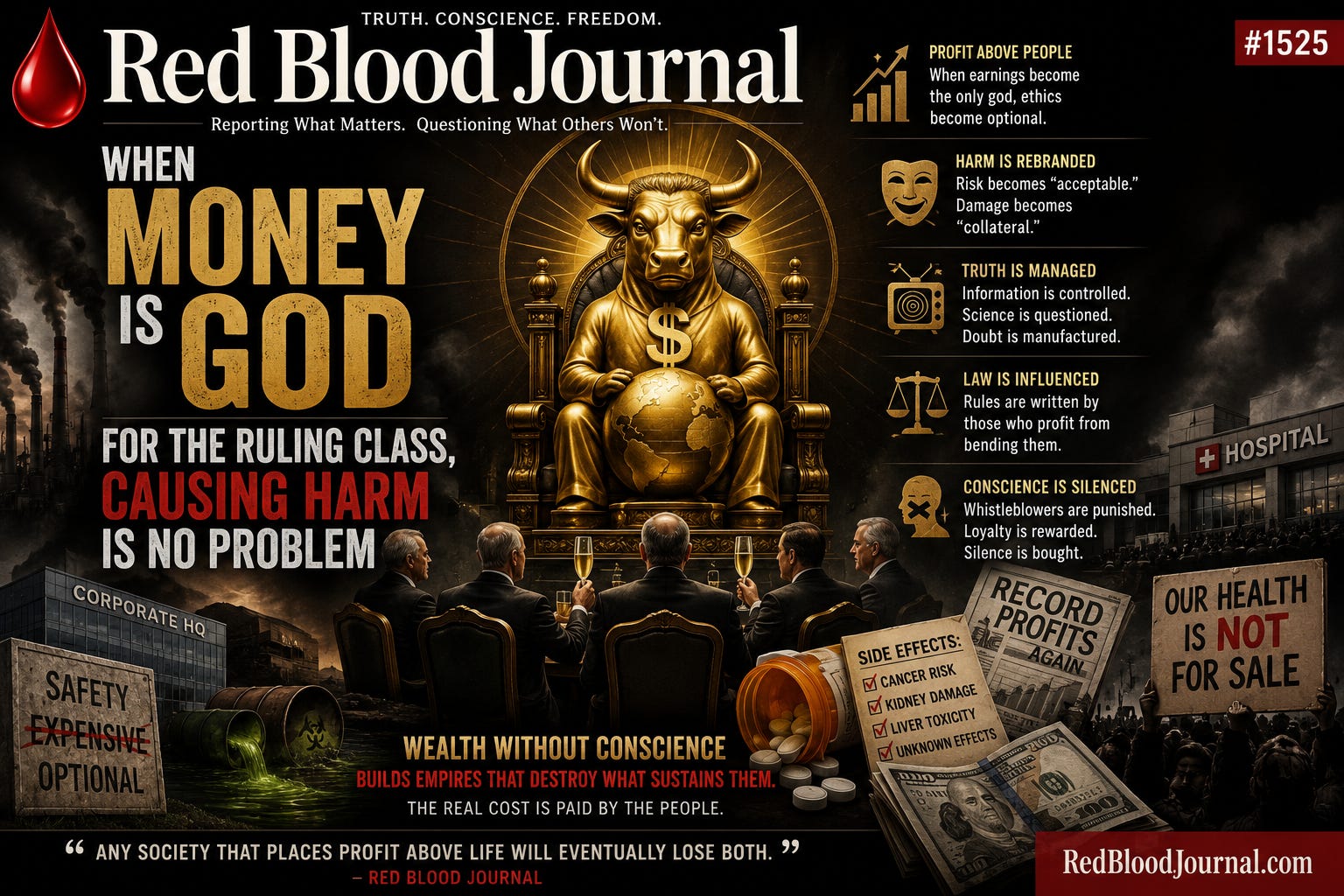
#1525 – ⭐⭐⭐⭐⭐ When Money Becomes God
Does Profit Eventually Justify Harm?
Throughout history, every civilization has worshipped something.
Some worshipped kings.
Some worshipped power.
Some worshipped ideology.
Some worshipped religion.
Today, one could argue that the highest object of worship for many institutions is neither truth nor justice.
It is money.
Not money as a useful tool.
Money as the ultimate measure of success.
When wealth becomes the highest value, every other value risks becoming negotiable.
Conscience becomes a business expense.
Ethics become a legal department.
Compassion becomes a marketing strategy.
Truth becomes whatever protects quarterly earnings.
The New Religion
Every religion has commandments.
Every religion has rituals.
Every religion has rewards.
When profit becomes the supreme objective, its commandments can appear surprisingly simple:
Increase revenue.
Reduce cost.
Protect market share.
Grow every quarter.
Anything that advances those goals is praised.
Anything that threatens them is resisted.
Success is measured not by wisdom, but by financial performance.
When Harm Becomes Acceptable
History contains many examples of products, industries, and practices that generated significant profits before their risks became widely acknowledged.
Whether involving environmental pollution, unsafe working conditions, defective products, or harmful substances, economic incentives have at times delayed change.
This does not mean every company acts without integrity.
Many organizations invest heavily in safety, quality, and innovation.
Yet history also shows that financial incentives can create powerful pressure to minimize, dispute, or postpone uncomfortable conclusions.
The temptation is simple.
If acknowledging harm reduces profit, delaying that acknowledgment may appear financially attractive.
The Cost of Looking Away
A society built solely upon financial gain may become wealthier while gradually becoming poorer in other ways.
Trust begins to erode.
Citizens question institutions.
Consumers question products.
Patients question medicine.
Investors question corporations.
Eventually, confidence itself becomes a casualty.
And confidence is far more difficult to rebuild than a balance sheet.
Wealth Is Not the Enemy
Money itself is neither good nor evil.
It is one of humanity’s greatest inventions.
It allows cooperation.
Trade.
Innovation.
Investment.
Opportunity.
The question is not whether wealth should exist.
The question is whether wealth serves humanity—
or humanity serves wealth.
The Highest Measure
Perhaps the true measure of success is not how much an institution earns.
Perhaps it is how much good it creates while earning it.
Can a business prosper without sacrificing integrity?
Can innovation coexist with honesty?
Can markets reward those who place long-term trust above short-term gain?
These questions have no simple answers.
But they remain worth asking.
Because whenever money becomes the highest authority, every other value risks becoming subordinate.
And when that happens, causing harm may become easier to justify—not because people desire harm, but because profit can gradually overshadow conscience.
Subjects
Profit and Ethics
Corporate Responsibility
Moral Philosophy
Wealth and Society
Business Ethics
Public Trust
Institutional Incentives
Economics and Values
Conscience
Long-Term Accountability
🩸🌊✨ Fantastic!
⚖️ The Altar of Profit:
When Wealth Subordinates Conscience
Jul 21, 2026
The provided text from the Red Blood Journal explores the moral dangers that arise when financial gain is elevated above all other human values. It suggests that modern institutions often treat profit as a religion, leading to a culture where ethics and compassion are sidelined in favor of quarterly growth. While acknowledging that wealth is a vital tool for innovation and trade, the author warns that prioritizing money over integrity inevitably erodes public trust. The narrative highlights how economic incentives can tempt organizations to ignore or delay addressing the harm they may cause to society. Ultimately, the source challenges readers to consider whether success should be measured by social contribution rather than just a balance sheet. It concludes that a society becomes impoverished when humanity serves wealth instead of wealth serving humanity.


