


🩸 Red Blood Journal
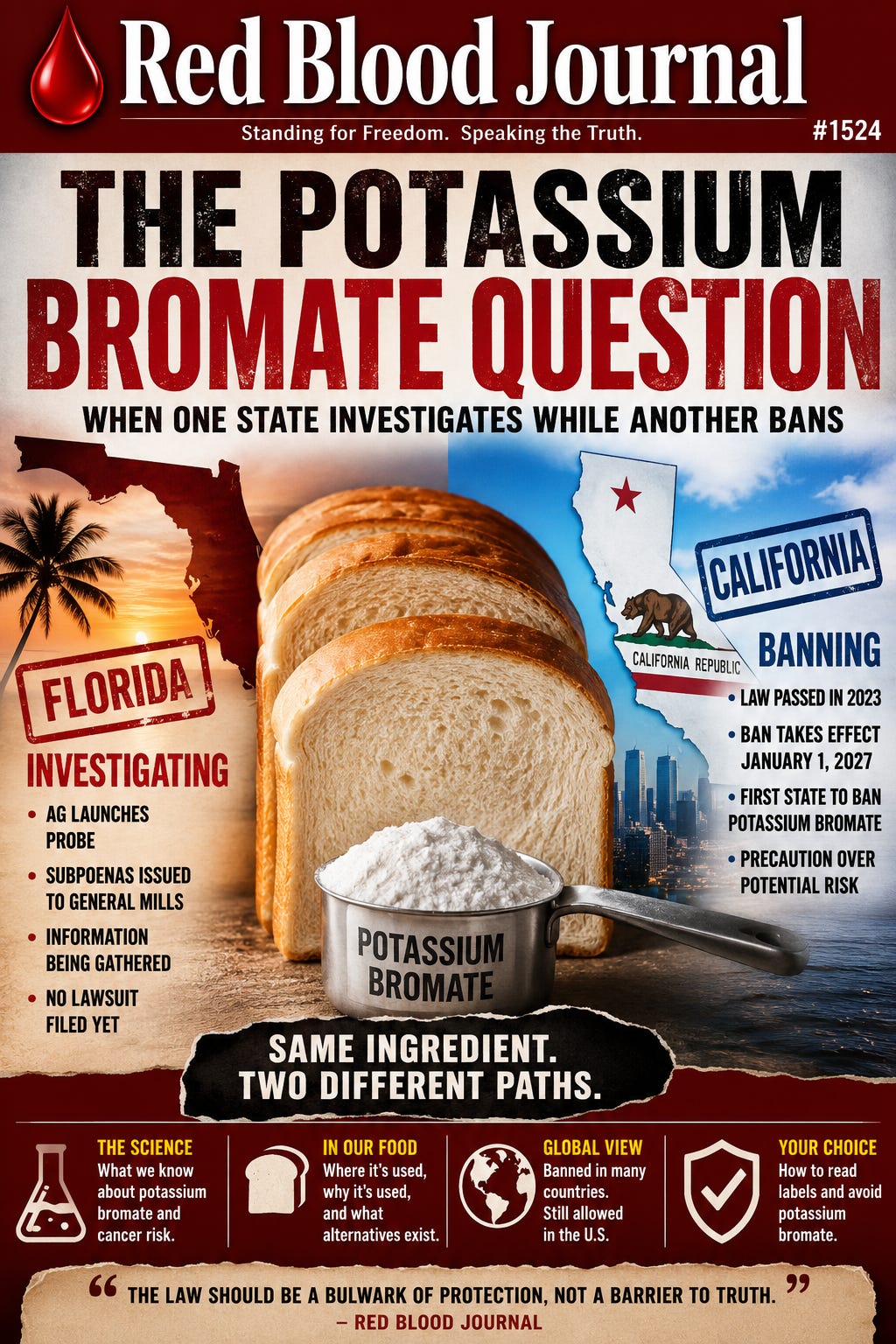
#1524 – ⭐⭐⭐⭐⭐ The Potassium Bromate Divide
Why Has Much of the World Banned It While America Still Debates It?
For decades, millions of people have eaten bread without ever wondering what helps it rise, stay soft, or maintain a consistent texture.
Behind many commercial loaves is a little-known ingredient called potassium bromate.
Most consumers have never heard of it.
Yet around the world, governments have reached dramatically different conclusions about whether it belongs in the food supply.
Some have banned it.
Others continue to allow it.
In July 2026, the debate entered a new chapter as Florida launched an investigation into its use while California prepared to become the first U.S. state to prohibit it.
The question is no longer simply about bread.
It is about how societies decide when enough evidence exists to remove an ingredient from the marketplace.
What Is Potassium Bromate?
Potassium bromate is a chemical dough improver used by some commercial bakeries to:
Strengthen dough
Improve elasticity
Increase loaf volume
Produce a more uniform texture
Improve baking consistency
For manufacturers, these properties can simplify large-scale production.
For consumers, however, the ingredient has become the focus of a longstanding safety debate.
Why Is It Controversial?
The International Agency for Research on Cancer (IARC) classifies potassium bromate as Group 2B – Possibly carcinogenic to humans, based primarily on evidence from animal studies.
Research has found that high-dose exposure caused tumors in laboratory animals, particularly affecting the kidneys.
Supporters of continued use point out that properly baked bread is intended to convert potassium bromate into bromide, leaving little or no detectable residue.
Critics respond that alternatives are readily available and argue that an ingredient carrying carcinogenic concerns should no longer be necessary in modern food production.
The World Has Been Moving Away
Over the past several decades, many governments have decided that the potential benefits do not outweigh the questions surrounding its safety.
Countries and regions that have prohibited potassium bromate in food include:
European Union
United Kingdom
Canada
Brazil
Argentina
China
India
South Korea
Nigeria
Sri Lanka
Peru
Many of these jurisdictions concluded that because alternative dough conditioners are available, there is little practical reason to continue using potassium bromate.
The United States
At the federal level, potassium bromate remains legal under specified manufacturing conditions.
The U.S. Food and Drug Administration has historically maintained that when the ingredient is used correctly during baking, it is expected to convert into bromide before the bread reaches consumers.
This approach focuses on controlling exposure rather than banning the ingredient outright.
California Takes a Different Path
California chose a more precautionary approach.
In 2023, lawmakers passed the California Food Safety Act, prohibiting the manufacture and sale of foods containing potassium bromate beginning January 1, 2027.
The decision reflects the view that if safer alternatives already exist, removing a potentially concerning additive is a reasonable public health measure.
Florida Begins Asking Questions
Rather than immediately banning the ingredient, Florida has opened an investigation.
Attorney General James Uthmeier has requested information from General Mills regarding products containing potassium bromate, including where they were sold, how they were labeled, and whether they reached public schools.
As of this writing, no lawsuit has been filed, and the investigation remains an information-gathering effort.
One Ingredient. Three Different Approaches.
The current landscape illustrates three distinct regulatory philosophies.
Much of the world: Ban the ingredient.
California: Ban it beginning in 2027.
Federal United States: Permit it under regulated conditions.
Florida: Investigate before deciding whether additional action is warranted.
Each reflects a different balance between scientific evidence, precaution, regulatory philosophy, and consumer protection.
The Larger Question
Potassium bromate represents more than a debate about bread.
It illustrates how scientific uncertainty can lead governments to adopt different policies while looking at many of the same studies.
Some regulators ask:
“Has harm been conclusively demonstrated under real-world conditions?”
Others ask:
“If safer substitutes exist, why continue using a controversial ingredient at all?”
Neither question is inherently simple, but together they explain why the regulatory landscape differs from one country to another.
Final Thoughts
The worldwide trend has been toward reducing or eliminating potassium bromate from the food supply.
Whether additional U.S. states follow California’s lead—or whether Florida’s investigation results in further action—remains to be seen.
For consumers, one practical takeaway is straightforward: ingredient labels matter. Understanding what is in food allows individuals to make choices that align with their own preferences and assessment of risk.
As research evolves and policies change, the discussion surrounding potassium bromate is likely to continue.
Subjects
Potassium Bromate
Bread Safety
Food Additives
California Food Safety Act
Florida Investigation
FDA
International Food Regulations
Consumer Transparency
Public Health Policy
Global Food Standards
🩸🌊✨ Fantastic!
🍞 The Potassium Bromate Divide:
Global Bread Safety Standards
Jul 21, 2026
The provided text from the Red Blood Journal examines the global controversy surrounding potassium bromate, a common additive used to enhance the texture of commercial bread. While many international regions and the state of California have moved to ban the substance due to its classification as a potential carcinogen, it remains legal under federal U.S. regulations. The source highlights a growing regulatory divide, noting that Florida has recently launched an investigation into the chemical’s presence in consumer goods and schools. This divergence in policy reflects different governmental philosophies regarding public health, scientific uncertainty, and the necessity of using controversial ingredients when safer alternatives exist. Ultimately, the text underscores the importance of consumer awareness and label transparency in navigating evolving food safety standards.


