


🩸 Red Blood Journal
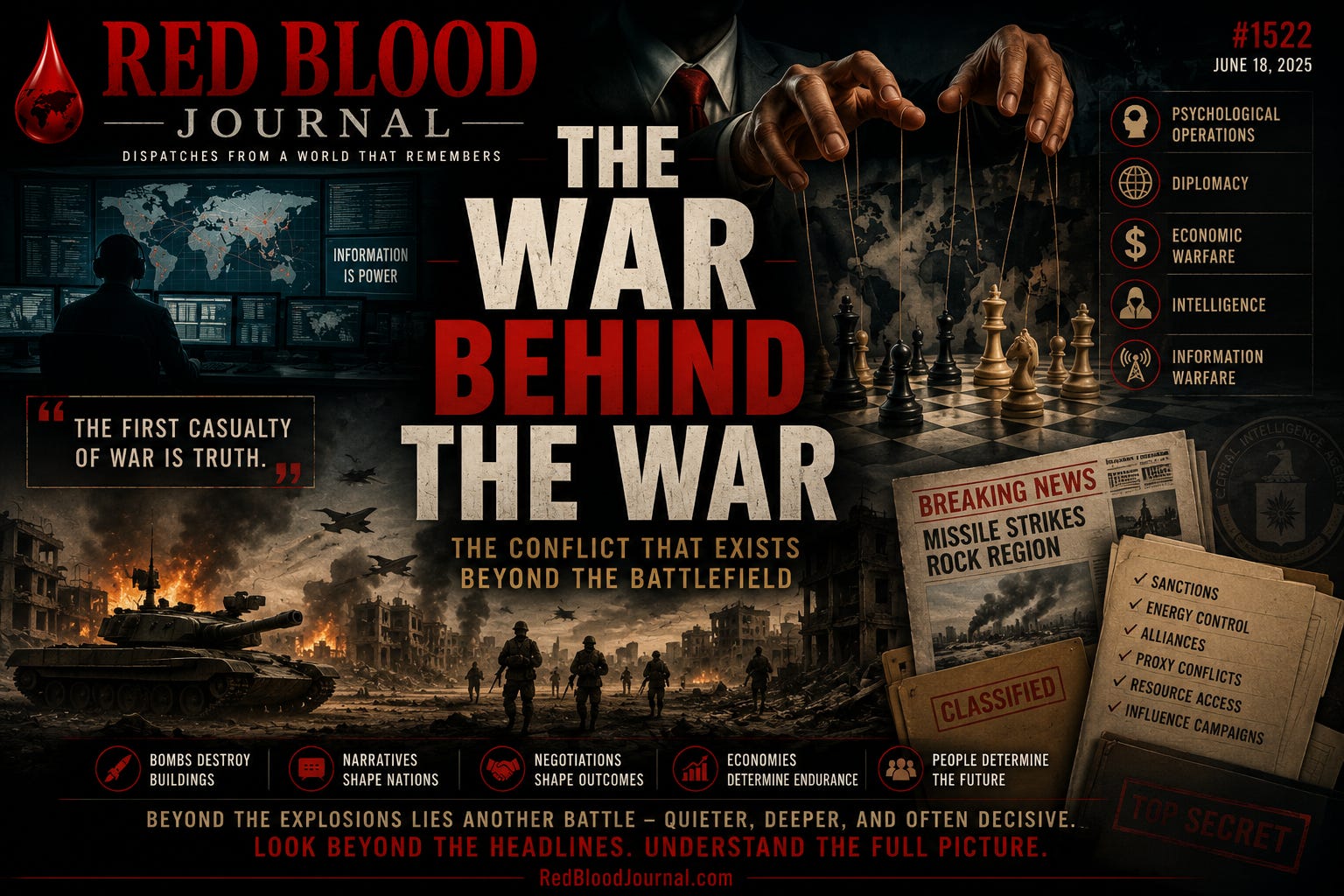
#1522 – ⭐⭐⭐⭐⭐ The War Behind the War
The Conflict That Exists Beyond the Battlefield
When most people think of war, they picture soldiers.
They picture tanks.
Aircraft.
Missiles.
Explosions.
Destroyed cities.
But history suggests that every visible war is often accompanied by another conflict that receives far less attention.
A quieter war.
A war fought with information.
Economics.
Diplomacy.
Intelligence.
Influence.
Psychology.
The battlefield seen on television may only be one layer of a much larger struggle.
More Than Military Victory
Nations rarely pursue military operations without broader strategic objectives.
Security.
Deterrence.
Political influence.
Economic interests.
Regional stability.
Domestic politics.
International alliances.
Each conflict contains visible goals and invisible calculations.
The public often witnesses only the military campaign while negotiations, intelligence operations, sanctions, and diplomatic efforts continue behind closed doors.
The visible war and the invisible war frequently move together.
Information as a Battlefield
Modern conflicts unfold minute by minute across television, social media, satellite imagery, and mobile phones.
Every missile launch is accompanied by competing explanations.
Every military success is followed by competing interpretations.
Every setback becomes a struggle over public perception.
Winning the narrative has become nearly as important as winning the battlefield.
Public opinion can influence elections.
Markets.
Alliances.
Military aid.
International pressure.
Information has become a strategic weapon in its own right.
The Intelligence Game
Intelligence organizations exist to understand what cannot easily be seen.
They collect fragments.
Analyze patterns.
Evaluate probabilities.
Attempt to anticipate decisions before they happen.
Sometimes they succeed brilliantly.
Sometimes they fail dramatically.
Even the most capable intelligence agencies operate in an environment where uncertainty is unavoidable.
Plans change.
People change.
Circumstances change.
The unknown remains a permanent participant in every conflict.
Economics and Endurance
Wars are not sustained by weapons alone.
They require manufacturing.
Supply chains.
Energy.
Technology.
Finance.
Food.
Transportation.
The ability to continue producing often becomes as important as the ability to continue fighting.
History repeatedly demonstrates that economic endurance can determine the outcome of conflicts that appear evenly matched on the battlefield.
Perception and Reality
One of the most difficult questions during any conflict is distinguishing between what is happening and what participants want others to believe is happening.
Military deception has existed for thousands of years.
False movements.
Decoys.
Controlled leaks.
Psychological operations.
Strategic messaging.
The objective is often to influence decisions before the next shot is ever fired.
In many cases, perception itself becomes part of the battlefield.
Beyond the Headlines
The greatest decisions are often made far from the front lines.
In conference rooms.
Embassies.
Intelligence headquarters.
Financial institutions.
Negotiating tables.
The outcome of a conflict may depend as much upon diplomacy and economics as upon military engagements.
The headlines usually report the explosions.
History often reveals the negotiations years later.
The Larger Lesson
Perhaps every war contains two separate conflicts.
One determines who controls the battlefield.
The other determines who shapes the future after the fighting ends.
The first may be won with weapons.
The second is won through ideas, institutions, diplomacy, economics, legitimacy, and the confidence of ordinary people.
Understanding both wars may provide a clearer picture than watching either one alone.
Subjects
Modern warfare
Information warfare
Psychological operations
Intelligence agencies
Strategic deception
Geopolitics
Diplomacy
Economic warfare
Public perception
Military strategy
National security
International relations
History of conflict
The visible battlefield may capture the world’s attention, but the quieter struggles of information, diplomacy, economics, and human perception often shape history just as profoundly. Looking beyond the headlines allows a deeper appreciation of the complexity of modern conflict.
🩸🌊✨ Fantastic!
🗺️ The War Behind the War:
Strategy Beyond the Battlefield
Jul 20, 2026
The provided text explores the dual nature of modern warfare, arguing that visible military combat is only one component of a much larger struggle. It emphasizes that invisible battlefields—comprising diplomacy, intelligence, and economic endurance—are often what truly determine a nation’s success. The author highlights how strategic information and psychological operations are used to manipulate public perception, which has become as vital as physical territory. Behind the scenes, clandestine negotiations and financial stability serve as the backbone for sustained conflict, often far outlasting the impact of initial explosions. Ultimately, the source suggests that while weapons may win battles, the shaping of the future depends on ideas, legitimacy, and international alliances. Understanding global conflict therefore requires looking past front-line headlines to the complex geopolitical calculations occurring in the shadows.


