


🩸 RedBloodJournal.com
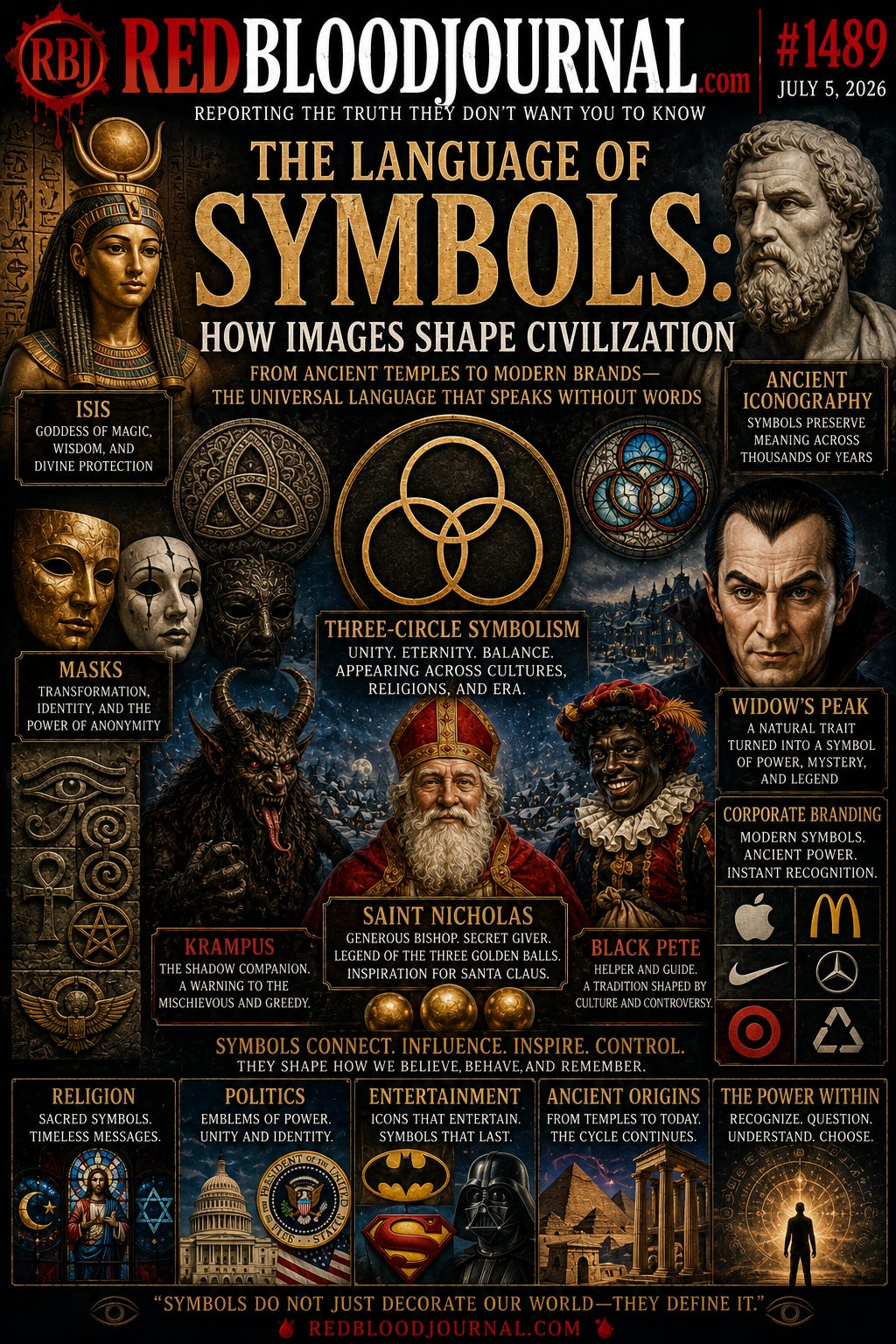
#1489 – The Language of Symbols: How Images Shape Civilization
From Ancient Temples to Corporate Logos: The Universal Language That Speaks Without Words
By Red Blood
July 5, 2026
Introduction
Long before humanity developed written language, people communicated through symbols.
A carved stone...
A painted circle...
A crowned figure...
A simple mask...
These images conveyed ideas that words alone could not express.
Thousands of years later, symbols continue to influence nearly every aspect of civilization. Governments build national identities around flags. Religions preserve sacred meaning through icons. Corporations spend billions designing logos. Political movements rally around colors and emblems. Entertainment creates instantly recognizable characters whose images become known worldwide.
Although languages change across generations, symbols often survive for centuries, continually acquiring new meanings.
This report explores how symbolic communication has evolved throughout history and why images remain among humanity’s most powerful forms of communication.
The First Language
Archaeologists believe symbolic communication predates writing by tens of thousands of years.
Early humans left behind:
cave paintings
carved animals
handprints
geometric patterns
sacred objects
These images likely communicated ideas involving:
survival
identity
territory
spirituality
memory
Unlike spoken language, symbols could outlive their creators.
Their permanence allowed knowledge to travel across generations.
Why Symbols Are Powerful
The human brain processes images remarkably quickly.
A single symbol may instantly communicate:
authority
danger
hope
peace
love
death
mystery
Because symbols bypass lengthy verbal explanation, they often create emotional responses before conscious analysis begins.
For this reason, symbols have always played central roles in religion, politics, commerce, and education.
The Three Circles
Among the simplest geometric arrangements is the three-circle design.
Throughout history, circles have represented:
unity
eternity
perfection
heaven
continuity
Three circles together have appeared in numerous contexts, including:
religious symbolism
family crests
heraldry
charitable organizations
modern corporate logos
Researchers continue debating whether repeated appearances represent historical continuity or independent artistic development.
Either way, simple geometric forms often become surprisingly enduring cultural symbols.
Masks
Masks have appeared in nearly every civilization.
They have served purposes including:
religious ceremony
theater
warfare
healing rituals
festivals
initiation rites
A mask simultaneously conceals one identity while revealing another.
Because of this duality, masks frequently symbolize transformation.
Modern entertainment continues using masks to represent mystery, anonymity, power, or hidden identity.
Widow’s Peak
Certain physical characteristics have also acquired symbolic meanings.
One example is the widow’s peak, a V-shaped hairline appearing naturally in many individuals.
Across different periods it has been associated with:
nobility
mystery
supernatural folklore
artistic elegance
fictional villains
Most of these associations developed through literature, theater, and later cinema rather than historical evidence.
The example illustrates how even natural human features can accumulate symbolic meaning.
Isis and Ancient Iconography
Among the most influential symbolic figures of antiquity is Isis, the Egyptian goddess associated with:
motherhood
wisdom
healing
protection
resurrection
Her imagery spread throughout the Mediterranean world long before the rise of Christianity.
Statues, temples, and artistic motifs associated with Isis influenced generations of artists.
Some historians identify visual similarities between later religious iconography and earlier Egyptian artistic traditions.
Others caution against assuming direct historical borrowing without documentary evidence.
The debate continues within comparative religious scholarship.
Ancient Symbols Never Truly Disappear
History demonstrates that civilizations rarely discard symbols entirely.
Instead, they reinterpret them.
An ancient emblem may later become:
a royal seal
a religious icon
a military insignia
a civic monument
a commercial trademark
Although meanings evolve, the visual form often survives.
This process explains why certain symbols appear repeatedly across very different historical periods.
Corporate Branding
Modern corporations understand the psychological importance of symbols perhaps better than anyone.
Successful logos are usually:
simple
memorable
emotionally recognizable
easily reproduced
instantly identifiable
The world’s largest companies invest enormous resources into creating symbols capable of communicating trust, innovation, strength, or familiarity within fractions of a second.
Corporate branding demonstrates that symbolic communication remains as important today as it was in ancient civilizations.
Politics and Symbolism
Political movements have always relied upon visual identity.
Flags...
Eagles...
Stars...
Colors...
Raised fists...
Olive branches...
National seals...
These images unite large populations through shared identity.
Throughout history, symbols have often proven more memorable than speeches.
For this reason, governments devote considerable attention to the design and preservation of national emblems.
Entertainment as Symbolic Communication
Films, television, music, and digital media have accelerated the spread of symbols across the globe.
Characters such as heroes, villains, mythical creatures, masks, and distinctive logos become instantly recognizable to billions of people.
Repeated exposure transforms entertainment symbols into cultural reference points.
Whether intentionally designed or not, these images often shape collective memory for generations.
The Psychology of Recognition
Psychologists have long recognized that familiarity influences perception.
The more frequently people encounter a symbol:
the more recognizable it becomes
the more emotionally familiar it feels
the more likely it is to influence memory
This phenomenon helps explain why repetition occupies such an important role in advertising, education, religion, and political communication.
Recognition builds trust.
Trust influences behavior.
One Symbol, Many Meanings
Perhaps the greatest lesson of symbolic history is that no image possesses a single permanent meaning.
The same symbol may represent:
hope to one culture
danger to another
spirituality to one generation
commerce to the next
Understanding history therefore requires examining the cultural context surrounding each symbol rather than assuming universal interpretation.
Final Thoughts
Symbols are among humanity’s oldest inventions—and perhaps its most enduring.
Empires collapse.
Languages evolve.
Governments disappear.
Yet symbols continue their journey across civilizations, continually adapting to new beliefs, technologies, and cultures.
Whether carved into ancient temples, painted on religious icons, displayed on national flags, or embedded within corporate logos, symbols silently influence how societies remember the past and imagine the future.
Learning to recognize symbolic communication does not require accepting every hidden interpretation.
It begins by appreciating how images shape thought, preserve history, and communicate ideas that words alone often cannot express.
Research Themes
Prehistoric symbolic communication
Ancient iconography and Egyptian symbolism
The symbolism of circles and geometric forms
Masks in religion, theater, and ritual
Widow’s peak in folklore and popular culture
Corporate branding psychology
Political symbolism throughout history
Religious iconography across civilizations
The psychology of visual communication
🩸 RedBloodJournal.com
“Civilizations rise through ideas, but they endure through symbols. Long after words are forgotten, images continue telling the story.”
👁️
👁️ The Language of Symbols:
How Images Shape Civilization
Jul 29, 2026
This source explores the profound influence of visual symbols on the development and endurance of human civilization. It posits that images communicate more rapidly and emotionally than written language, allowing ideas regarding identity, power, and spirituality to survive for millennia. By examining diverse examples like ancient Egyptian iconography, corporate logos, and ritualistic masks, the text illustrates how simple forms acquire complex cultural meanings. The author emphasizes that while the specific interpretations of emblems may shift over time, their visual structures persist across different political and religious eras. Ultimately, the article argues that symbolic recognition remains a fundamental psychological tool used by modern industries and governments to foster trust and collective memory.


