


🩸 🖱️ RedBloodJournal.com
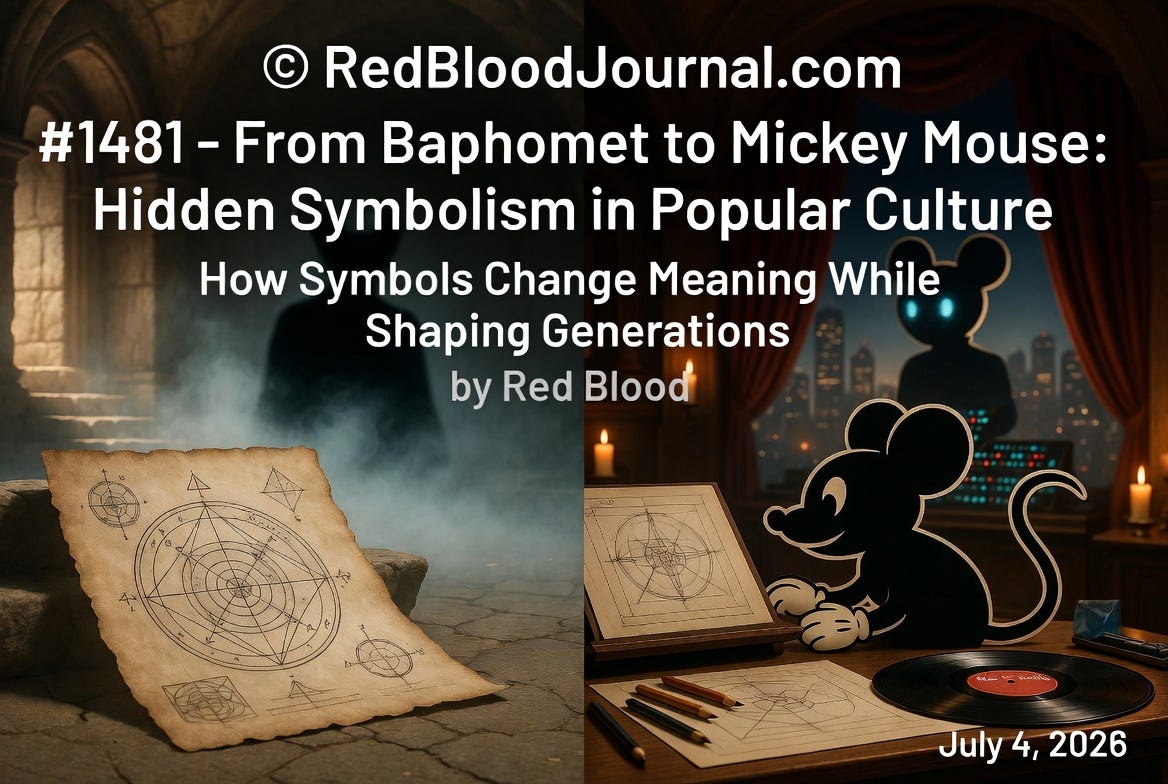
#1481 – From Baphomet to Mickey Mouse: Hidden Symbolism in Popular Culture
How Symbols Change Meaning While Shaping Generations
By Red Blood
July 4, 2026
Introduction
Few fictional characters are as universally recognized as Mickey Mouse. His silhouette is instantly identifiable around the world, appearing on clothing, toys, films, television, theme parks, and corporate branding. To millions, Mickey represents childhood, imagination, and entertainment.
Yet some writers and independent researchers have proposed that the imagery surrounding Mickey Mouse contains layers of symbolism that reach far beyond children’s entertainment. These interpretations connect Mickey to medieval legends, religious symbolism, folklore, historical literature, and even the mysterious figure known as Baphomet.
Most of these connections remain speculative and are not accepted by mainstream historians. Nevertheless, they illustrate how symbols can accumulate new meanings over time, especially when viewed through different historical, psychological, or cultural lenses.
This report examines these interpretations without asserting them as established historical fact, allowing readers to consider how symbols evolve across generations.
A Symbol Larger Than the Character
Mickey Mouse is more than an animated character.
His head silhouette—three circles arranged in a simple design—is among the most recognizable corporate logos ever created.
Researchers interested in symbolism often ask a simple question:
Why has such a simple shape become one of the world’s most powerful visual icons?
Some argue that the design’s simplicity allows people to project meaning onto it, while others see it as a continuation of much older symbolic traditions.
Whether intentional or coincidental remains a matter of interpretation.
The Three-Circle Logo
One recurring interpretation focuses on Mickey’s famous three-circle silhouette.
Throughout history, circles have represented concepts such as:
unity
eternity
perfection
divinity
the Trinity
celestial bodies
Some researchers compare the logo to historical symbols associated with:
medieval heraldry
religious iconography
alchemical diagrams
Saint Nicholas traditions
ancient geometric symbolism
There is no documented evidence that Walt Disney designed Mickey’s head with these meanings in mind. However, the comparison illustrates how visual symbols can acquire multiple interpretations over time.
The White Gloves
Mickey did not originally wear white gloves.
They first appeared in later cartoons, helping animators distinguish his hands from his dark body on black-and-white film.
Some symbolic researchers nevertheless assign deeper meaning to the gloves.
One interpretation compares them with the elegant white gloves worn by the fictional criminal Mac the Knife, whose clean gloves concealed bloody deeds in later musical adaptations.
Others compare them to ceremonial gloves worn in various traditions, suggesting purity, concealment, or ritual significance.
Most animation historians, however, explain the gloves as a practical artistic decision rather than symbolic intent.
Mac the Knife
One of the more unusual theories links Mickey Mouse to Mac the Knife, the famous character from The Threepenny Opera.
The argument centers largely on linguistic similarities between the names “Mickey” and “Mackie” in German, along with coincidental historical timing during the late 1920s.
Supporters of this theory suggest hidden inspiration.
Most historians reject a direct connection due to the lack of documentary evidence.
Nevertheless, the comparison demonstrates how easily popular culture invites symbolic reinterpretation.
Deadmau5 and Modern Symbolism
Modern popular culture has introduced additional symbolic layers.
The electronic musician Deadmau5 adopted a stylized mouse head as his signature image.
Some commentators have compared the logo with:
Mickey Mouse
skull imagery
occult iconography
Baphomet-inspired artwork
These interpretations remain speculative and largely reflect audience perception rather than confirmed artistic intention.
As with many cultural symbols, meaning often develops through public interpretation rather than creator explanation.
Tom and Jerry
Another recurring comparison involves Tom and Jerry, whose endless pursuit of predator and prey has entertained audiences for decades.
Some symbolic interpretations suggest the relationship represents:
order versus chaos
hunter versus hunted
civilization versus instinct
survival
Animation historians generally view the series as slapstick comedy inspired by classic theatrical traditions.
Yet the enduring appeal of the characters demonstrates how simple stories can generate increasingly complex symbolic readings over time.
Saint Nicholas and the Three Circles
One of the most surprising symbolic comparisons links Mickey Mouse to Saint Nicholas.
Saint Nicholas has long been associated with an emblem of three golden circles, representing charity in medieval Christian tradition.
Some researchers note visual similarities between this arrangement and Mickey’s famous three-circle silhouette.
Others point to the coincidence that Walt Disney was born on December 5, traditionally associated in some European countries with Saint Nicholas celebrations.
Whether meaningful or merely coincidental remains open to interpretation.
Baphomet Enters the Conversation
Some independent researchers eventually connect these various symbolic threads back to Baphomet.
Their reasoning generally follows this chain:
Ancient symbols →
Medieval reinterpretations →
Occult imagery →
Modern entertainment →
Corporate branding
According to this perspective, symbols rarely disappear.
Instead, they evolve, absorbing new meanings while retaining echoes of older traditions.
Mainstream scholarship generally cautions against drawing direct historical lines without documentary evidence.
Still, the persistence of these theories reflects humanity’s long-standing fascination with hidden meanings.
Why Symbols Matter
Symbols possess remarkable power because they communicate without words.
A single image can evoke:
memory
identity
fear
nostalgia
authority
trust
mystery
Whether intentionally designed or not, symbols often become cultural shorthand that outlives the people who created them.
This is one reason why researchers across disciplines—including psychology, marketing, religion, history, and anthropology—continue studying symbolic communication.
Seeing Patterns—or Creating Them?
One of the greatest challenges in symbolic research is distinguishing between genuine historical influence and pattern recognition.
Humans naturally seek connections.
Sometimes those connections reveal forgotten history.
Other times they simply reflect the remarkable ability of the human mind to organize information into meaningful narratives.
The responsible researcher acknowledges both possibilities.
Final Thoughts
The story linking Baphomet, Mickey Mouse, Saint Nicholas, and modern entertainment illustrates less about certainty than about the evolution of symbols.
Whether these connections represent deliberate design, historical coincidence, or imaginative interpretation remains an open question.
What is undeniable is that symbols survive long after their original meanings have faded. Each generation reinterprets them according to its own beliefs, fears, technologies, and cultural experiences.
For readers, the value lies not in accepting every symbolic claim, but in recognizing how powerful images shape culture—and how culture, in turn, reshapes those images.
Questioning symbols does not require believing every interpretation. It begins by understanding where they came from, how they changed, and why they continue to capture the human imagination.
Research Themes
The historical evolution of Baphomet
Early animation and character design
Symbolism in branding and corporate identity
The Threepenny Opera and Mac the Knife
Medieval Christian iconography
Saint Nicholas traditions
Cultural psychology of symbols
Visual communication throughout history
🩸 RedBloodJournal.com
“The most powerful symbols are often those whose original meaning has been forgotten, allowing every generation to give them a new one.”
🖱️ The Alchemical Mouse:
Evolution of Modern Cultural Symbols
Jul 4, 2026
This text explores the evolution of cultural symbols, specifically focusing on how the iconic Mickey Mouse silhouette has been reinterpreted through various historical and occult lenses. While mainstream historians attribute Mickey’s design to practical animation needs, independent researchers suggest visual parallels to medieval heraldry, alchemical diagrams, and religious iconography like the three circles of Saint Nicholas. The report examines speculative theories linking the character to diverse figures ranging from Mac the Knife to the deity Baphomet, highlighting a human tendency to find deep meaning in simple shapes. By discussing modern examples like Deadmau5 and the archetype of order versus chaos in Tom and Jerry, the source illustrates how corporate branding can absorb ancient symbolic traditions. Ultimately, the writing emphasizes that symbols possess enduring power because each generation projects its own fears and values onto them, regardless of the creator’s original intent. These interpretations serve as a case study in cultural psychology and the fluid nature of visual communication over time.


