


🩸 RedBloodJournal.com
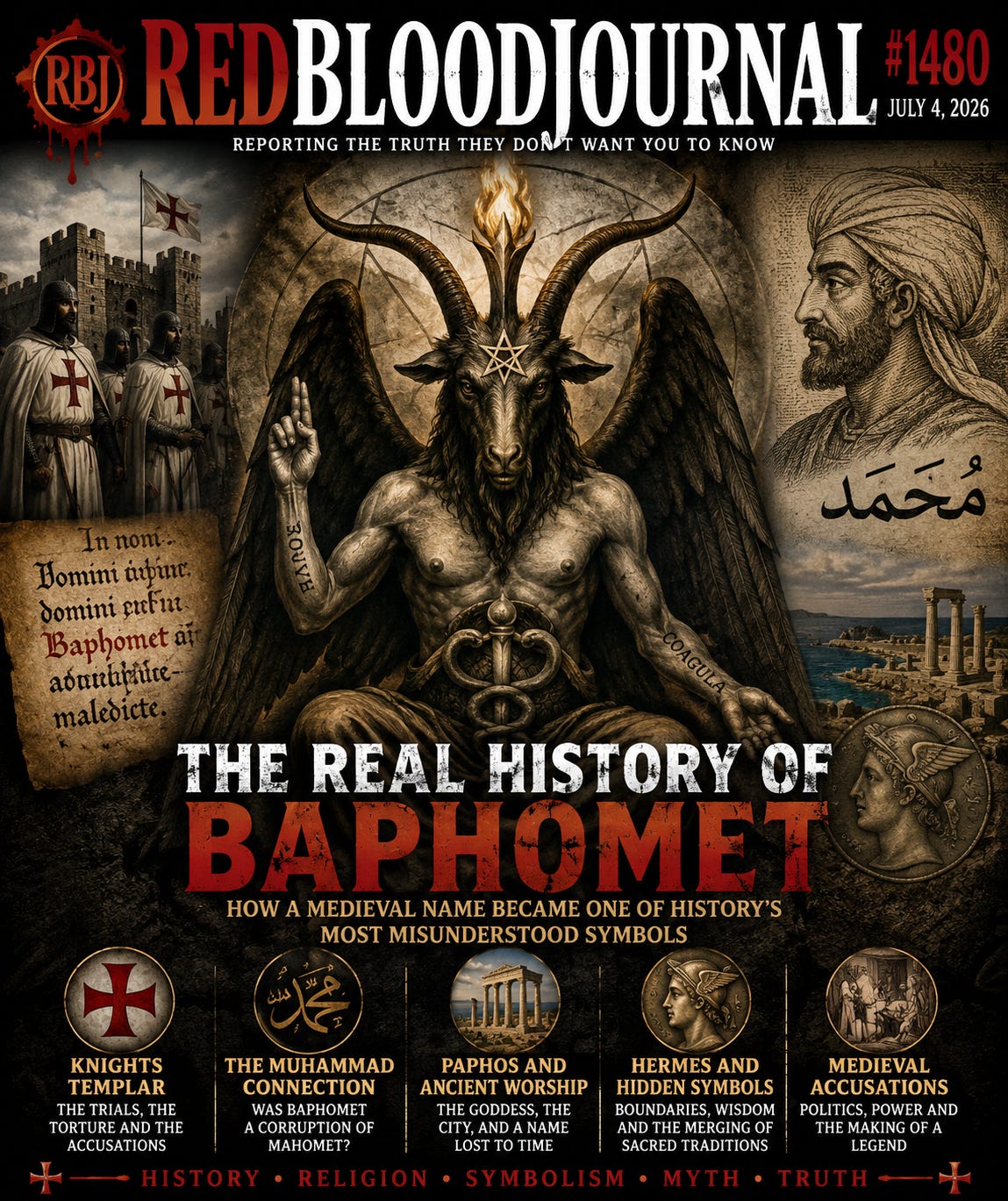
#1480 – The Real History of Baphomet
How a Medieval Name Became One of History’s Most Misunderstood Symbols
By Red Blood
July 4, 2026
Introduction
Few names have generated more mystery, controversy, and speculation than Baphomet. Today, the image is commonly associated with occultism, Satanism, conspiracy theories, and popular culture. Yet the historical record tells a far more complicated story.
The origins of the word are uncertain. Its meaning has evolved over centuries, often changing according to the political, religious, and cultural climate of each era. Historians, linguists, and researchers continue to debate whether Baphomet began as a misunderstanding, a deliberate accusation, a symbolic figure, or something else entirely.
This report examines several of the major historical theories surrounding Baphomet. Rather than presenting a single conclusion, it summarizes the historical claims and allows readers to examine the evidence for themselves.
The First Known Appearance
The name Baphomet appears most famously during the trials of the Knights Templar in the early fourteenth century.
The Templars were among the most powerful military and financial organizations in medieval Europe. Founded during the Crusades, they accumulated enormous wealth, political influence, and land holdings throughout Christendom.
In 1307, King Philip IV of France ordered the arrest of hundreds of Templars. Facing enormous debts owed to the order, the king accused them of numerous crimes, including:
Heresy
Idolatry
Secret rituals
Denying Christ
Worshipping an idol called Baphomet
Many historians believe these accusations were obtained through torture, making the reliability of the confessions highly questionable.
Whether Baphomet represented an actual object, a misunderstood ritual, or a fabricated accusation remains one of history’s enduring mysteries.
Was Baphomet Simply Muhammad?
One of the oldest scholarly explanations proposes that Baphomet was not originally the name of an idol at all.
Several nineteenth-century historians suggested the word was simply a medieval corruption of Muhammad, the prophet of Islam.
During the Crusades, Europeans frequently altered Arabic names into forms more familiar to Latin and French speakers. Variations such as:
Mahomet
Mahom
Bafomet
Bafumet
appear in medieval writings.
Because the Knights Templar spent decades in the Holy Land, rumors circulated that they had developed friendly relations with Muslim leaders. Political enemies later used these rumors to accuse the order of secretly abandoning Christianity.
Under this interpretation, “Baphomet” may simply have been a distorted version of “Mahomet,” later transformed into accusations of idol worship.
Paphos and the Ancient Goddess Theory
Another theory traces the name to the ancient city of Paphos on the island of Cyprus.
Paphos was famous throughout antiquity as a major center for the worship of Aphrodite, the Greek goddess later identified with the Roman Venus.
Some nineteenth-century researchers suggested that sacred boundary markers associated with Paphos gradually merged linguistically with references to Hermes, producing words similar to Paphomet before eventually evolving into Baphomet.
Although this theory remains speculative, it illustrates how language can transform over centuries, especially when different cultures interact through trade, conquest, and religion.
Hermes and Sacred Symbols
Hermes occupied a unique position in ancient Greek religion.
Known as the messenger of the gods, Hermes also represented:
wisdom
boundaries
travel
commerce
hidden knowledge
Stone markers bearing the image of Hermes often stood beside roads and property boundaries.
Some researchers have proposed that symbols associated with Hermes gradually blended with other religious traditions encountered during the Crusades, creating later misunderstandings regarding mysterious idols allegedly worshipped by secret societies.
No consensus exists on this interpretation, but it remains one of several historical hypotheses.
Medieval Europe and the Politics of Accusation
The medieval period was an age in which accusations of heresy carried enormous political power.
Organizations or individuals who threatened established authority could be accused of:
devil worship
secret ceremonies
magical practices
hidden idols
Such accusations often justified confiscation of property, imprisonment, or execution.
Many historians therefore caution against accepting every confession recorded during the Templar trials as literal historical fact, particularly when torture was routinely employed.
The case of Baphomet illustrates how political conflict and religious fear could combine to create enduring historical legends.
From Medieval Mystery to Modern Symbol
The familiar goat-headed image now widely recognized as Baphomet did not originate with the Knights Templar.
That depiction emerged centuries later, most notably through nineteenth-century French occultist Éliphas Lévi, who created an illustration combining numerous symbolic elements, including:
balance between opposites
masculine and feminine imagery
alchemical symbolism
ancient mystical traditions
Over time, Lévi’s artistic creation became the image most people now associate with Baphomet, despite having no verified connection to the medieval Templars.
This distinction is often overlooked in modern discussions.
Why the Mystery Endures
The story of Baphomet survives because it sits at the crossroads of several historical worlds:
the Crusades
medieval politics
religious conflict
linguistic evolution
ancient mythology
secret societies
later occult traditions
Each generation has interpreted the symbol according to its own fears, beliefs, and cultural narratives.
As a result, Baphomet has become less a single historical figure than a mirror reflecting centuries of human imagination.
Final Thoughts
Whether Baphomet began as a misunderstood word, an accusation born of political necessity, a forgotten religious symbol, or something entirely different remains unresolved.
What is clear is that much of what is commonly believed today developed centuries after the original Templar trials.
Separating documented history from later interpretation allows readers to better understand how symbols evolve, how narratives are constructed, and how historical mysteries often become larger than the events that first inspired them.
As with many subjects from antiquity, the evidence leaves room for continued research and thoughtful discussion rather than absolute certainty.
Sources and Research Themes
Medieval Templar trial records
Historical studies on the Crusades
Linguistic research into the evolution of the word “Baphomet”
Ancient Greek religion and the cult of Paphos
Studies of Hermes and classical symbolism
Nineteenth-century writings on occult history
Research into the development of Éliphas Lévi’s Baphomet illustration
🩸 RedBloodJournal.com
“History is often less about discovering certainty than understanding how stories, symbols, and beliefs evolve across generations.”
📜 The Many Faces of Baphomet: A Historical Metamorphosis
Jul 4, 2026
The history of Baphomet is a complex narrative that began as a medieval accusation against the Knights Templar during the early fourteenth century. Historians suggest the name may have originated as a linguistic corruption of Muhammad or evolved from ancient Greek traditions involving Hermes and the city of Paphos. While the term was initially used to justify political and religious persecution, its modern visual identity was actually created by a nineteenth-century occultist. This iconic goat-headed figure represents a blend of alchemical symbols and balance that has no verified link to the original medieval order. Ultimately, the source illustrates how a misunderstood word can transform into a powerful, enduring symbol through centuries of cultural and religious shifts.


