


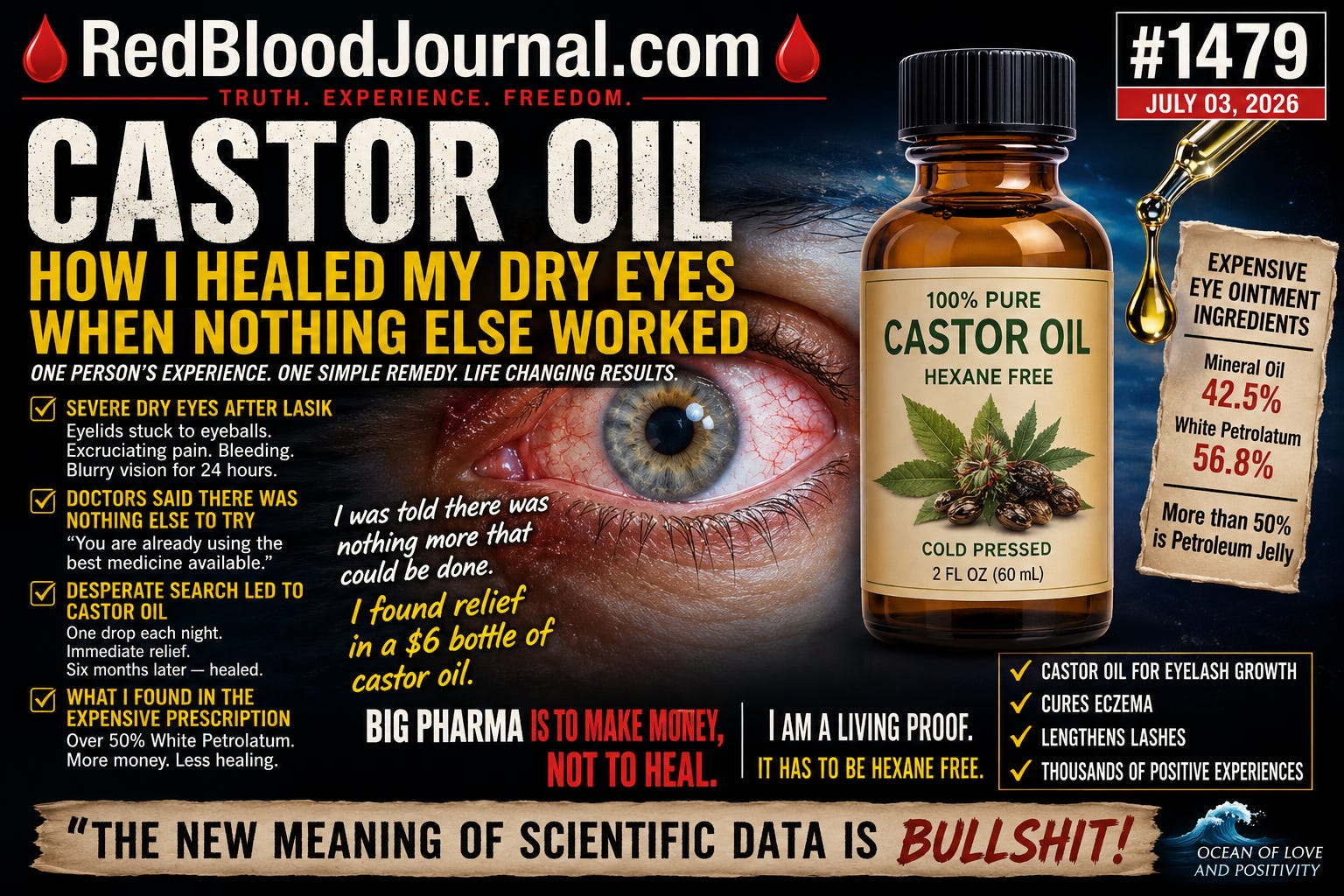
🩸 #1479 – When Personal Experience Collides With Medical Consensus
One Patient’s Journey From Severe Dry Eyes to Castor Oil
🩸 By Red Blood | RedBloodJournal.com
For years I trusted the medical system to solve what became one of the most painful experiences of my life.
After undergoing LASIK surgery to improve my vision, I developed severe dry eye syndrome.
This wasn’t ordinary dryness.
Every night while I slept, my eyelids would adhere to the surface of my eyes. The following morning, the moment I opened my eyes, my eyelids would literally pull against my eyeballs.
The pain was indescribable.
The tearing sensation was so intense that I wanted to bite the ground just to distract myself from the agony.
My vision would immediately become blurry and often remain that way for an entire day.
Eventually my eyelids became so dry that they began bleeding.
For a period of time I genuinely feared I was going blind.
The Medical Journey
I visited my ophthalmologist.
He referred me to a specialist.
The specialist examined my eyes and explained that I was already using the best available treatment.
There was nothing else they could recommend.
Night after night I continued applying the prescribed eye ointment.
Nothing changed.
After more than a year, I was no better.
Desperation Leads to a Search
Eventually I reached the point where necessity replaced caution.
I searched online for natural remedies for severe dry eyes.
One suggestion appeared repeatedly:
Castor oil.
Without hesitation I purchased a bottle that was labeled hexane-free.
That first drop felt like pouring water onto a fire.
The relief was almost immediate.
I continued using one drop each night before bed.
Not for a few days.
Not for a few weeks.
For approximately six months.
Gradually the sticking stopped.
The bleeding stopped.
The blurry vision disappeared.
Today my dry eye symptoms are gone.
Then I Looked at the Prescription
Curiosity led me to examine the ingredients of the expensive prescription ointment I had relied on for more than a year.
To my surprise, the primary ingredients were:
Mineral Oil — 42.5%
White Petrolatum — 56.8%
More than half of the ointment consisted of white petrolatum.
That discovery raised questions for me personally.
If my eyes responded dramatically to castor oil after prescription treatment had failed, why had I never been told about it as a possibility?
My Conclusion
This is where my personal experience differs from what I was told.
I was informed there were no better alternatives.
Yet my own experience suggested otherwise.
That experience permanently changed how I view medicine.
In my opinion, modern medicine often focuses more heavily on managing conditions with commercial products than on exploring every possible avenue that may help patients.
Others may reach different conclusions.
This article is simply my story.
An Important Note
This article is not medical advice.
It describes one individual’s personal experience.
Dry eye disease has many different causes, and what helped one person may not help another. Anyone considering putting substances into their eyes should discuss the risks and benefits with a qualified eye-care professional.
A Question Worth Asking
Perhaps the most interesting part of this story is not whether castor oil helped me.
It unquestionably did.
The real question is the feeling that follows.
What do you call the moment when your own lived experience directly contradicts what every expert told you was possible?
When you have personally lived both realities, which one becomes more convincing?
Scientific knowledge advances by testing observations and evidence. Personal experience can inspire questions and further investigation, but it does not, by itself, establish that a treatment is safe or effective for everyone.
Sometimes the most valuable outcome is not certainty—but the willingness to keep asking questions.
👁️ Vision Beyond Consensus: The Castor Oil Revelation
Jul 4, 2026
This personal narrative details an individual’s struggle with severe chronic dry eye following a LASIK procedure. After conventional prescription ointments failed to provide relief for over a year, the author turned to hexane-free castor oil as a natural alternative. This unconventional remedy successfully alleviated their pain and physical symptoms, eventually leading to a complete recovery that medical experts deemed unlikely. The experience prompted the author to critically evaluate the limitations of modern medicine and the profit-driven nature of pharmaceutical treatments. Ultimately, the text serves as a cautionary yet hopeful account of how personal evidence can sometimes challenge established medical consensus.


